The views expressed herein are solely mine.
Israel and Taiwan: Defying the Dictators
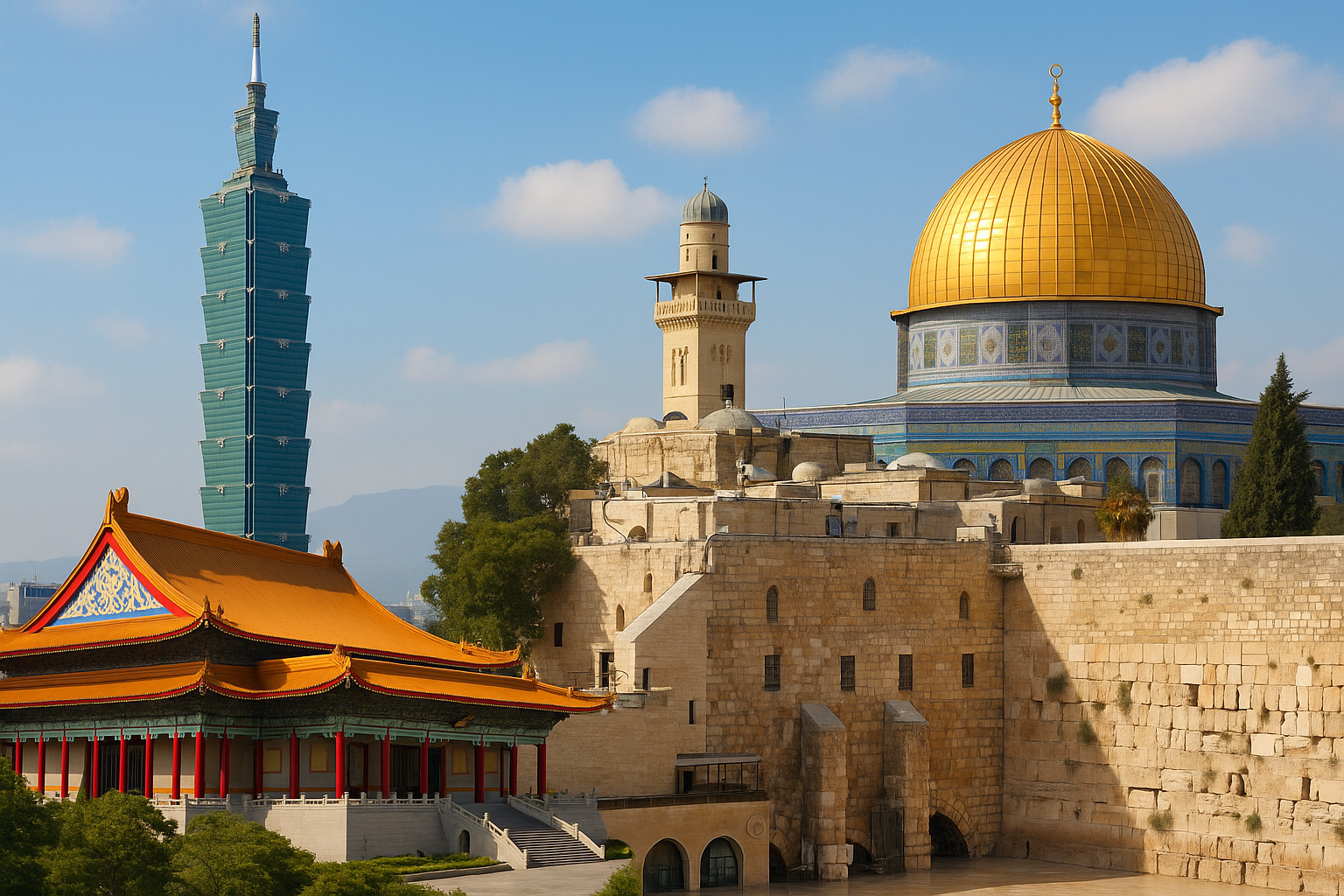
The image merges Israel’s and Taiwan’s iconic landmarks—Jerusalem’s Old City alongside Taipei 101—symbolizing unity between two vibrant democracies. Credits: AI-generated image.
Two small nations. Two big targets. Israel and Taiwan—vibrant democracies surrounded by enemies—stand as living proof that freedom can survive even in the world’s most dangerous neighborhoods. Both are hated by tyrants, betrayed by global elites, and yet they endure through grit, faith, and unmatched innovation.
When Israel was founded in 1948, it was immediately attacked by five Arab armies. When Taiwan broke from the Chinese mainland in 1949, Mao’s forces vowed to “liberate” the island. Both were born in fire. And both learned early that survival does not depend on sympathy—it depends on strength.
Today, Israel’s Iron Dome system intercepts over 90% of incoming rockets from Hamas and Hezbollah. Taiwan, facing 1,500 Chinese missiles aimed at its shores, has developed cutting-edge air defense and drone technologies that rival the world’s best. Both countries pour more than 5% of GDP into defense and innovation, a figure that dwarfs most Western democracies too comfortable to remember what an existential threat feels like.
Their technological cooperation is quiet but real. Taiwan’s world-class semiconductor giant TSMC supplies key components used in Israeli high-tech and defense industries, while Israeli firms like Elbit Systems and Rafael Advanced Defense Systems provide cyber and counter-drone expertise that helps Taipei strengthen its security grid. Academic partnerships between Tel Aviv University and National Chengchi University foster joint research in AI and cybersecurity, showing that shared democratic values can produce tangible strategic gains.
Yet the connection runs deeper than commerce. Both nations know what it means to live under siege—militarily, diplomatically, and ideologically. Beijing pressures countries to cut ties with Taipei; the UN passes more resolutions condemning Israel than it does against all autocracies combined. Still, Israel maintains formal relations with 165 countries and Taiwan, despite diplomatic isolation, and trades with nearly every major economy on Earth. The message? You cannot cancel competence.
Both nations are also test cases for the limits of Western courage. Washington sells Taiwan F-16s while begging China for trade deals. Brussels criticizes Israeli self-defense while buying Iranian oil through back channels. This double standard is not just hypocrisy—it is moral rot.
China and Iran, meanwhile, have noticed their similarities too. Tehran now uses Chinese satellite technology to bolster its missile programs, while Beijing blocks every attempt to hold Iran accountable at the UN. Both regimes support Hamas, Hezbollah, and a propaganda machine that paints Israel as an aggressor and Taiwan as a “breakaway province.” It is a new Axis of Authoritarianism—and Israel and Taiwan are the targets.
But neither is backing down. Israeli start-ups continue to lead in cybersecurity, biotech, and artificial intelligence, fields that protect the entire democratic world. Taiwan remains the global heartbeat of advanced chip manufacturing—producing over 60% of the world’s semiconductors and over 90% of the most advanced ones. If Taiwan falls, the global economy collapses. If Israel falls, the Middle East collapses. That is why dictators tremble when they see Jerusalem and Taipei standing strong.
The alliance between these two nations won’t be defined by formal treaties but by shared purpose. It is not about photo-ops—it is about survival. When the missiles fly, they will rely not on UN speeches, but on their own iron wills and Western values.
Israel and Taiwan are proof that freedom still has defenders willing to fight for it. They are the two democracies the world’s bullies fear most—and the ones the free world should finally start defending with the same conviction they have shown for decades.
Related Topics
Related Posts