
A Liberal Atheist Who Supports and Studies Israel
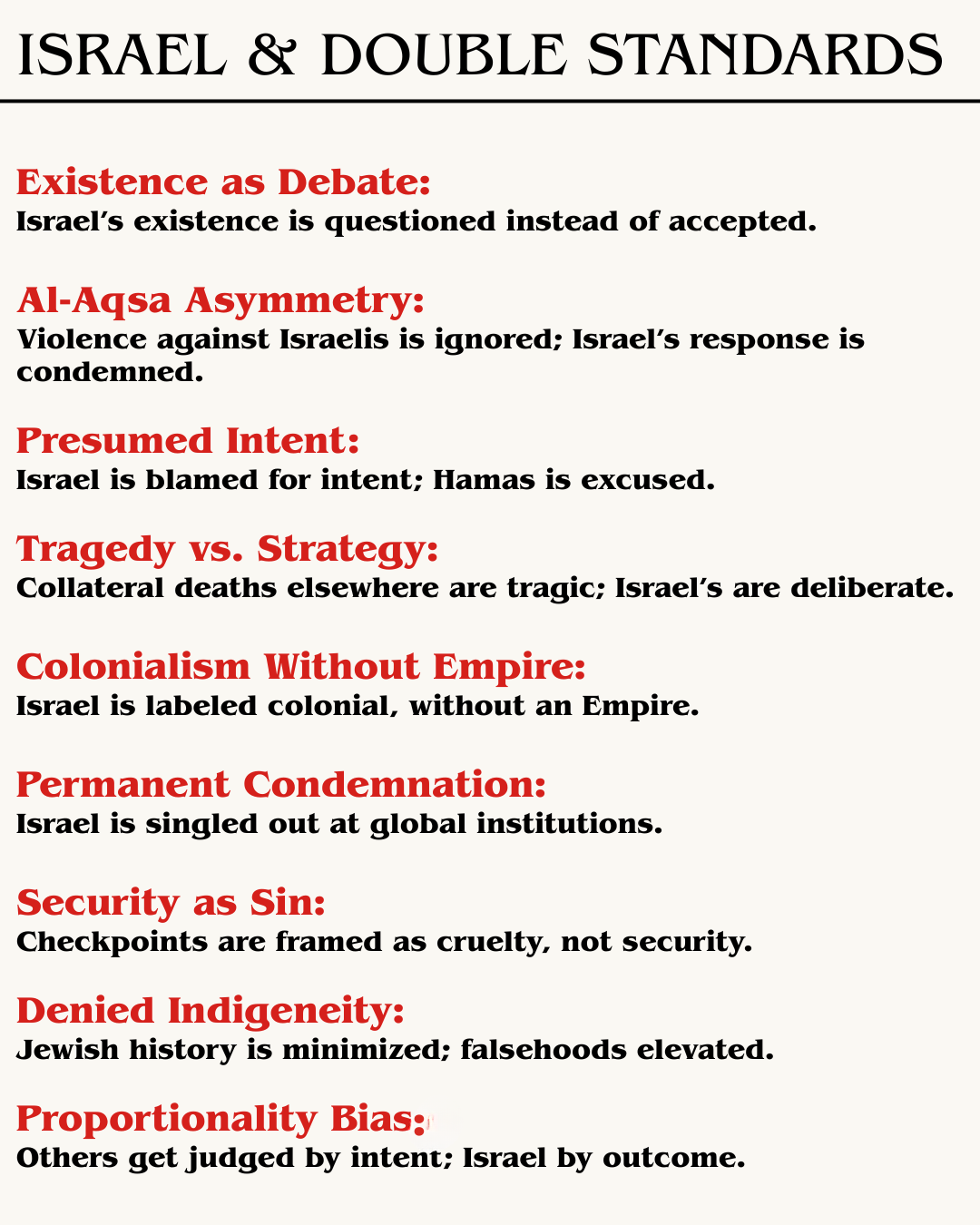
Israel and the Infinitely Rising Bar: 13 Double Standards and a Singular State
Source: Adobe Stock, naevermillion
I’ve compiled a list of ways in which the state of Israel are held to double standards. From what I’ve gathered, I could continue this list indefinitely. That’s because the bar Israel is held to is infinitely rising. Israel is expected to defend itself without force, absorb blame without context, and be a country without borders. The expectations are sometimes so quixotic that, when applied to other states, they become comical. The burden placed on Israel is not only heavier—it’s conceptually different, as though the consensus rules of statehood are suspended when they’re involved. This is exemplified in my first double standard.
Existential Threat of Statehood: Israel’s existence is debated; no comparable scrutiny elsewhere.
Israel is subjected to debates over whether it has a “right to exist”—a standard never used towards others. The World Conference Against Racism in 2001 described Israel as a “racist, apartheid state” and framed its founding as “illegitimate.” “Illegitimate” is one of those words that’s part of a symbolic lexicon, that is, a vocabulary and particular language used only towards Israel. We’ll get to more of them later. You’ll notice how no other country in the UN has their existence questioned. Even though many of them, like Israel, developed official sovereignty during post-WWII decolonization.
The debates over Israel are almost never just about policy or leadership, because they challenge the state’s ontology—a kind of neo-Luddite iconoclasm usually only witnessed during historical periods of revolution or world war, when leaders are emboldened enough to proclaim a country shouldn’t exist. But this is not history for Israel, it’s happening contemporaneously with groups like Hamas, Hezbollah, the Houthis, PIJ, Al-Qaeda, ISIS, and the Taliban. North Korea and Iran as well. Let’s not forget the KKK and the Aryan Nation. At least those who debate this get to witness their company.
What other country is asked to justify its existence while being threatened with annihilation in 2026? In fact, when is the last time you heard someone say a country shouldn’t exist? Besides Israel? The question sounds deranged when applied to France, Japan, or Brazil—and yet it’s treated as normal, even reasonable, when used towards Israel.
Al-Aqsa Asymmetry: October 7th is contextualized; Israel’s response is moralized.
The October 7th massacre was widely framed as a product of context, while Israel’s response was subjected to moral and legal judgment almost instantly. On October 24th, UN Secretary-General António Guterres told the Security Council the Hamas attacks “did not happen in a vacuum.” This statement explicitly contextualized Oct 7th. The massacre was treated as a natural response, or even a liberation tactic. Israel’s retaliation was considered unjustified and genocidal. UN debates focused on root causes, proportionality, and a possible truce without naming Hamas. Media talked about Gaza casualty counts and the legality of Israeli air strikes. UN Rapporteurs labeled Israel’s actions “collective punishment” or “disproportionate,” and global protests targeted the country’s response rather than its trigger. In effect, Israeli suffering was historicized away, blamed on the victim, and replaced with scrutiny. All of this occurred while Hamas was torturing their citizens.
Intent Presumption: Israeli self-defense is presumed malicious; Hamas’s explicitly genocidal language is treated as rhetorical excess.
Israel’s actions are often evaluated by selecting harsh statements from officials and treating them as clear signs of intent. Two days after the massacre, Israeli Defense Minister Yoav Gallant announced a complete siege and used the phrase “human animals.” His comment was treated as evidence of intent, rather than an angry response or wartime rhetoric. The standard here is unforgiving: Israel’s words are read maximally, stripped of context, and presented as insidious.
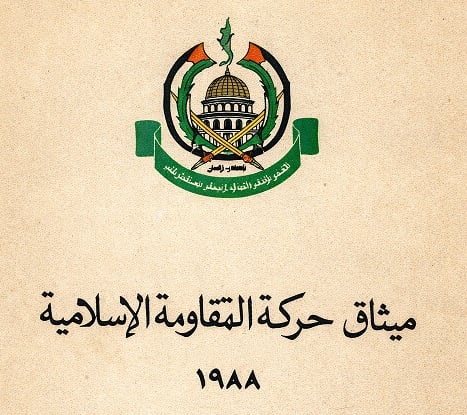
Hamas’s founding charter (1988) includes explicit language about Israel being “obliterate[d],” yet somehow is treated as political hype or the pomp of liberation, rather than clearly stating intent. Similarly, while Israel’s evacuation warnings are cited as proof of forced displacement, Hamas’s use of civilian infrastructure is brushed aside. Intent, it seems, is inferred selectively—always damning in one direction and minimizing the other. The imbalance that reads Hamas charitably and Israel as definitively suspect, is damning.
Tragedy Elsewhere, Strategy Here: War, destruction, and civilian deaths are tragic elsewhere; for Israel, they prove a colonial strategy.
In Israel–Palestine coverage, war, borders, refugees, and civilian deaths are presented within a “colonial” framework that treats outcomes as evidence of strategy. UN humanitarian chief Tom Fletcher told the Security Council that Israel was “deliberately and unashamedly imposing inhumane conditions on civilians,” assigning intent behind the deaths of civilians. There was no “this is a consequence of war,” or “an unfortunate tragedy” that we’ve heard during other conflicts—Israel was killing innocent civilians on purpose with genocidal intent. This inflexible lens leaves no room for error during the reality of combat. If you already view Israel as a colonizing entity of unbridled blood-lust—or if you read Al-Jazeera—you’re going to interpret every atom of damage through the prism of malicious strategy.
Civilian deaths in Syria’s Aleppo were widely attributed to “war conditions,” while similar urban destruction in Gaza is described as intentional Israeli policy. The same images produce radically different conclusions, depending on the flag involved.
Colonialism, Without Empire: Zionism is called colonial despite lacking an empire, “metropole,” decree, imposed language, extractive economy, currency imposition, or homeland left behind.
Zionism is frequently labeled “colonial” despite lacking core features of colonialism. It’s described as colonial despite the absence of an empire, the fact they were refugees, and having gone through persecution in all of the countries they fled to. This is colonialism without a crown, without a fleet, without a home—an accusation stripped of its own requirements. UN human-rights reporting has described Israel’s conduct as part of a “settler-colonial project of displacement and replacement,” embedding “colonial” practices as their guiding calculus. The irony of applying “colonial” to Israel is particularly poignant, given they are situated among states that were colonized by Arabs, and later run by the British.
The accusation of colonialism persists not because of its veracity, but because you can make everything confirm a theory when it’s assumed apriori. The almost constant hypnotic repetition of terms like “colonial,” “European,” and “Imperial”—part of the symbolic lexicon I mentioned earlier—normalize the atmosphere with anti-Zionist assumptions. Basically, when you hear something so often, even if it’s false, you get accustomed to it, and what would otherwise be libelous slander becomes an accepted framework for viewing Israel’s actions. Jews haven’t actually colonized: they had a continual presence in Israel, the immigration process was peaceful, and they agreed to the partition set up by the British. They didn’t come as conquerors.
Refugee Exception: Palestinian refugee status is inherited indefinitely; Jewish refugees from Arab countries are excluded.
UNRWA explicitly affirms that “children of refugees and their descendants are also considered refugees.” This is a core operational feature of the Palestinian-refugee system. Its approach is unprecedented and promoted as an indefinite permanence. UNHCR doesn’t treat refugee status as inheritable in this way, a distinction the U.S. Congressional Research Service noted about how refugee populations are classified. Their status was originally meant to be “temporary,” but has been continued on to their children. Sabine Sterk highlights how “Palestinians are the only group in the world whose refugee status is automatically inherited, generation after generation, regardless of citizenship, residence, or living conditions.” This keeps Palestinians in perpetual refugee status, teaching them not to prepare for coexistence, advances perpetual victim-hood, and continues to feed historical resentments.
UN Watch describes the difference when referring to the Arab-Israeli War: “the conflict also created hundreds of thousands of Jewish refugees who were forced to leave their homes in Arab countries. Unlike the Palestinians, these Jews moved on and settled in other countries and are no longer refugees.” One refugee population was absorbed, and the other was preserved in stasis.
Occupation Selectivity: Israeli occupation compared to decades-long occupations elsewhere.
Item 7 of the UN is treated by multiple governments as a standing, dedicated agenda item focused solely on Israel. It’s the only agenda in existence to target a specific country. The U.S. formally opposed Item 7 as institutional bias in 2017, and the UK described it as “unacceptable and systematic bias” in 2019. This procedural anomaly should raise alarms about the UN’s credibility and bias. Ban Ki-moon expressed “disappointment” at the decision to single out Israel given the breadth of allegations worldwide. Israel is uniquely and persistently condemned, despite other long-running occupations. China has controlled Tibet since 1950, Morocco has occupied Western Sahara since 1975, Turkey has held Northern Cyprus since 1974, and Russia has effectively occupied parts of Georgia (Abkhazia and South Ossetia) since 2008. None of these are subject to a permanent, country-specific agenda item or the volume of recurring resolutions, investigations, and condemnations. The UN has been emblematic of the double standards I’ve been showing, and this is yet another example.
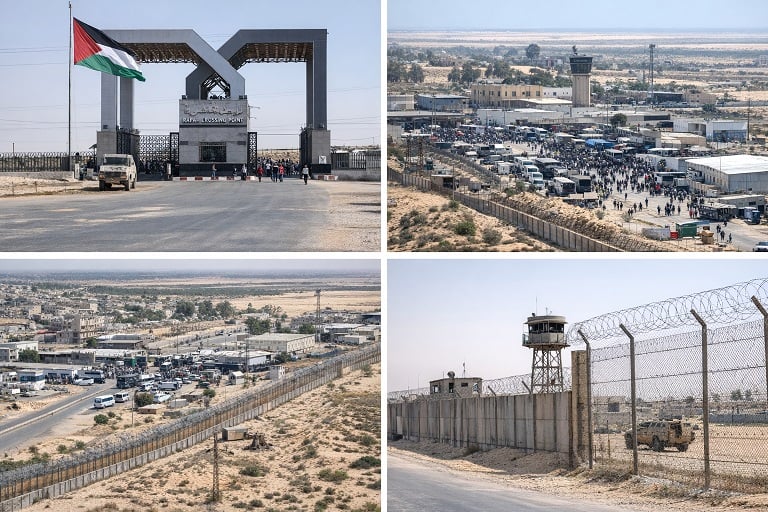
Security as Racism: Israeli checkpoints are condemned; Egypt’s Gaza blockade is treated as security policy.
Israeli restrictions on Palestinian movements are often framed as collective punishment, with legal warnings that such measures must comply with international humanitarian law. Israel’s security measures are judged first, and rarely ever put in context. By contrast, Egypt’s restrictions on Gaza are widely described as regular policy, justified by Egyptian authorities as necessary to preserve national security. Egypt says this without any censure or condemnation. So while Israel’s security barrier is labeled an apartheid structure, similar barriers in India, Morocco, and Saudi Arabia are described as border control. Our southern border in America, for instance, isn’t talked about as a way to deliberately punish Mexicans: even though the southwest was Mexican land prior to the Mexican-American war in 1848. Apparently, borders are immoral when Jews build them.
Peace and Negotiation Amnesia: Israel’s Gaza withdrawal is re-framed as a crime; Sinai and Jordan peace treaties are discounted.
Israel’s peace actions are regularly minimized, even when formally recognized as historic. The Camp David Accords, and the Israel–Jordan Peace Treaty, were concessions quickly categorized as political maneuvers or they were forgotten altogether. At the 2000 Camp David Summit, Israeli PM Barak’s offer, where a Palestinian state would have 91% of the West Bank and all of Gaza, is often remembered through the breakdown, with Arafat’s rejection and lack of counter-proposal. Israeli peace efforts are judged not by what was offered, but by whether they produced the right outcome. So it plays out like this: when Israel acts like any other country, it’s motives are wicked; when it goes above and extends an olive branch, motives don’t matter because it failed.
Denied Indigeneity: Jewish indigeneity is denied while far newer national identities are affirmed.
Many peoples are recognized as indigenous under international law and practice. The Māori are recognized in New Zealand, the Lakota in America, and the Maya in Guatemala, are a few examples of the 5,000 groups in 90 countries recognized by UNDRIP, the UN Declaration on the Rights of Indigenous Peoples. The UN does not recognize Jews as indigenous to the land of Israel. Indigeneity elsewhere is expansive, flexible, and empathetic. By contrast, Jewish claims to indigeneity in the land of Israel—grounded in historical continuity, language, genetics, and every other metric—are treated as propaganda.
Arab countries, post-colonial authors, and various leftist groups have denounced Jewish claims of being indigenous to Israel, and to this day view Jews as foreigners in their ancestral homeland. Rashid Khalidi argues that Zionism represents “a classic settler-colonial movement” in which Jews “came from Europe to displace an indigenous population.” Patrick Wolfe describes Zionism as “an invasion rather than a migration.” I’m not being facetious here, but I don’t have enough space or time to give you all the evidence that Jews are indigenous to the Levant. I don’t feel the need to. It’s undeniable. The denial of Jewish indigeneity, says to me that Khalidi and Wolfe don’t understand basic history. Or they think exile erases indigeneity. Both are incorrect. Their views reflect a political move, one that refuses to apply to Jews the same standards routinely used to prove any indigeneity.
Protest Bias: Massive protests focus on Gaza; minimal sustained protest addresses Syria, Yemen, Sudan—or October 7th.
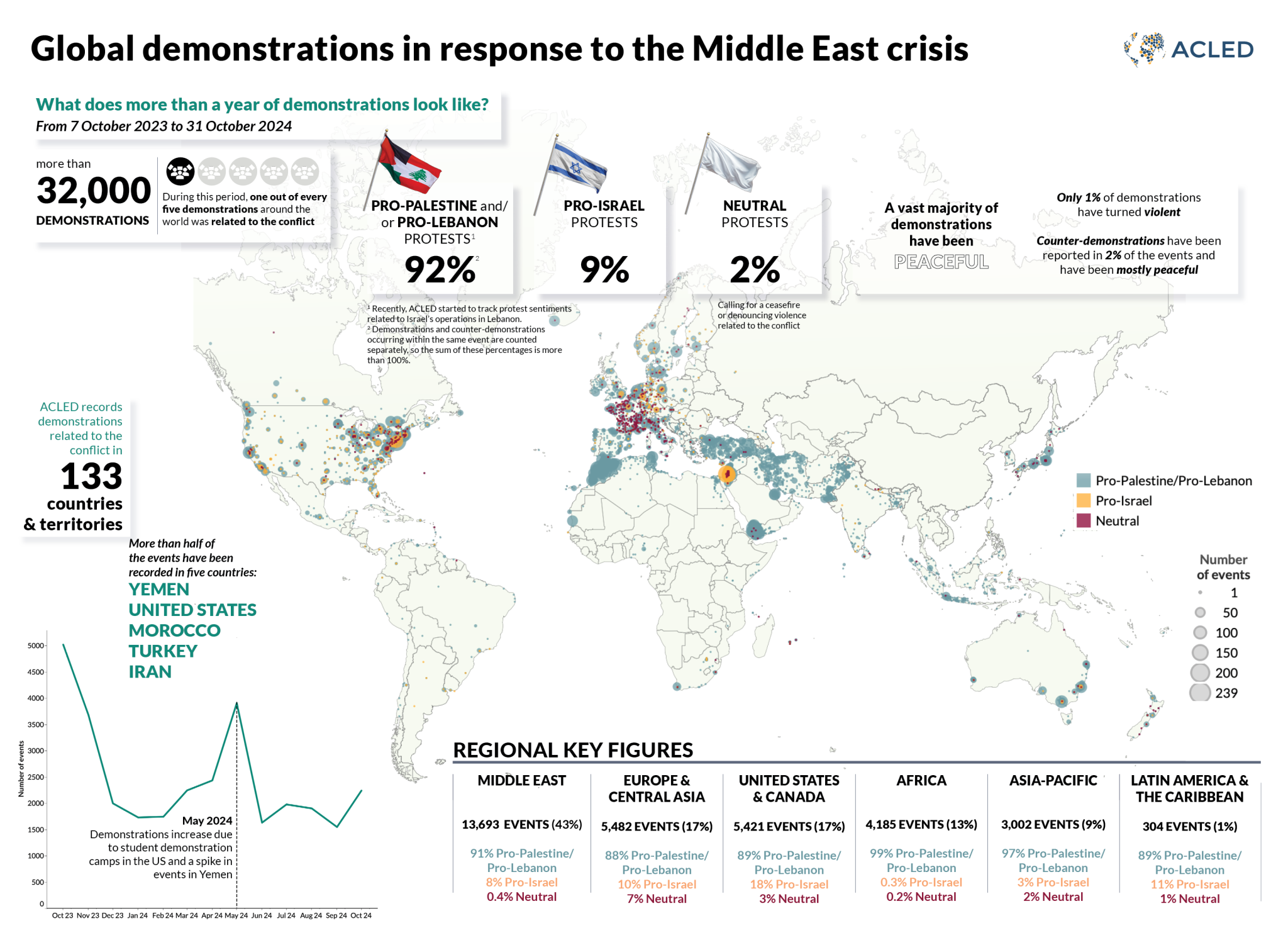
Since October 7th and the Gaza war, global protest has skyrocketed for Palestinians. ACLED counts nearly 48,000 pro-Palestine demonstrations from Oct 2023–Sep 2025. It’s disproportionate mobilization relative to most wars or conflicts. Despite prolonged crises elsewhere, global protests are minimal compared to Gaza: in Syria, even after chemical weapons attacks and hundreds of thousands of civilian deaths, protests outside the region largely faded after 2016; in Yemen, one of the world’s worst humanitarian disasters generated only sporadic demonstrations, without sustained participation; in Sudan (Darfur, 2023–2024), warnings of ethnic cleansing and mass displacement produced little international protest; and following October 7th, there were comparatively few protests centered on condemning Hamas. Compared with other major conflicts with higher civilian casualties, ACLED shows that Gaza generated an disproportionately large amount of protests.
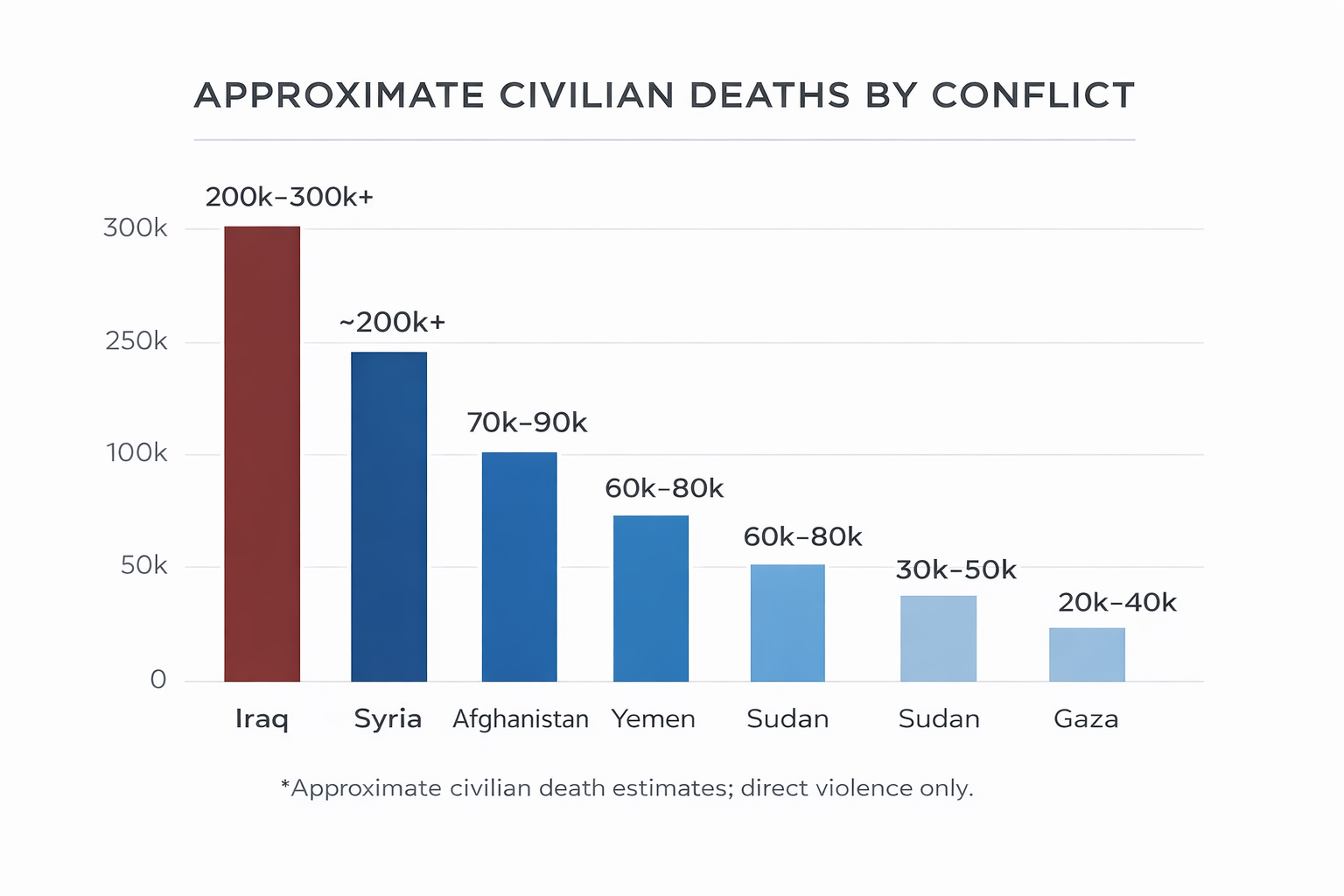
Civilian Harm and Proportionality in Gaza: Conflicts with higher civilian deaths are somehow viewed more favorably.
In coverage of the Gaza war, proportionality is discussed as a ratio of dead civilians, “X Palestinians killed vs Y Israelis,” with the implication that any imbalance signals war crimes or implies deliberately targeting civilians. During the battles of Mosul (2016–17) and Raqqa (2017), media and NGOs reporting framed civilian deaths as tragic but expected, especially when the enemy was embedded among civilians. Casualty numbers were reported, but they weren’t treated as proof of intent or illegality. In other conflicts, proportionality is talked about in terms of target legitimacy, military necessity, and enemy embedding. In other words, they are put in context. Israel is not. Hamas using human shields, placing themselves in schools, hospitals, and other civilian-laden places, is rarely mentioned compared the story that Israel is deliberately targeting civilians. In cases like this, Israel is judged by outcomes alone, and others are judged by context.
Hostage Relativism: Hostage-taking is relativized when Israelis are the captives.
Hostage-taking is prohibited under international law and is clearly condemned in the Geneva Convention. The prohibition is absolute—or is supposed to be. Shortly after the massacre, UN politics centered around ceasefires and diplomacy. In discussions of incidents where Hamas took Israelis captive, broader terms and focus were used—such as, emphasizing negotiations, humanitarian considerations, or the context of war—rather than saying the act is a blatant violation committed by terrorists, and Israel has the international legal right to rescue those hostages.
Put together, these patterns reveal a simple reality: Israel is held to rules no one else is asked to meet. It’s expected to defend itself without force, win wars without casualties, seek peace without credit, and accept blame without context. Its history is dismissed, its security concerns minimized, and its intentions presumed suspect. If applied to any other country, these unrealistic and impossibly high expectations would be mocked. Especially after something like October 7th. “When Israel is singled out by the United Nations [or anyone else] for human rights abuses, while the behavior of known and major abusers, such as China, Iran, Cuba, and Syria, is ignored…this is anti-Semitism.”
Related Topics
Related Posts