
Writer covering Israel–Africa, Jewish affairs, and Israel worldwide
Israel as Accountant-in-Chief for Its Adversaries: Efficiency Over Ethics
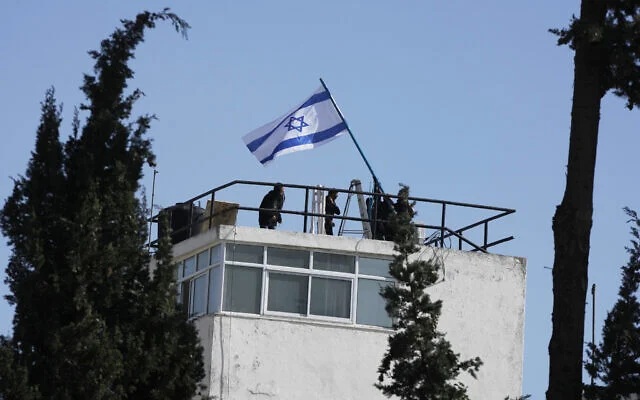
Israeli police and officials hang an Israeli flag on the UNRWA compound in East Jerusalem, December 8, 2025. (AP Photo/Mahmoud Illean)
When your adversary runs a business that pays people to harm you, and the world expects you to manage the payroll on time.
The Palestinian Authority: The ‘Legitimate’ Government That Never Asks Voters
There’s an international consensus that the Palestinian Authority (PA) is the legitimate governing body for Palestinians, so legitimate, in fact, that democracy apparently took a permanent holiday. The PA hasn’t held meaningful elections in decades, yet it continues to be treated as the single, indispensable representative of the Palestinian people on the world stage.
The most visible stage for this legitimacy theatre is the United Nations. In a series of symbolic votes, the General Assembly has repeatedly boosted the Palestinian position, urging broader recognition and supporting greater participation for Palestine in the UN system — even as the PA’s democratic mandate remains as thin as air in a vacuum.
The UN General Assembly even adopted a resolution affirming that the Palestinian entity qualifies for full United Nations membership and should be considered for that status, even though the more democratic bodies charged with evaluating membership, like the Security Council, have not recommended it, the vote was overwhelming.
The PA’s role was reaffirmed again in 2025, when a broad UN vote backed a declaration endorsing a future independent Palestinian state, envisioning the PA as the authority that would govern its territory once such a state exists. The resolution passed with 142 votes in favor, ten against, and 12 abstentions — despite Israel’s fierce rejection of statehood and concerns about granting diplomatic legitimacy without accountability.
From Brussels to New York, governments and international bodies routinely treat the PA as The Palestinian People’s Government, regardless of whether Palestinians have ever had the chance to renew that government through any kind of electoral process. And yet, somewhere between the endless resolutions and rushing to affirm legitimacy, no one seems to ask the obvious question: When did diplomatic applause replace democratic endorsement?
In this new normal, legitimacy is not what you earn at the ballot box — it’s what the UN stamp approves.
At the UN: Demands, Not Accountability
At the United Nations, the role of “Palestinian representatives asking for money” has become as predictable as stadium anthems. In late November 2025, a senior Palestinian minister stood before the world and demanded that Israel immediately release some $4 billion in tax revenues it had withheld. The catch? The demand came completely untethered from any suggestion that the Palestinian side reform the policies — including how those funds are spent.
According to the minister, withholding tax revenues was intolerable and must be resolved without delay. The demand was phrased not as a negotiation, not as a policy discussion, but as an absolute expectation: Israel must comply. No conditions. No accountability. No questions about how the funds are used or whether they sustain a governance model that actively undermines Israeli security. This wasn’t a diplomatic request. It was a royal summons issued from the lectern of the world’s most prestigious international forum.
What makes this moment surreal is not only the demand itself, but the way it was framed as if the mere act of withholding money — regardless of why — were an outrage of historic proportions. The ministry’s public statement did not pause to reconcile how billions might be responsibly managed, nor did it touch on the controversial stipends paid to families of attackers — a policy that has been repeatedly cited as one of the very reasons Israel withheld the revenues in the first place.
Instead, the narrative was elegantly simple: Israel’s job is to pay. Palestine’s job is to receive. Accountability is optional. Apparently, timelines and cash flows are now considered more urgent than transparency or governance — and never mind the reasons the money was ever withheld.
The Reason Everyone Mentions Quietly
Let’s be blunt about why Israel has been reluctant to hand over billions in tax revenues to the Palestinian Authority: the PA runs a pay-to-slay stipend program, compensating perpetrators of terrorist attacks and their families. Billions are not just cash flows. They are monetary incentives for violence, and not exactly the hallmark of responsible governance.
Even as a senior Palestinian minister stood in the UN and demanded a swift release of those funds, international commentary quietly sidestepped the elephant in the room: the financial encouragement of murderers. Instead of interrogating how tax revenues might be used to reward terror, diplomats framed the controversy as a logistical injustice. The assumption: Israel should pay now, ask questions later — even though the very policy that motivated the withholding is a matter of public record.
But let’s double down on the absurdity: the same authority demanding prompt payment also oversees an education system that, according to multiple analyses, teaches hate and normalizes martyrdom. School curricula and textbooks under PA administration have been documented teaching young students that violence against Jews is legitimate, valorized, and noble. In classrooms where children are meant to learn history or citizenship, too often they absorb hostility and grievance instead.
And yet somehow the narrative becomes not “let’s fix the incentives” but “why aren’t the rails cleared for payment?” In this wunderkind world of diplomacy, violence is a feature, not a bug — as long as the bills arrive on time.
“Lift All Barriers”: Logistics for an Adversary
At the United Nations, diplomatic language often resembles corporate speak: earnest, vaguely urgent, and infused with an assumption that every problem is a logistical tick‑box away from resolution.
In his recent statement before the UN Security Council, Ambassador James Kariuki — the UK’s chargé d’affaires, delivered a laundry list of calls: lift all barriers to aid without delay, let international NGOs operate freely, and urgently release withheld Palestinian tax revenues. There was none of the caveats one might expect — no mention of accountability, reform, or the reasons these revenues were ever withheld.
Let’s pause on that last bit: the urgent release of billions in tax revenues. The ambassador expressed it not as a negotiation, not as a conditional policy shift, not even as a “we should discuss this further” — but as an immediate imperative. This was not a debate about responsibility or reciprocal obligations. It was a diplomatic demand for compliance.
In this framing, Israel’s role is reduced to expediter‑in‑chief: collect the taxes, clear the internal review, move the funds — and do so quickly, with the very urgency one might reserve for defusing a bomb.
Yet what makes this demand perplexing is that the tax revenues in question are not a neutral sum. They are tied up precisely because of policies the international community quietly ignores — policies like stipends to attackers or educational incitement. Israel is being told, in essence: Never mind why the funds were withheld — the important thing is that they be unfrozen urgently.
In modern diplomacy, solving hostility is less about changing behavior than ensuring cash moves quickly — because delays are humanitarian crises, but incentives are footnotes.
The Unspoken Doctrine: Israel as the Financial Concierge
By now, a pattern is unavoidable. Israel is expected to act as the world’s most efficient financial concierge for a governing authority that openly works against its interests. Collect taxes, review them, release them promptly, and ensure that the PA’s internal operations—education, stipends, and all—continue uninterrupted.
Notice what isn’t expected:
-
Any reform of violent incentives
-
Accountability for public funds
-
Revision of curricula that glorify martyrdom
The doctrine is simple: hostility is negotiable, bureaucracy is not. Diplomats from multiple nations nod sagely, reiterating that Israel must expedite, facilitate, and streamline — because apparently the health of the international order rests on timely payments rather than security or ethics.
In this world, the moral hazard isn’t that terror is rewarded — it’s that a transfer might arrive late.
When Absurdity Becomes International Policy
Let’s distill the takeaway: Israel is being asked to fund, empower, and optimize a system whose policies encourage violence against its own civilians. Every reminder of accountability, every explanation for withholding funds, is politely ignored. Every urgent call to “release the revenues without delay” carries the tacit understanding that deadlines matter more than deeds. This isn’t diplomacy. It’s outsourcing morality and efficiency to the very entity that undermines your existence — and treating Israel’s compliance as a moral imperative.
The irony is sharp, almost cinematic:
-
A system that indoctrinates children to hate,
-
Rewards attacks financially,
-
Receives demands for uninterrupted funding,
all while the world insists Israel is the obstacle to normal operations.
Apparently– you can glorify hostility, reward violence, and ignore elections — but heaven help you if a bank transfer is delayed.
Related Topics
Related Posts