
Gaza’s women get lost in the argument about them
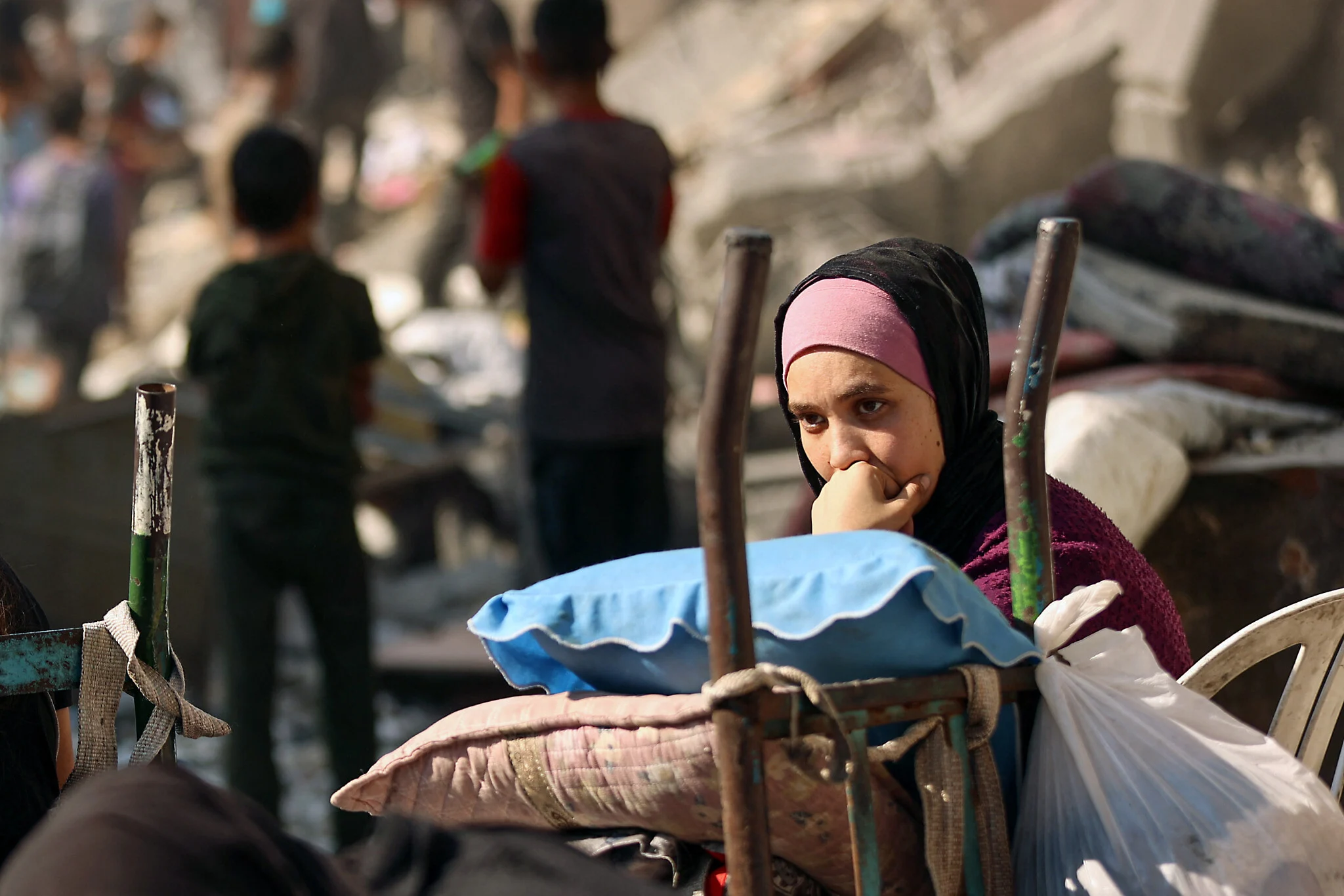
In recent weeks, more and more reports have emerged from Gaza about families marrying off underage girls, about women pushed into complete dependence on men, and about men exploiting desperation by demanding sex in exchange for flour and medicine. In situations like these, the female body once again becomes a form of currency within a patriarchal social order that persists even inside catastrophe. But what is disturbing is not only the expansion of the phenomenon itself, but also the way the woman herself almost immediately disappears within the political readings of her suffering.
Child marriage in Gaza had been in gradual decline for more than a decade, but the war reversed the trend. Data collected by Gaza’s Supreme Sharia Court at the request of the Associated Press show that around one-fifth of the marriages registered over the past two years involved girls under the age of 18, some of them under 15. According to estimates by officials in Gaza, the real number is likely higher, since many marriages were never formally registered amid the chaos of war.
A girl handed over to an older man, a woman forced to comply with sexual demands in exchange for food, should provoke shock, perhaps even a call for protection, before any other question is asked. But once these testimonies enter public discourse, whether Israeli or international, the shock is displaced and absorbed into another argument.
One reading sees the suffering of Gazan women as proof of Israeli cruelty, evidence against the war and against conditioning Gaza’s reconstruction on Hamas’s disarmament. Another reading sees the suffering as an inevitable consequence of a war Hamas initiated and wages from within the civilian population, and therefore places responsibility on Hamas. The two readings differ on almost everything, yet they agree on one thing no one says out loud: the woman herself is not the issue. She becomes raw material inside an argument larger than herself.
Moreover, someone disappears within this argument: a father or a family member marrying off a girl, the husband on whom a woman is completely dependent, the armed operative who demands sex from a widow in exchange for aid. These are real people, the direct perpetrators of the harm. Hunger, the collapse of the healthcare system, the absence of schools and livelihoods create the conditions in which child marriage or sex in exchange for food become more common. But war itself did not hand over a girl, demand sex, or exploit a widow. People did. When context becomes the only explanation, the perpetrators themselves disappear, and women are abandoned once again inside the struggle over the meaning of their suffering.
It is easy to forget, amid all this, that these women and girls had lives of their own, inner worlds and desires. Some wanted to study, dreamed of a profession, resisted the idea of marriage. But in order to see them that way, as human beings rather than as tokens inside an argument, something is required that has almost vanished: the ability to look at another woman, a stranger beyond national lines, and say “we.”
Simone de Beauvoir saw this clearly. The working class can say “we,” she wrote in “The Second Sex,” because it shares a history, a common interest, a place of its own. Women have none of that. Scattered among men, each tied more tightly to her father or husband, to her home and class, than to other women, they never built a “we” of their own. A wealthy woman feels closer to the men of her class than to a poor woman; a white woman feels closer to white men than to Black women. Again and again, class and race win out over what women share. War only sharpens this. To class and race it adds nation, the most absolute division of all.
In wartime, this collapse of women’s “we” becomes almost complete. A woman ceases to be seen first as a woman and immediately becomes Gazan, Israeli, Arab, Jewish. Once that happens, the very possibility of looking at another woman and simply saying that a man hurt her, exploited her, trafficked her, becomes nearly impossible, because the first question asked is no longer what was done to her, but which side she belongs to.
And so the question is not what position to take, but how to see. To see a woman in Gaza is not only to see the scale of the destruction around her, or to ask how reconstruction might ease her life. It is also to see that the hand that harmed her was a human hand, close to her, a man in her own world, and that no rebuilding will reach her if he remains invisible. Seeing a woman means resisting the urge to dissolve her immediately into the national argument surrounding her suffering. It means refusing to let political interpretation replace the woman herself.
The question of which side this woman belongs to is not the first question. It is the first distraction. As long as it is asked first, the one who handed her over, demanded, exploited, remains outside the frame. To truly see a woman means asking what was done to her, and who will be held accountable for it. Perhaps this is the heart of women’s “we.” And in wartime, it may also be the hardest thing to do.