
Israel: Between Alliance and Autonomy
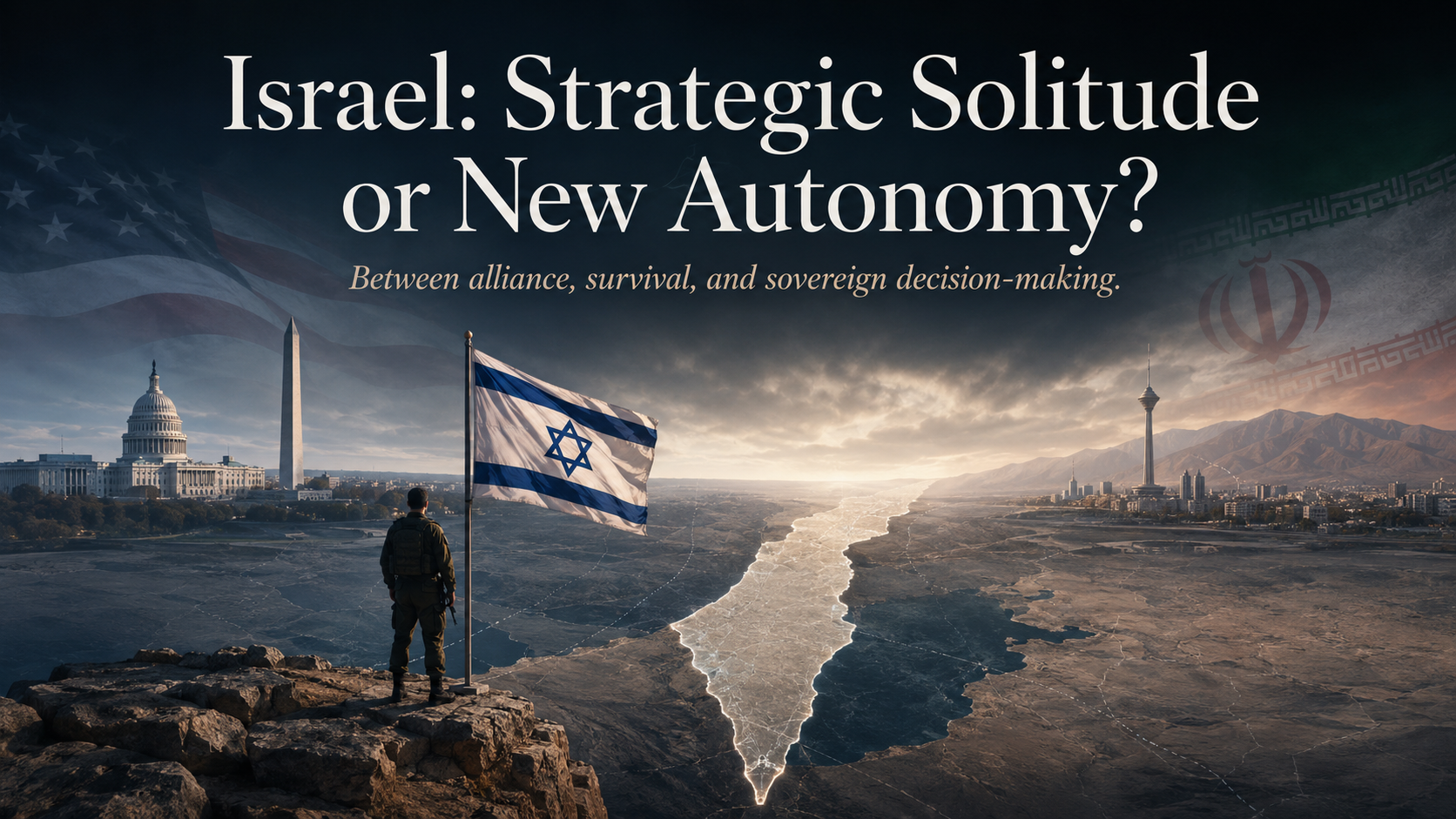
For several days now, a question has been circulating in Israel: are we alone, or are we simply regaining control over our own decisions?
The agreement between Washington and Tehran, presented as a way out of war, has caused deep unease in Jerusalem. Officially, the United States remains Israel’s central ally. Militarily, diplomatically, technologically, this alliance remains vital. But politically, something has cracked. The interim agreement between the United States and Iran provides for de-escalation, the resumption of nuclear talks, the reopening of the Strait of Hormuz, and an easing of sanctions, while Israel is concerned to see Iran regain strategic breathing room without a clear dismantling of its regional capabilities.
This is where the Israeli paradox begins.
Israel may have won part of the military sequence against Iran, but it could lose politically in the aftermath. Military victory is not enough if the diplomatic settlement gives the adversary time to rebuild, reinsert itself, save its networks, and turn mere survival into a narrative victory.
For Washington, the goal is clear: exit the war, calm the markets, reopen energy routes, and avoid a regional quagmire. For Israel, the objective is different: prevent Iran, even weakened, from retaining intact its capacity for disruption through Hezbollah, its missiles, networks, and nuclear program. These are not two enemy policies. They are two diverging priorities.
And this divergence creates a sense of solitude.
But caution: solitude is not necessarily abandonment. The United States is not leaving Israel. They are not breaking the alliance. They are not withdrawing their strategic support. On the other hand, they are reminding us of a brutal truth in geopolitics: even among allies, interests are never totally identical. America thinks as a global power; Israel thinks in terms of regional survival. America can live with a managed Iranian ambiguity. Israel, however, cannot afford this luxury.
The Lebanese front perfectly reveals this fracture. Israel refuses to withdraw its forces from southern Lebanon until the Hezbollah threat is neutralized, while American diplomatic pressure pushes for rapid stabilization. Reuters reports that Israel has even published a map expanding its control zone in Lebanon, despite tensions with Washington and upcoming negotiations.
This is where the real question lies: is Israel isolated, or is it entering a new doctrine of strategic autonomy?
Since October 7, 2023, Israel has gradually realized that it can no longer outsource its existential security, not even to its best ally. The American alliance remains indispensable, but it can no longer be confused with a delegation of sovereignty. In other words: Israel can receive help, weapons, intelligence, partial diplomatic cover. But at the decisive moment, it must alone decide the level of risk it is willing to accept.
This evolution is significant. For a long time, Israel lived in a form of double dependence: material dependence on the United States, but also psychological dependence on the idea that Washington would always end up sharing the same threat assessment. However, the agreement with Iran shows that this is no longer automatic.
Israeli strategic solitude is therefore not just diplomatic isolation. It may be a maturation. Israel discovers that the American ally may want stability where Israel wants the neutralization of a threat. Washington wants to manage disorder. Israel wants to prevent that disorder from returning to its borders.
The danger, of course, would be to turn this autonomy into isolation. A totally isolated Israel, defying Washington, Europe, moderate Arab countries, and part of its public opinion, would expose itself to considerable political exhaustion. But the opposite would be just as dangerous: accepting a regional architecture designed without it, in which its security becomes a variable for adjustment.
The right formula may be this: remain an ally of the United States, but no longer be a prisoner of its timetable.
Israel is not abandoned. But it is no longer automatically understood. And in this nuance lies all the geopolitics of the moment.
Related Topics
Related Posts