
A Midwestern Jewish Politico
Israel Can’t Afford Another Netanyahu Government
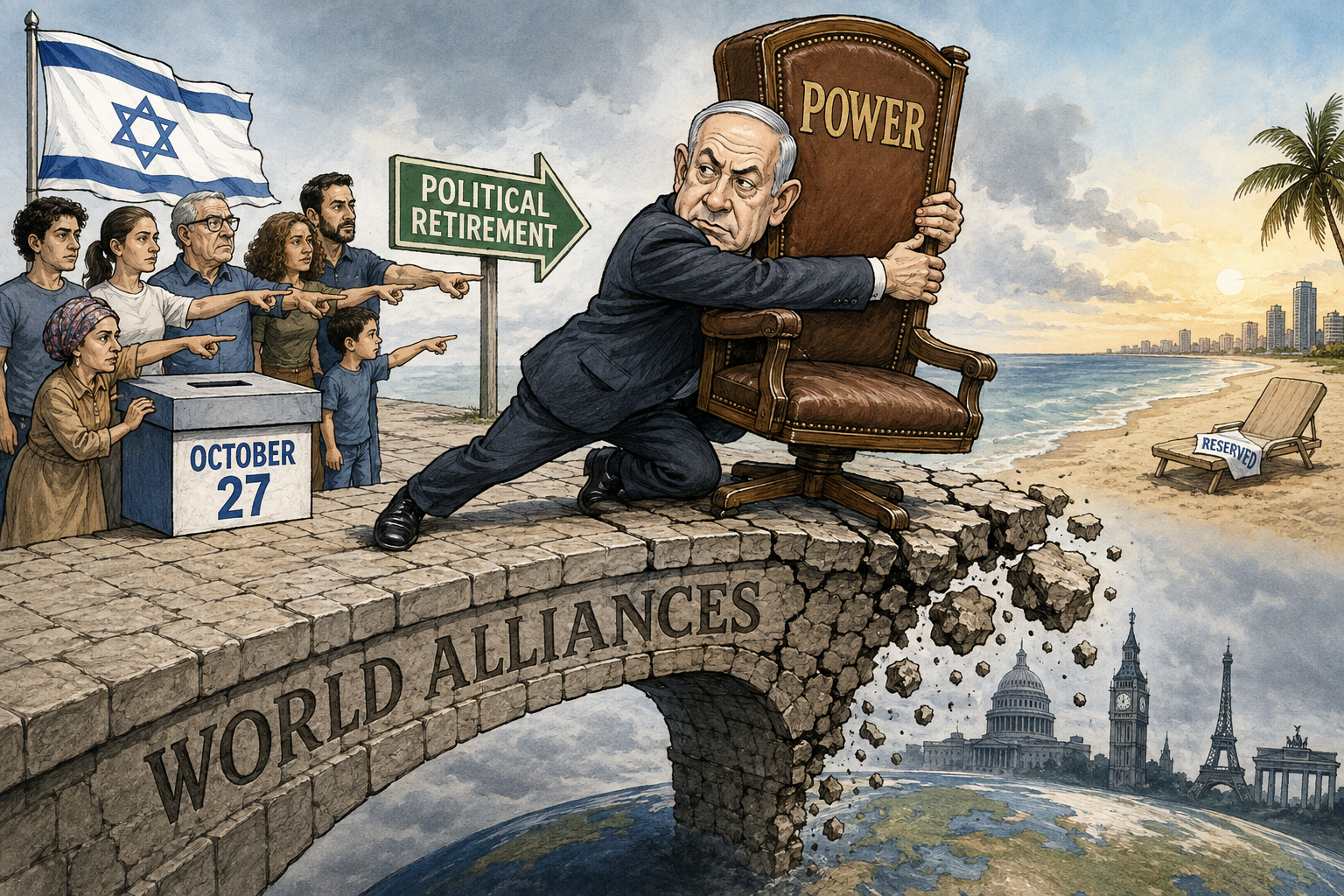
Netanyahu clinging to his political life (ChatGPT)
This fall, Israelis will make a choice far larger than Benjamin Netanyahu, Likud, or the familiar arithmetic of coalition politics. They will decide whether Israel begins repairing the damage of the past several years or allows that damage to harden into something far more difficult to reverse.
Netanyahu and Likud need to lose. Israel’s future may depend on it.
That is not an easy sentence for every supporter of Israel to write. It certainly will not be an easy sentence for every Israeli to read. But supporting Israel cannot mean granting one politician permanent immunity from failure. Patriotism is not loyalty to a prime minister. Zionism is not a personality cult. Sometimes loving a country requires saying plainly that its leader has become a danger to it.
Hamas bears full responsibility for the barbaric massacre of October 7. Nothing about Netanyahu’s failures diminishes the guilt of the terrorists who murdered, raped, kidnapped, and terrorized Israelis. Israel had every right to defend its people and confront Hamas. But that truth does not erase the responsibility of the government that failed to protect the country before the attack or excuse every decision made afterward.
October 7 occurred on Netanyahu’s watch. Senior security officials have resigned and acknowledged their share of responsibility. Netanyahu, meanwhile, has repeatedly tried to redirect blame while resisting the kind of independent state commission of inquiry that Israelis deserve. Leadership cannot mean taking credit for every success and outsourcing every catastrophe.
Since October 7, Netanyahu has also allowed Israel’s legitimate war against Hamas to become entangled with his own political survival and the demands of extremists in his coalition. Rather than offering a credible diplomatic horizon, his government has empowered ministers whose rhetoric repels allies, inflames the conflict, and makes Israel appear indifferent to Palestinian civilian suffering. It has treated concern from longtime friends not as an alarm to consider, but as betrayal to denounce.
That posture is not strength. It is strategic self-harm.
Israel cannot thrive as a fortress permanently at war with the world. It depends on military cooperation, trade, investment, diplomatic legitimacy, and relationships that require constant tending. Those relationships are not indestructible. Public opinion is shifting, particularly among younger Americans and Europeans. Governments that once defended Israel almost reflexively now face growing pressure to impose conditions, sanctions, or diplomatic consequences.
Some of that hostility is unfair. Some of it is unquestionably driven by antisemitism or by the grotesque refusal to recognize what Hamas did. But Netanyahu has made the work of Israel’s enemies easier. He has handed them images, statements, and policies they use to argue that Israel has abandoned both restraint and democracy. Worse, he has forced Israel’s friends to spend their energy defending the indefensible instead of defending Israel’s right to exist in security.
For Jews in the diaspora, this is painful to watch. We defend Israel against people who deny its legitimacy, while its own government steadily weakens the moral and diplomatic ground from which that defense must be made.
There will come a point when these relationships cannot simply be reset by a better press conference or another speech to Congress. Trust, once squandered long enough, becomes policy. Academic boycotts become commercial ones. Symbolic diplomatic rebukes become formal recognition shifts, arms restrictions, and lasting estrangement. Israel cannot wait until the damage is irreparable to discover that Netanyahu stayed too long.
The damage at home matters just as much. Before October 7, Netanyahu’s coalition was already tearing Israeli society apart through its assault on judicial independence. Since then, reservists have carried an extraordinary burden, hostage families have pleaded to be heard, and Israelis have been asked to accept endless war without meaningful accountability or a convincing plan for the day after. A government that demands sacrifice must also submit itself to scrutiny.
Replacing Netanyahu will not magically end antisemitism, eliminate Hamas, heal Israeli divisions, or produce peace overnight. No opposition coalition will be perfect. But political change would tell Israelis and the world that the country can still correct course. It would create space for an independent October 7 inquiry, renewed democratic safeguards, more responsible diplomacy, and leadership that places the state above one man’s career.
On October 27, Israelis should send Benjamin Netanyahu into political retirement. He has dominated Israeli life long enough, and Israel has paid enough for his refusal to leave the stage.
Perhaps, once security permits, Yair can save his father a lounge chair back in Miami. Israel, meanwhile, has a country to rebuild.
Related Topics
Related Posts