The views expressed herein are solely mine.
Israel Cripples Iran’s Drone Pipeline in Africa
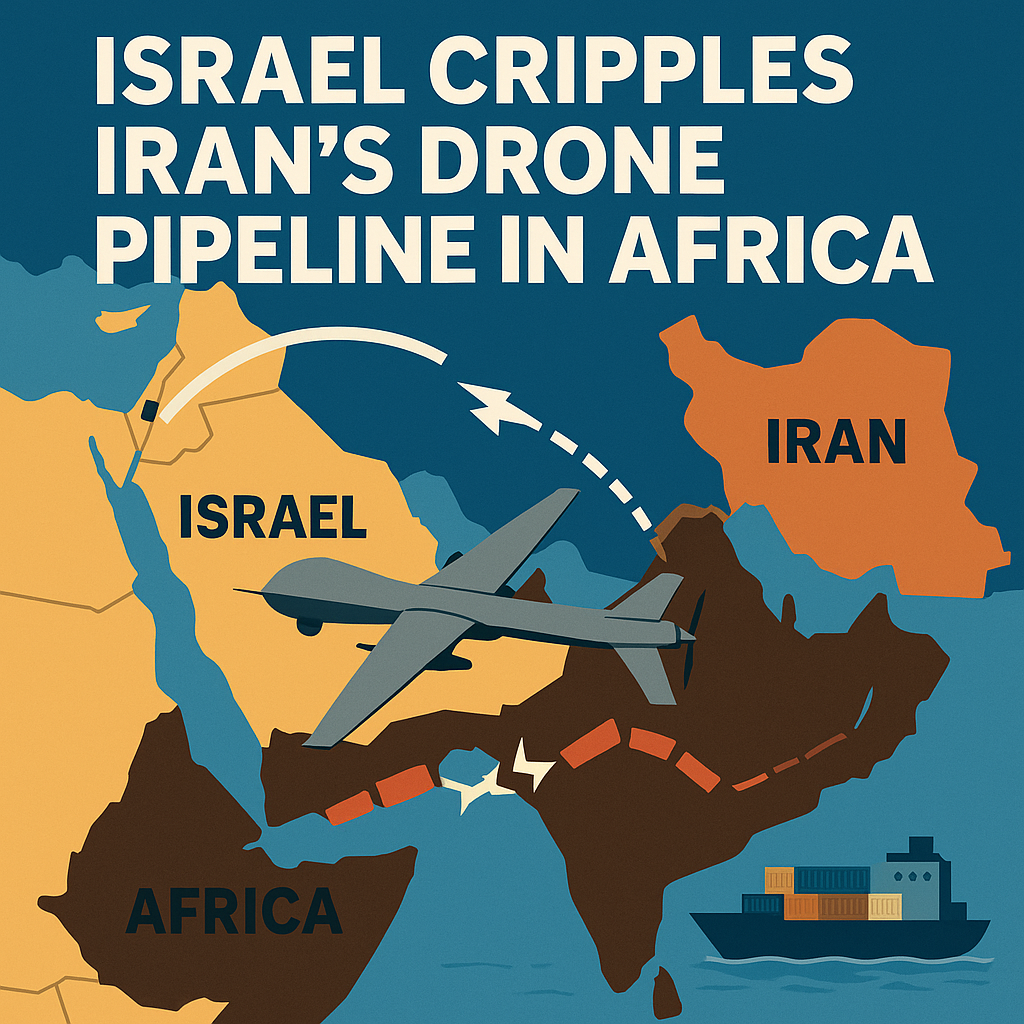
A stylized geopolitical map showing Israel intercepting Iran’s drone supply routes through Africa, symbolizing disruption of Tehran’s UAV pipeline. Credits: AI-Generated.
In a bold evolution of deterrence strategy, Israel’s security forces have moved beyond simply defending their skies—they have shifted into offensive supply-chain disruption mode, targeting the logistics backbone of Iran’s unmanned aerial vehicle (UAV) enterprise as it snakes through Africa.
The gambit: cut off the flow before the drones even launch.
Recent intelligence confirms that Iran’s drone ecosystem is not a lone factory tucked away somewhere—it is a sprawling procurement network, dependent on global components and clandestine delivery routes.
A 2025 report found that the Yemen-based Houthis movement carried out 388 UAS attacks between 2018 and 2024, relying on Iranian-origin parts assembled abroad.
At the same time, the U.S. Commerce Department placed 15 Chinese firms on its Entity List in October 2025 for supplying U.S.-origin electronics to Iranian drones later captured by Israel and other states.
Israel’s recent maritime and intelligence leaps—tracking cargoes, intercepting shipments, and disrupting trans-African transits—send a clear message: the battle for air dominance is increasingly a battle of the supply chain.
The academic theory of deterrence has long focused on threat credibility and cost-imposition.
However, Israel’s pivot demonstrates a third leg: denial by disruption—where the adversary’s ability to field the system is degraded before it arrives.
But, why does this matter? Because Iran’s drone campaign is not static.
The loitering munition Shahed 136 (and its variants) embodies Tehran’s export-oriented drone strategy—cheap, mass-produced, with components traceable to Western origins.
By targeting Africa-based transshipment points and supplier networks, Israel undermines Iran’s forward-projection model.
On the other hand, Russia’s dependence on Iranian drone tech also underlines the broader utility of this disruption model: Iran shipped kits and components—some sourced via Africa and Asia—for assembly in Europe and Africa rather than just via the Middle East. Hence, cutting these hubs matters for global proliferation control.
Consider the larger strategic calculus: Israel cannot stop every drone attack launched at it. But it can make those attacks much harder to sustain.
As a result, if Iran’s drone factories survive but the parts cannot move, the deterrence equation tilts again—ratchet up the cost, delay the cycle, and force Tehran into a logistics ledger it cannot afford.
Of course, this is neither low-risk nor friction-free.
Africa’s littoral states are weak links, and Iran will shift methods—from dual-use civilian logistics to cut-outs, local assembly, or micro-shipments.
Doubtlessly, Africa will become the next supply-chain battleground and Israel’s success will depend on intelligence reach, maritime domain control, and diplomatic access—hard to maintain at the scale Iran needs.
Still, the policy implications are striking.
Deterrence by punishment (strike after attack) is increasingly complemented by deterrence by denial of procurement. Israel is applying this effectively—and others should watch. The goal is not just to shoot down drones—it is to stop them from being built.
In the raw contest of power, the world’s great UAV races—with shadows cast by Iran and its proxies—are not simply about warheads or airframes. They are about circuit-boards shipped through Africa, microprocessors nodding in drones, hidden manifests, and long sea legs.
Israel has moved upstream in the flow.
Jerusalem is not fighting yesterday’s drone: it is fighting tomorrow’s.
Related Topics
Related Posts