
Writer covering Israel–Africa, Jewish affairs, and Israel worldwide
Israel Has Lost the World. That Is the Story, Anyway.
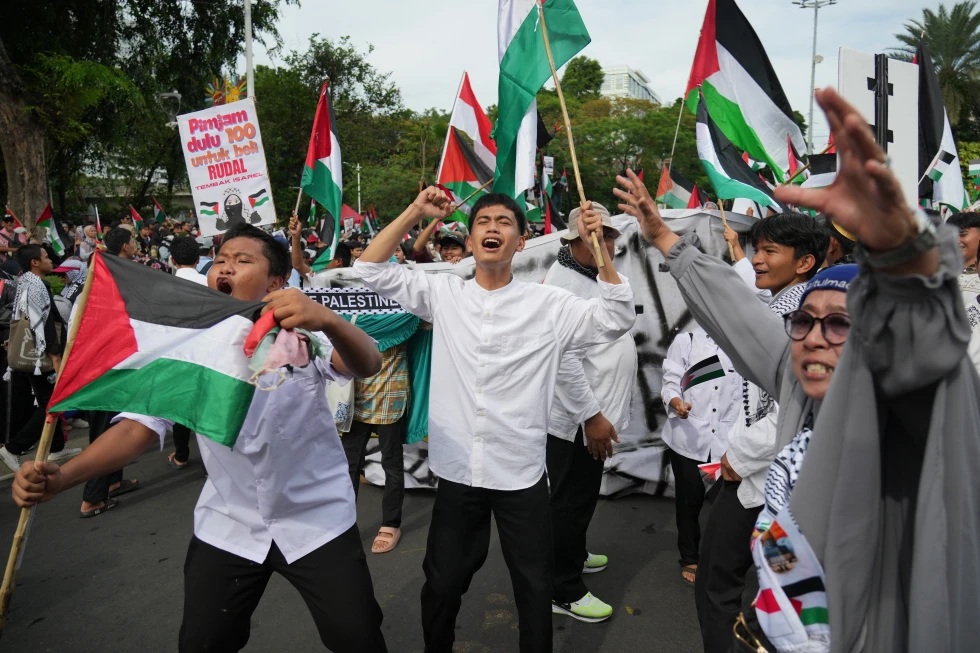
Protesters wave Palestinian flags as they shout slogans during a rally commemorating the second anniversary of the war in Gaza, outside the US Embassy in Jakarta, Indonesia, Tuesday, Oct. 7, 2025. (AP Photo/Achmad Ibrahim)
Since October 7, we have been treated to a relentless lecture. Israel, we are told, has lost the world. It has squandered international goodwill. It has alienated its allies. It has isolated itself through its conduct in Gaza. Polls showing declining support in the United States are presented as exhibits in a trial whose verdict was apparently reached long ago.
Israel was attacked in the most brutal massacre of Jews since the Holocaust, responded by fighting a just war against the organization that carried out that massacre, and somehow emerged as the primary culprit in the eyes of much of the international community. The conclusion, we are assured, is obvious: Israel has lost support because of its actions.
There is only one problem with this theory. It assumes Israel enjoyed remarkable support before October 7.
When exactly was this golden age?
Was it during the years when the BDS movement was expanding across Western campuses? Was it when student groups were calling for boycotts, divestment, and sanctions against the Jewish state? Was it when anti-Israel activism became a permanent feature of university life? Or was it at the United Nations, where Israel has long occupied a unique category of international obsession?
From 2015 through 2024, the UN General Assembly adopted more than twice as many resolutions against Israel as it did against all other countries combined. At the UN Human Rights Council, democratic Israel has routinely attracted more condemnation than regimes run by dictators, warlords, and revolutionary clerics. Apparently, the world’s most pressing human rights crisis is not Syria, Iran, North Korea, or Russia. It is the existence of a Jewish state.
We are told Gaza transformed Israel into an international outcast. Curiously, many international institutions seem to have reached that conclusion years before Gaza.
The idea that October 7 destroyed decades of goodwill would be more persuasive if anyone could point to the decades of goodwill.
None of this means support for Israel has not declined in some places. But that is not the same as proving why. In fact, attitudes towards Israel were shifting long before Hamas crossed the border on October 7. The trend predates the war. The fever existed before the diagnosis.
And this raises a more uncomfortable question.
What exactly is the value of support that disappears the moment it is needed?
Imagine a regional alliance that proudly advertises its commitment to mutual defense, only to announce during the first missile barrage that its support was intended primarily for peacetime. In the Middle East, we already have a word for such arrangements. We call them temporary.
Much of the support Israel supposedly lost after October 7 increasingly resembles one of those arrangements.
When Israelis are burying their dead, the world expresses sympathy. When Israelis defend themselves, the sympathy develops conditions. When Israelis absorb attacks, they are praised for restraint. When they respond to attacks, they are criticized for responding. Israel is permitted to be a victim for approximately forty-eight hours, after which it is expected to return to being a defendant.
Apparently, Israel enjoyed overwhelming support right up until the moment it needed it.
That is not support.
The speed with which much of the world moved on from October 7 should have been instructive. Before Israeli forces had entered Gaza in significant numbers, before casualty figures dominated headlines, before military operations had fully unfolded, many people had already decided who the villain was.
This is perhaps the most revealing aspect of the entire saga. We are constantly told that outrage emerged because of what Israel did in Gaza. Yet a remarkable amount of outrage appeared before Israel had done much of anything in Gaza at all.
On campuses across the West, demonstrations appeared almost immediately. Others rushed to contextualize, rationalize, or explain away atrocities that would have horrified them in any other setting. The issue was never simply Israeli military conduct. The reactions arrived too quickly for that explanation to carry all the weight being placed upon it.
October 7 did not create these attitudes. It exposed them.
The reality is that many people support Israel in theory but become deeply uncomfortable with Israel in practice. They support Jewish self-determination provided it remains largely symbolic. They celebrate the right of Jews to defend themselves until Jews actually begin defending themselves.
There has always been a preferred version of the Jew in international opinion: vulnerable but not powerful, endangered but not sovereign, mourned but not armed.
The sovereign Jew creates complications.
A Jewish state that fights wars, secures borders, destroys terrorist infrastructure, and refuses to seek permission for its survival is a much less comfortable proposition. Not because it violates international norms, but because it violates expectations.
And so Israel is subjected to demands rarely made of any other country. It is expected to defeat enemies without defeating them, eliminate threats without using force, and win conflicts while preserving the approval of people who oppose the conflict’s very existence.
No nation in history has ever met such a standard. Yet Israel is condemned for failing to achieve it every few years.
The conventional narrative says October 7 damaged Israel’s relationship with the world. The reality is more embarrassing for the world than it is for Israel. What October 7 revealed was not the fragility of Israel’s position. It revealed the fragility of much of the support that supposedly surrounded it.
If support disappears the moment it is tested, was it ever support at all?
An ally who vanishes during a war was never much of an ally. And support that exists only during periods of calm, only when no difficult choices must be made, only when no existential threats are present, is not support in any meaningful sense of the word.
Perhaps Israel did lose something after October 7.
But if that support evaporated precisely when Israelis were massacred, kidnapped, and forced into a war they did not seek, then perhaps what disappeared was not genuine solidarity at all.
Perhaps October 7 did not reveal how isolated Israel had become.
Perhaps it revealed how much of the applause had been mistaken for friendship.
Related Topics
Related Posts