
Geopolitical Analyst: Bridging Somaliland & Israel to the world
Israel Has Voted. The Region Still Needs a Way Out of War.
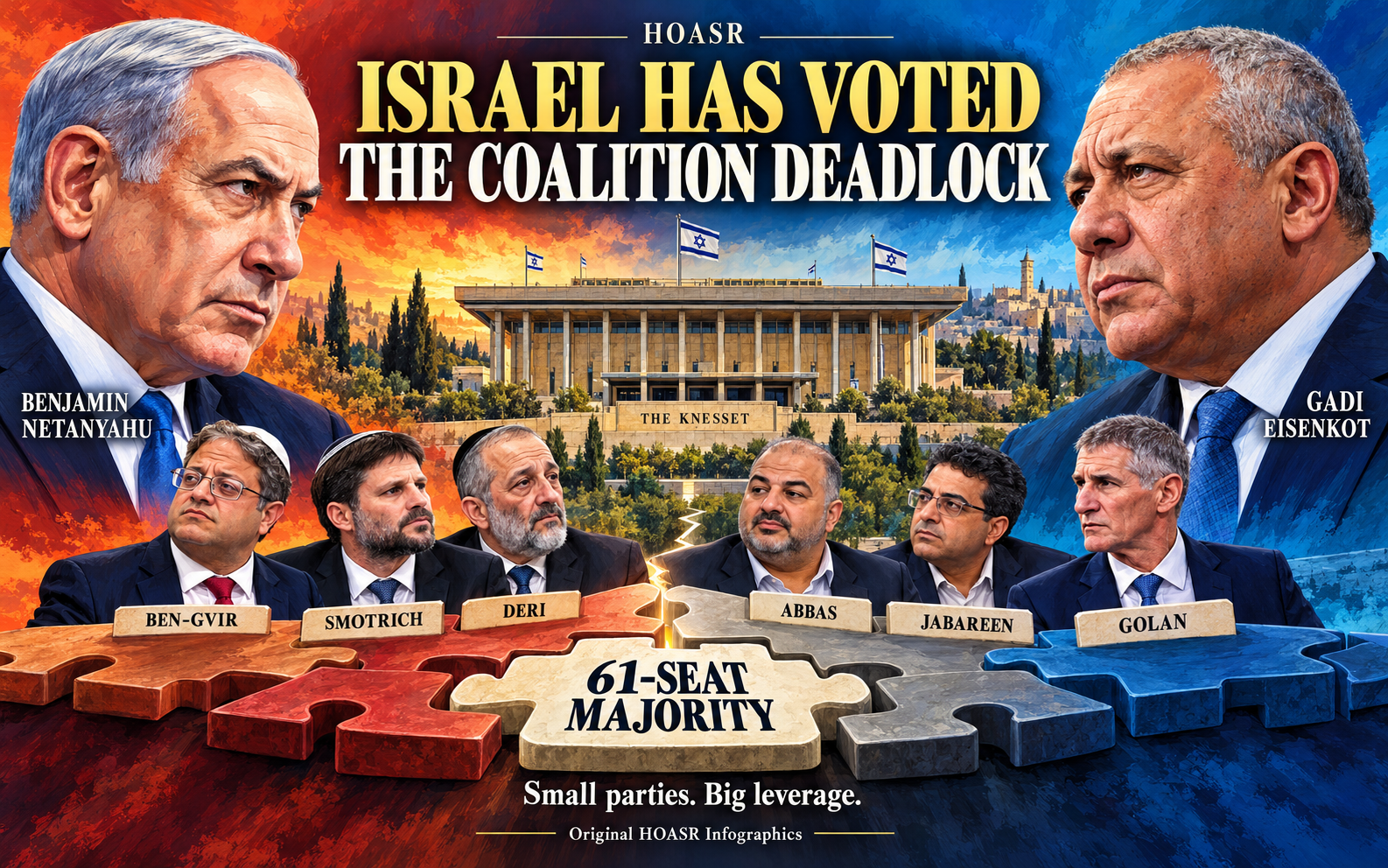
Israel’s coalition deadlock places smaller parties at the centre of government negotiations, with consequences across the Middle East and Red Sea. Original HOASR Infographics.
Israel’s election has left its leading political camps without a clear governing majority, while the region continues to face the consequences of war. Benjamin Netanyahu remains in office, Gadi Eisenkot is seeking a route to power, and coalition bargaining will determine who can govern.
For Israel’s neighbors, the immediate concern is what decisions emerge during this uncertain transitional period. A vote can change the balance in parliament; ending a regional conflict requires agreements that governments are prepared to honour. Post
As counting continued on 29 October, the emerging result pointed to difficult negotiations rather than an immediate transfer of power. Neither major camp had secured the 61 seats normally needed for a stable majority in the 120-member Knesset.
Arab-led parties had made a strong showing and could influence the formation of an alternative government. Their participation has exposed how far Israel’s politicians must travel from campaigning against one another to accepting the compromises required to govern together. Post · AP
That political uncertainty carries consequences beyond Israel’s borders. Meanwhile, the outgoing government remains in office until a successor is established, and its caretaker status leaves it with substantial security powers.
Iran, Lebanon, the Gulf states and the countries around the Red Sea cannot assume that coalition negotiations will postpone military decisions. The transition therefore demands restraint from those exercising power and serious diplomacy from the governments trying to contain the conflict. Knesset · Times
Israel’s democratic credibility will also be tested by the treatment of its own voters. Allegations of foreign interference deserve investigation, but the suspicions reported this week have not been substantiated publicly.
Arab citizens’ political participation cannot fairly be discredited because their votes complicate somebody else’s coalition calculations. President Isaac Herzog’s warning against tarnishing an entire community goes to the responsibility elected leaders carry after the ballots have been cast. AP
A change of prime minister could alter Israel’s diplomatic conduct without removing the security concerns shared across its political establishment.
Eisenkot has supported military action against Iran’s nuclear programme if necessary, while questioning whether regime change in Tehran is militarily achievable.
Although that choice could influence negotiations, it nevertheless offers no guarantee that a new government would avoid further confrontation. Semafor
Israel has an interest in preventing attacks on its people and in ensuring that Iran does not acquire a nuclear weapon. Its partners also have an interest in knowing the political objective of each military operation and the conditions under which fighting can stop.
A campaign that repeatedly expands without producing a sustainable settlement exposes allies, civilians and trade routes to continuing danger. The next government’s judgement will be measured partly by its ability to turn military capability into security that lasts.
For Palestinians, a new cabinet would have significance through the decisions it makes about civilian protection, humanitarian access, settlement activity and Gaza’s future administration.
Reuters reports that both Netanyahu and Eisenkot oppose Palestinian statehood and insist on dismantling Hamas’s military capability, although Eisenkot has pledged to curb settler violence in the West Bank.
Those positions suggest both continuity and room for differences in implementation. Any claim of a new diplomatic beginning must be tested against what changes in people’s lives. Reuters
Lebanon faces a similar need for concrete commitments. Carnegie’s regional assessment identifies a broad Israeli security consensus on southern Lebanon and the use of force against Iran’s nuclear ambitions.
A different coalition could change negotiating methods and relations with allies, while leaving important military objectives intact. Neighbouring governments will consequently judge the next cabinet by its decisions on deployments, ceasefire implementation and the terms of a political settlement. Carnegie
The Gulf states have reasons to want a more predictable Israeli partner. For the United Arab Emirates, established diplomatic and commercial relations provide an interest in preserving cooperation while reducing the regional tensions that make it politically costly.
Saudi Arabia faces the separate decision of whether the conditions justify normalisation. Semafor analysts argue that a new Israeli government could create diplomatic space, but Riyadh’s demand for a credible path toward Palestinian statehood remains a substantial obstacle. Semafor
The election also makes the recent Tehran diplomatic opening relevant. Saudi Arabia presented the 26 October consultations with Iran, Türkiye and Pakistan as an effort to reduce escalation and support mediation.
Iran, meanwhile, has advocated regional security arrangements without outside military presence. These positions reveal ambitions that extend beyond Israel’s coalition negotiations. An Israeli government able to combine credible defence with serious diplomatic engagement would have more opportunity to influence those discussions. Saudi · Mehr
The UAE’s solidarity with Saudi Arabia against Houthi attacks also shows why the region cannot be divided neatly into permanent camps. Governments can compete over influence while cooperating against threats to their facilities and shipping.
Israel’s relationships will be more durable if its partners see them as contributing to their security and economic interests. Demanding support while leaving those partners to absorb the consequences of escalation would naturally narrow the gap for cooperation. UAE
Washington will play a key role in these calculations but claims that it has already selected Israel’s next coalition are premature. A US official told The Times of Israel that the administration had not decided to intervene in government formation.
Whatever the case, an American endorsement cannot supply the parliamentary consent an Israeli government needs. Nor can a close personal relationship between leaders substitute for agreements that their institutions can implement. Times
As we approach the upcoming American midterm elections political uncertainty on both sides is rising. Israeli leaders must consider how their decisions affect support in the United States as well as the administration’s immediate objectives.
As for Washington, the credibility of regional diplomacy will depend on whether its partners believe American policy reduces their risk to conflict. The interests of the alliance are better served by clear objectives and dependable commitments than by treating every disagreement as a test of loyalty.
Beyond the region, commercial interests will be affected by what happens at sea and around energy infrastructure. The EIA’s historical data show how Houthi attacks redirected shipping and sharply reduced oil traffic through Bab el-Mandeb before this election.
Further escalation could increase pressure on transport costs, supply chains and import-dependent economies. More predictable maritime conditions would offer benefits extending well beyond the governments directly involved in the fighting. EIA
For Somaliland, the election is a reminder that an important bilateral relationship must endure changes of leadership. A successor cabinet would inherit that relationship, and Somaliland’s interest lies in its development across Israeli institutions, rather than in the fortunes of a single politician. Knesset
Meanwhile, prolonged coalition negotiations could slow high level official meetings, agreements and implementation, while a new cabinet might reassess particular proposals.
Hargeisa’s interests in recognition, investment and effective security cooperation will continue throughout that process. Berbera’s commercial role gives the relationship an economic foundation alongside its strategic possibilities. BII
Likewise, Ethiopia’s maritime interests require continuity across several partnerships. The IMO’s August record of work toward an Ethiopian National Maritime Information Sharing Center shows an institutional agenda rooted in shipping, coordination and regional cooperation.
The value of such work depends partly on the stability of the surrounding waters. However, renewed Middle Eastern escalation could make Addis Ababa- Hargeisa relations and cooperation more complicated. IMO
The responsibility now falls on Israel’s political leaders to build a government capable of making decisions that extend beyond its own survival.
The region needs protection for civilians, workable ceasefires, safer navigation and negotiations whose commitments can be verified. Israel’s friends have reasons to support that effort and reasons to insist on clear political objectives.
The voters have changed the parliamentary balance; the next government will decide whether it can improve the security of the country and the region around it.
Related Topics