
Israel-Iran missile war exposes strategic titanium supply concerns
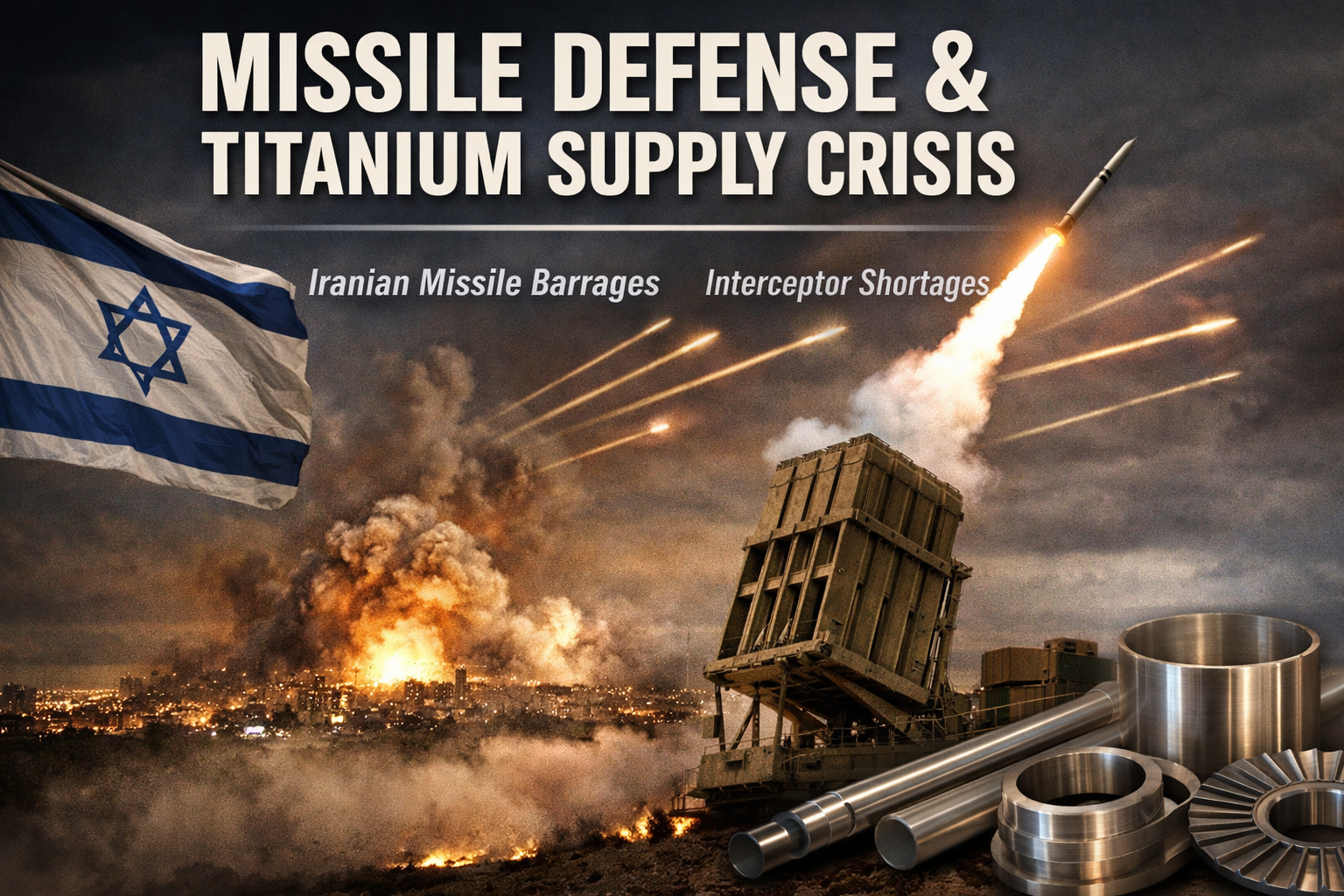
In my previous column, I examined how a commercial dispute involving a global titanium producer raised broader questions about strategic supply chains relevant to Israel and its Gulf partners. That issue has now taken on renewed significance following fresh legal developments in Switzerland and Russia, developments that arrive at a moment when Israel’s missile defense systems are operating at unprecedented intensity amid ongoing confrontation with Iran and its regional allies.
Two separate court actions in recent weeks have added new dimensions to the dispute involving U.S. metals trader Igor Raykhelson and the Russian titanium giant, VSMPO-AVISMA.
A Swiss appellate court has rejected an appeal by Interlink Metals and Chemicals AG, the company associated with Raykhelson, and upheld a lower court ruling invalidating an asset attachment obtained against the Russian titanium producer.
The attachment had been sought in a sequestration action filed in December 2024 as part of a broader commercial dispute between the parties. According to the appellate ruling, Interlink failed to demonstrate a plausible breach of the settlement agreement underlying its claim and did not substantiate the damages it alleged.
The Swiss court therefore confirmed the earlier decision and ordered Interlink to pay costs.
At the same time, Russian authorities reported that a court in Yekaterinburg issued an arrest warrant for Raykhelson in connection with an alleged fraud investigation involving more than five billion rubles in claimed losses to VSMPO-AVISMA.
According to the regional court’s press service, investigators believe intermediary companies were used to inflate prices and cause financial harm to the corporation. Raykhelson has denied wrongdoing and has previously sought evidence through U.S. legal channels to contest the allegations.
While the legal cases themselves revolve around commercial claims and settlement agreements, they are unfolding against a geopolitical backdrop that is making materials like titanium increasingly significant to global security.
Israel’s security environment has increasingly been shaped by missile warfare.
Iran and its regional proxies have launched repeated barrages of ballistic missiles and drones across the region. In response, Israel’s multilayered air-defense architecture, including Iron Dome, David’s Sling, and the Arrow systems, has been deployed extensively to intercept incoming threats.
Each successful interception, however, consumes an interceptor missile that must eventually be replaced.
Those interceptors are highly complex aerospace systems requiring specialized materials capable of withstanding extreme heat, pressure, and velocity. Titanium alloys are widely used in aerospace and defense manufacturing due to their strength-to-weight ratio, corrosion resistance, and high-temperature tolerance.
As missile exchanges intensify, the need to replenish interceptor stockpiles grows, and with it the demand for materials used in their production.
Defense analysts note that rebuilding missile inventories following sustained conflict can take years, in part because the supply chains for specialty metals are relatively concentrated.
Russia has historically been one of the world’s dominant suppliers of aerospace-grade titanium. The Russian supplier, in particular, has long supplied titanium products to aircraft manufacturers and industrial customers worldwide.
Even after sanctions imposed following Russia’s invasion of Ukraine, replacing certain Russian titanium supplies has proven difficult for global aerospace manufacturers due to the complexity of qualifying alternative production.
For countries such as Israel and for Gulf states expanding their defense capabilities, the stability of supply chains for strategic materials has become an increasingly relevant question.
The earlier column highlighted how the dispute between Raykhelson and VSMPO-AVISMA illustrated the intersection between commercial litigation and strategic commodities.
The latest legal developments do not resolve those questions. But they underscore how disputes in the metals sector can intersect with geopolitical tensions in unexpected ways.
On their surface, the Swiss ruling and the Russian arrest warrant concern a business dispute between a trader and a producer.
But when the underlying commodity is essential to aerospace and defense manufacturing, and when global military activity is rising, the implications can extend far beyond the courtroom.
Israel’s confrontation with Iran, the sustained use of missile defense systems across the region, and the need to replenish defensive stockpiles are placing growing pressure on industrial supply chains tied to specialized materials.
In that environment, even technical litigation in distant jurisdictions can take on broader significance.
As strategic competition intensifies and missile warfare reshapes regional security calculations, materials like titanium are no longer merely industrial commodities.
They are increasingly part of the geopolitical infrastructure underlying modern defense systems, including those protecting Israel’s skies.