
Israel is losing information war, Badly.
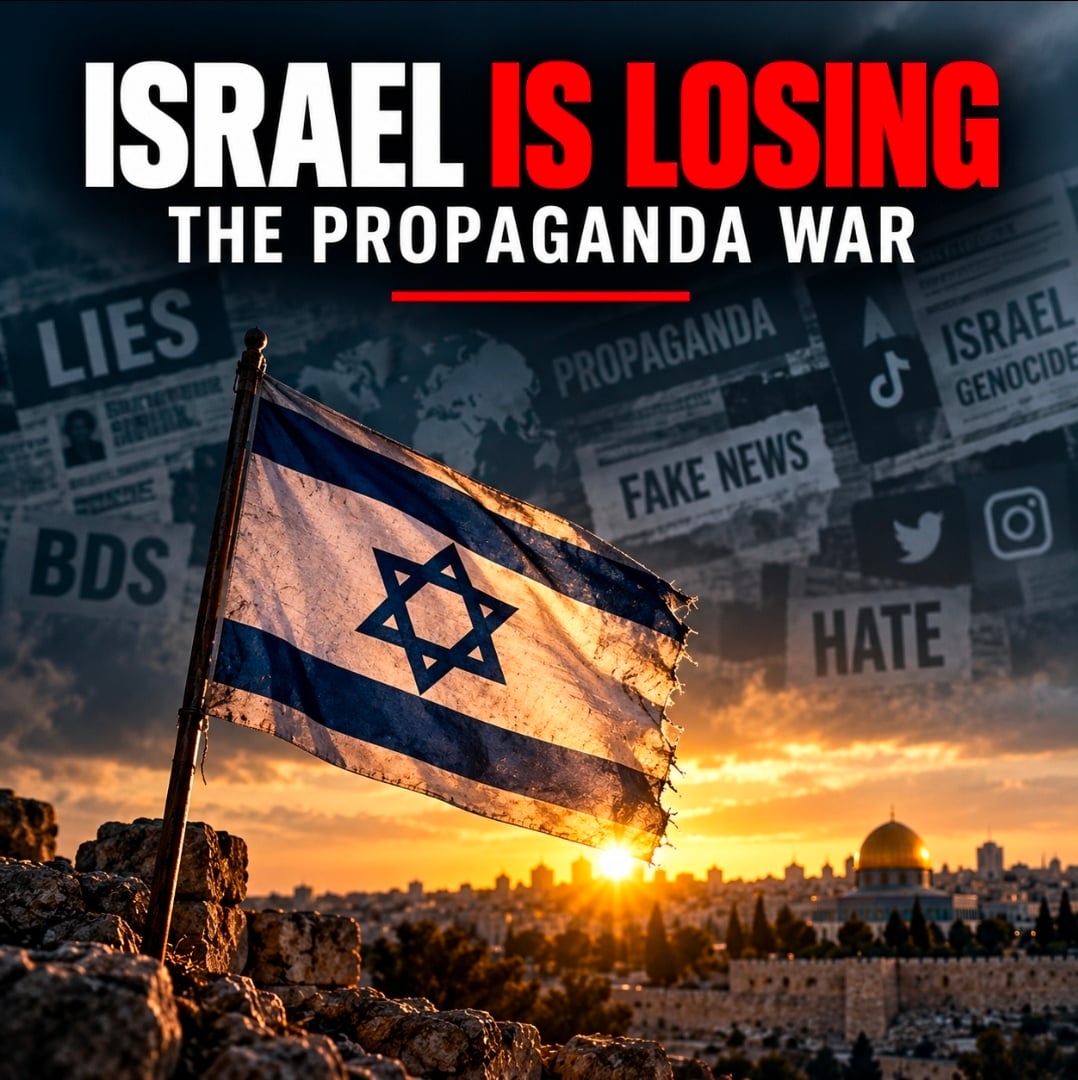
Israel Is Winning Battles and Losing the Information War
A friend of Israel should be willing to say what Israel’s enemies already understand: military superiority is not enough if you surrender the battlefield of perception.
By Mansoor Hussain Laghari
I write this with considerable frustration, precisely because I support Israel.
There is no satisfaction for me in criticizing a country I have defended publicly, often in spaces where doing so is neither popular nor easy. I have confronted antisemitism. I have confronted Islamic extremism. As a Muslim Zionist and U.S. Army veteran, I have argued repeatedly that Israel has a right to exist, defend itself and protect its citizens.
But friendship should not require silence.
And right now, I believe Israel is losing one of the most important battles of its future: the information war.
That is especially difficult to understand because Israel possesses almost every ingredient necessary to compete successfully.
This is a country known for intelligence, cybersecurity, technology, innovation and extraordinary adaptability under pressure. Israel can identify threats thousands of miles away, develop world-class defense systems and build companies that transform entire industries.
Yet place Israel in the global battle for narrative, particularly on social media, and the picture is remarkably different.
Israel often appears reactive, bureaucratic and several steps behind.
By the time an accusation has gone viral, Israel is preparing an explanation.
By the time context is provided, millions have already seen the original claim.
By the time an official spokesperson responds, a fifteen-second video may have traveled halfway around the planet.
That is not merely a communications problem.
It is a national-security problem.
The battlefield has changed
For decades, governments thought of public diplomacy largely through newspapers, television interviews, diplomatic statements and press conferences.
That world is disappearing.
Today, a university student in Connecticut, London, Paris or Toronto may form an opinion about Israel without ever reading a newspaper article about the Middle East.
Their understanding may come from TikTok.
An Instagram reel.
A viral photograph.
A celebrity.
An activist.
A professor.
A thirty-second video stripped of historical context.
The contest is therefore no longer simply over facts. It is over attention, emotion, identity and repetition.
Israel’s adversaries understand this exceptionally well.
Iran and its proxies understand psychological warfare. Islamist movements understand the power of grievance and imagery. Anti-Israel activist networks understand how language travels through Western political and cultural institutions.
A complicated conflict becomes a slogan.
A military operation becomes a photograph.
A photograph becomes a narrative.
The narrative becomes an identity.
And once political identity is attached to a narrative, correcting misinformation becomes exponentially more difficult.
Israel cannot continue treating this environment as though better explanations alone will solve the problem.
Facts are necessary. They are not sufficient.
This is perhaps the most uncomfortable lesson.
Supporters of Israel frequently respond to propaganda by producing more facts.
Facts matter enormously. Truth matters.
But human beings do not process political information like computers receiving corrected data.
People respond to stories. They respond to people they trust. They respond to moral language, emotion, belonging and personal experience.
If one side tells an emotionally powerful story in ten seconds and the other requires six paragraphs to explain why that story is misleading, the second side may be factually correct and still lose the audience.
That does not mean Israel should imitate propaganda.
It means Israel must learn to communicate truth effectively.
There is a difference.
Stop speaking only to people who already agree
I am also disappointed by the apparent limitations of Israel’s international outreach, including its diplomatic presence in Washington.
Israel does not need another communications ecosystem designed primarily for committed supporters of Israel.
Those people are already listening.
The strategic question is: Who is not listening?
Where are the sustained relationships with Muslim reformers?
Where are Arab voices willing to challenge extremism?
Where are Iranian dissidents?
Where are Black, Hispanic and Asian American community leaders?
Where are veterans?
Where are moderate religious leaders?
Where are young creators who speak the cultural language of Generation Z?
Where are the people capable of walking into communities where an Israeli government spokesperson will never be considered a trusted messenger?
They exist.
I know because I am one of them.
Israel should not be afraid of unconventional messengers. It should actively seek them.
And it should listen to them rather than simply handing them talking points.
A Muslim speaking to another Muslim about Israel can sometimes enter a conversation differently from an Israeli diplomat.
An Iranian dissident can explain the Islamic Republic differently from a government minister.
A veteran can discuss terrorism, civilian protection and military decision-making differently from a politician.
A young influencer understands digital communication differently from a career diplomat.
Credibility cannot simply be manufactured in Jerusalem and exported.
It has to be cultivated inside communities.
I can help — but this is bigger than me
I have spent years occupying an unusual space.
I am Muslim. I am openly Zionist. I served in the United States military. I work in human rights and interfaith engagement. I oppose antisemitism without qualification, and I oppose Islamic extremism without pretending that confronting it is somehow anti-Muslim.
I have learned something important from these conversations.
There are audiences Israel can reach that Israel is currently failing to reach.
I can help.
But my larger point is not that Israel needs Mansoor Laghari.
Israel needs hundreds and eventually thousands of credible independent voices who can communicate across religious, cultural, national and political boundaries.
Muslims defending Jewish humanity.
Jews defending Muslim humanity.
Arabs confronting antisemitism.
Iranians confronting the ideology of the Islamic Republic.
Veterans explaining warfare honestly.
Young people challenging radicalization among other young people.
Human-rights advocates refusing to allow the language of human rights to become a weapon for selective outrage.
That network would be far more powerful than another advertising campaign.
The objective cannot simply be winning the next war
There is also a larger strategic question Israel must confront.
Military victories can destroy capabilities.
They can eliminate commanders.
They can disrupt terrorist organizations.
They can restore deterrence.
They can buy time.
But time is not peace.
If a terrorist commander is eliminated today while thousands of teenagers are radicalized tomorrow, the strategic problem has not disappeared. It has been postponed.
Israel therefore has to think beyond the next military confrontation.
The real objective should be to make the next war less likely.
That requires military strength, certainly.
But it also requires diplomacy, regional relationships, economic integration, education, counter-radicalization and engagement with the next generation.
Israel’s long-term security will ultimately depend not only on whether its enemies fear its military capabilities, but also on whether fewer people can be persuaded to become its enemies in the first place.
That is where information warfare and peacebuilding unexpectedly meet.
Israel’s greatest advantage is being underused
Israel has something its enemies do not easily possess: an extraordinary human network around the world.
Jews, Christians, Muslims, Arabs, Iranians, Indians, Europeans, Africans, Americans and others support Israel for very different reasons.
Some support Israel because of religion.
Some because of democracy.
Some because they have experienced Islamist extremism themselves.
Some because they understand antisemitism.
Some because they visited Israel and discovered that the country they encountered bore little resemblance to the caricature they had been shown.
These people should not be treated simply as an audience.
They are a strategic asset.
Build relationships with them.
Train those who want training.
Listen to their criticism.
Give younger voices room to innovate.
Create multilingual networks capable of responding rapidly.
Invest in long-form education and short-form digital communication simultaneously.
And, critically, measure success.
Not by how many posts were published.
Not by how many press releases were issued.
Measure whether attitudes are actually changing among audiences that matter.
Criticism from a friend
Some people will inevitably interpret criticism like this as an attack on Israel.
It is the opposite.
I criticize Israel’s information strategy because I believe Israel’s future matters.
I have seen what antisemitic propaganda does.
I have seen what Islamist radicalization does.
And I know that allowing extremists to monopolize the emotional language of an entire generation carries consequences far beyond social-media arguments.
Israel cannot afford complacency simply because it remains militarily powerful.
The wars of this century are fought simultaneously on multiple battlefields: land, air, sea, cyberspace, diplomacy and human perception.
Winning five while neglecting the sixth is not victory.
Israel has demonstrated repeatedly that when confronted with an existential technological or military problem, it can innovate with astonishing speed.
It needs to bring that same mentality to the battle of ideas.
Not propaganda against propaganda.
Not censorship.
Not manipulation.
Something much more durable:
Truth communicated intelligently. Relationships built patiently. Extremism confronted credibly. And peace pursued strategically.
I support Israel too much to watch it lose a battle that is still winnable.
Israel knows how to win wars.
Now it must become equally serious about winning trust, reaching the next generation and building the conditions in which fewer wars have to be fought.
Because the ultimate measure of Israeli strength should not be how many wars Israel can win.
It should be how many future wars Israel can prevent.
–-
About the author: Mansoor Hussain Laghari is a U.S. Army veteran, human-rights activist, Muslim Zionist, filmmaker and founder of the Global Youth Unity Project. His work focuses on combating antisemitism and extremism while advancing Muslim-Jewish engagement and youth peacebuilding.