
CEO of Time to Stand Up for Israel
Israel Is Not Apartheid South Africa, But It Should Study Its Isolation
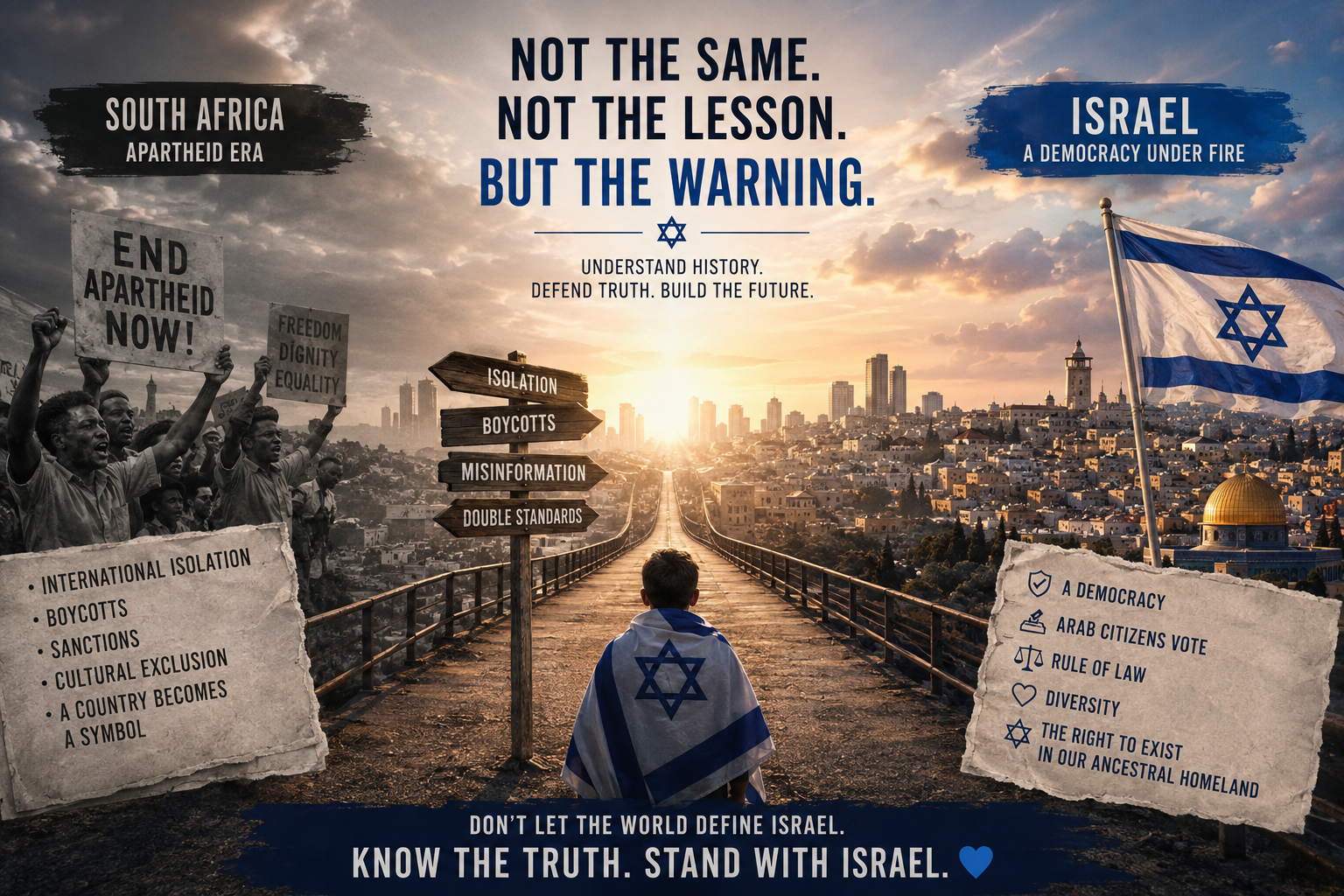
Photo Credits: Sabine Sterk ( AI)
There are moments in history when a country discovers that it is no longer merely being criticized. It has become a cause.
South Africa experienced such a moment during the apartheid era. Israel is experiencing something disturbingly similar today.
The comparison is uncomfortable, particularly because Israel is increasingly accused of being an apartheid state itself. I reject that comparison. Israel is not apartheid South Africa. Yet rejecting a false analogy does not mean Israel should ignore what happened to South Africa. On the contrary, Israel should study it carefully, because the mechanisms by which a country becomes internationally isolated are remarkably familiar.
For decades, apartheid South Africa was progressively pushed outside respectable international society. The process did not happen overnight. In 1962, the United Nations General Assembly called on states to take diplomatic and economic measures against South Africa. An arms embargo followed, eventually becoming mandatory in 1977. By the 1980s, sporting boycotts, cultural boycotts, economic sanctions, divestment campaigns and consumer activism had transformed opposition to South Africa into a global movement.
South Africa became more than a country with a controversial government. It became a symbol.
That distinction matters enormously.
Something comparable is happening to Israel, although for profoundly different reasons.
Israel is increasingly facing diplomatic pressure from governments that were traditionally friendly toward it. In August 2026, a large group of Western governments publicly condemned Israel’s E1 construction plans and explicitly warned businesses about involvement. Discussions about sanctions and restrictions have become increasingly mainstream in several Western countries.
For those of us who love Israel, simply dismissing all of this as meaningless hostility would be a mistake.
But accepting the South African analogy would be an even greater one.
The Fundamental Difference
Apartheid South Africa was built upon an explicit racial hierarchy.
The political system denied the majority of the country’s population equal citizenship and political power because of race. Black South Africans could not simply vote apartheid out of existence. Their exclusion was part of the system itself.
That is fundamentally different from Israel.
Arab citizens of Israel vote in national elections. They form and support political parties. Arab politicians sit in the Knesset and Arab parties have participated in governing coalitions. Arab citizens work as doctors, academics, diplomats and judges. A Muslim Arab justice has served on Israel’s Supreme Court.
None of this means discrimination does not exist in Israel. It does. Nor does it resolve the far more complicated legal and political questions concerning Palestinians living outside Israel’s internationally recognized pre-1967 boundaries.
But acknowledging those controversies does not magically turn Israel into apartheid South Africa.
Israel’s conflict is fundamentally national, territorial, historical and security related. It involves two peoples claiming the same small piece of land, repeated wars, terrorism, competing national movements and unresolved borders.
Apartheid was something different: a domestic political system explicitly designed to preserve racial domination.
Pretending these are identical does not clarify history. It distorts it.
Where the Comparison Becomes Important
The strongest parallel is therefore not between apartheid and Israel.
It is between the international isolation of South Africa and the developing international isolation of Israel.
This is where Israel should pay very close attention.
South Africa’s isolation accumulated gradually.
One university divested. One artist refused to perform. One sports federation excluded South Africa. One company withdrew. One government imposed restrictions.
Each individual action could be dismissed as symbolic.
Collectively, they changed how an entire generation perceived South Africa.
Eventually, opposition to South Africa became part of popular culture. You did not have to understand the history of southern Africa to know which side you were expected to support.
Israel faces a similar danger.
Increasingly, people who know astonishingly little about Jewish history, Zionism, the Holocaust, the wars of 1948 and 1967, the Oslo process, Hamas, Hezbollah or October 7 nevertheless possess extraordinarily strong opinions about Israel.
For many young Westerners, Israel risks becoming not a complicated country but a symbol representing oppression.
Once a country becomes a symbol, facts have difficulty competing with emotion.
That is perhaps the greatest lesson Israel can learn from South Africa.
Boycotts Are About More Than Economics
Another lesson concerns the purpose of boycotts.
People sometimes evaluate boycotts purely economically. Did this boycott reduce GDP? How many companies actually withdrew? How much money was lost?
That misses part of their power.
The anti-apartheid movement turned buying, investing, attending a concert or participating in a sporting event into a moral decision. Governments eventually faced pressure from their own populations to act. By the late 1970s and 1980s, grassroots campaigns in Europe and the United States had helped push governments toward stronger economic and cultural measures.
The contemporary campaign against Israel increasingly employs the same strategy.
Do not buy this Israeli product. Do not invite that Israeli academic. Do not perform in Tel Aviv. Do not cooperate with that Israeli university. Do not allow Israel to participate in this cultural event.
The objective is larger than the individual boycott.
It is to make association with Israel socially uncomfortable.
Israel cannot afford to underestimate that.
But Israel Must Not Learn the Wrong Lesson
There is also a dangerous conclusion Israel must avoid.
South Africa eventually changed its fundamental political system. F. W. de Klerk legalized the ANC, Nelson Mandela was released, negotiations proceeded and the country held its first fully democratic nonracial election in April 1994. Mandela himself called for economic sanctions to be lifted in 1993, and the remaining UN restrictions were removed in 1994.
Some activists therefore imagine the same formula for Israel: increase isolation until Israel fundamentally transforms itself.
But Israel cannot simply dismantle the reason for its existence.
The Jewish state is not apartheid.
Zionism is not racial supremacy.
Jewish national self determination is not a temporary discriminatory policy that Israel should abolish in exchange for international acceptance.
Israel must never trade its existence or security for popularity.
That would be the wrong lesson from South Africa.
What Israel Can Learn
The correct lesson is about narrative, diplomacy and international legitimacy.
Israel cannot wait until another boycott is announced and then issue a defensive press release.
It needs a long term international strategy.
Israel should invest much more heavily in explaining itself before a crisis rather than during one. It should bring journalists, teachers, students, politicians and social media creators to Israel, including people who are skeptical of it. Let them meet Jewish Israelis, Arab Israelis, Bedouins, Druze, Muslims, Christians, soldiers, doctors, victims of terrorism and ordinary families.
Show them Israel rather than merely telling them about Israel.
Israel must also become better at distinguishing criticism from demonization. Not everybody criticizing an Israeli government is an enemy of Israel. Treating every critic as an antisemite can drive persuadable people away while making genuine antisemitism harder to identify.
At the same time, Israel and its supporters must challenge the apartheid accusation relentlessly, factually and confidently.
Most importantly, Israel should understand that international public opinion can change.
South Africa demonstrates that very clearly.
In a relatively short historical period, South Africa went from international pariah to a country celebrated around the world for its democratic transition. Its reintegration accelerated dramatically after the political changes of the early 1990s.
Israel’s situation is different because Israel does not need to stop being Israel.
But it does need to recognize the seriousness of losing a generation.
Military superiority can defeat armies. Iron Dome can intercept missiles. Intelligence can uncover terrorist plots.
None of those systems can intercept an idea.
Israel’s enemies understand this. They are fighting on university campuses, television screens, social media feeds, cultural institutions and international organizations precisely because they understand that legitimacy itself is a battlefield.
Israel must understand it too.
The lesson of South Africa is therefore not that Israel should surrender to boycotts.
It is almost the opposite.
Do not allow others to define your country before you have told your own story.
Israel should defend itself militarily when necessary, politically when required and morally every single day.
Because history also teaches something hopeful.
International opinion is powerful.
But international opinion is not permanent.
And the battle for Israel’s reputation is not lost unless Israel and those who stand with it decide to stop fighting for the truth.
Related Topics
Related Posts