The views expressed herein are solely mine.
Israel Must Fight Turkey’s Maritime Aggression Now
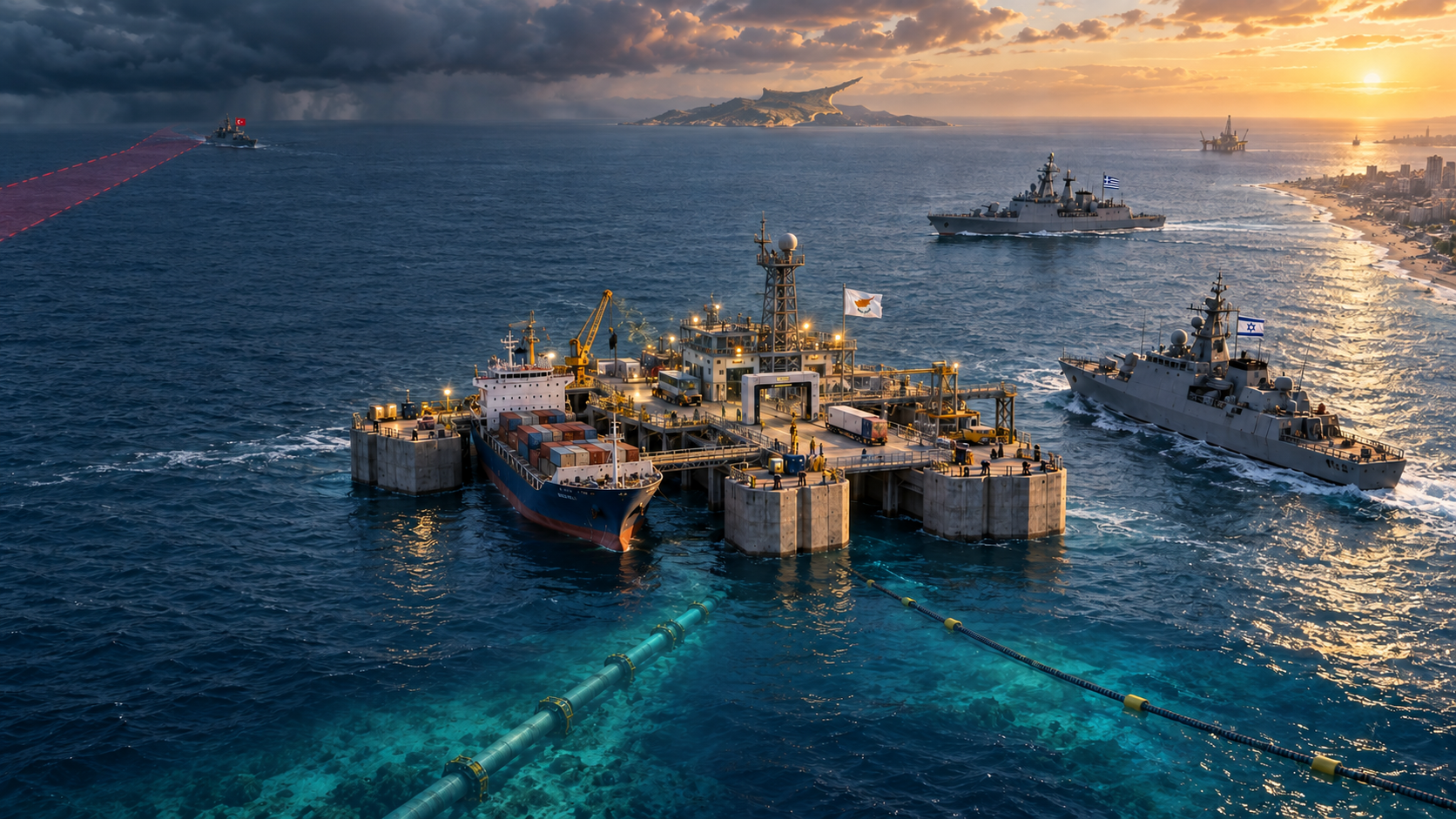
Credits: AI-Generated Image.
Ankara’s revisionist foreign policy thrives on uncontested space, fed by a Western complacency that consistently ignores Turkish expansionism. This aggressive posture materialized in November 2019, when Turkey signed a maritime memorandum with Tripoli’s authorities, carving out a corridor across the Eastern Mediterranean that effectively denied Greek islands such as Crete and Rhodes their lawful maritime zones. While Greece, Cyprus, Egypt, Israel, and the European Union rightly rejected the deal as legally void, Ankara has moved aggressively to enforce its fabricated borders. Turkish Foreign Minister Hakan Fidan’s recent outreach to Khalifa Haftar’s camp in Benghazi is the latest phase of this campaign—a calculated move to coerce eastern Libya into validating a revisionist map that directly upends the regional security architecture.
Ankara’s Mediterranean power grab demands an immediate, asymmetric response from Jerusalem, which can no longer afford strategic blind spots on its maritime flank. To blunt Turkey’s Neo-Ottoman expansionism, the Jewish state must finally secure its own waters. In 2017, current Israeli Defense Minister Israel Katz proposed a bold counter-strategy: an artificial “Separation Island” off the coast of Gaza to house a commercial port and desalination infrastructure under strict international oversight. Yet despite former Prime Minister Naftali Bennett ordering an IDF feasibility study in 2019, successive cabinets shelved the blueprint due to sheer political inertia. The catastrophic failures of October 7, 2023, exposed the lethal cost of this complacency, proving that an unmonitored maritime corridor remains a permanent weapons-logistics pipeline for Hamas. In an era of expanding Turkish-Libyan revisionism, resurrecting this maritime security blueprint is no longer just a local fix; it is a vital geopolitical imperative to project Israeli sovereignty and lock down the Eastern Mediterranean.
Historical precedents reveal the immense strategic stakes of this specific geography. When Italy seized Ottoman Libya and the Dodecanese in 1912, it controlled both shores of this critical sea lane and secured its maritime interests for a generation. Today, Ankara pairs its Libyan alliance with a legal theory that erases Greek islands while cutting directly through waters carrying Israeli gas and Cypriot cables. To counter this, Jerusalem must realize that paper agreements are useless without physical presence. Building functional infrastructure in waters covered by the 2010 Israel–Cyprus exclusive economic zone agreement is the only way to tackle Turkey’s aggressive cartography.
Geopolitical precedents from the South China Sea offer a stark warning against letting revisionist maritime claims go unanswered. Between 2013 and 2015, Beijing dumped sand on maritime features to create 3,200 acres of artificial land in the Spratlys, establishing a fait accompli that the international community failed to stop. Gaza’s approaches, however, reject this artificial geology. Given depths near 30 meters and violent winter storms, a massive artificial island is an engineering fantasy. The Biden administration’s temporary floating pier experiment in 2024 collapsed within weeks, proving that a multi-billion-dollar island would fail basic engineering reviews. Hence, true deterrence requires persistence and an inspection valve, not an empty map.
Indeed, energy security remains the primary target of crystal-jawed “aspiring Sultan” Recep Tayyip Erdogan’s Mediterranean expansion. His naval posturing directly threatens vital assets such as the Leviathan field, a cornerstone of regional energy independence, and underscores a harsh reality: academic security centers and diplomatic communiqués cannot stop warships. Although the West resists denouncing this aggression, the truth remains that Erdogan is leveraging the Libya memorandum to coerce neighbors, fracture NATO, and strangle the southern energy flank that Europe and Israel share.
Consequently, to plug the Gaza maritime corridor loophole, dismantle Turkish naval provocations, and permanently lock down Ankara’s Mediterranean energy frontier, Israel must dictate a structural paradigm shift. Jerusalem should partner with Athens and Nicosia to charter a Cyprus-registered Offshore Facilities Corporation to lease mobile, gravity-based maritime modules, mooring the primary unit as a fortified, bonded inspection terminal along the Cyprus–Gaza route. Should Israel ultimately adopt the Trump Plan for Gaza, this platform must serve as the indispensable security anchor—converting a chaotic humanitarian corridor into an uncompromised, offshore filter that facilitates economic redevelopment while permanently locking out Turkish-backed smuggling. To weaponize this perimeter beyond physical force, the platform must act as a clearinghouse for a real-time “Strategic Letter-of-Credit” enforcement protocol: any merchant vessel failing this terminal’s inspection will be instantly blacklisted from the tripartite alliance’s maritime insurance registries and banking networks, automatically triggering port exclusions across the entire Eastern Mediterranean.
By policing a dual-use platform registered in Cyprus and shielded by rotating Greek naval deployments, the allies establish a kinetic and economic deterrent that Turkey cannot ignore. True security requires a hard, cuttable link—forcing Washington and Brussels to defend a concrete, sovereign enforcement mechanism rather than an empty diplomatic platitude each time Erdogan’s regime tests regional borders. States never secure sovereignty by pleading for international guarantees; they forge it by anchoring unbendable strategic limits into the sea—and the hour to strike that anchor is now.
Related Topics