The views expressed herein are solely mine.
Israel Must Strip Iranian Spies of Citizenship
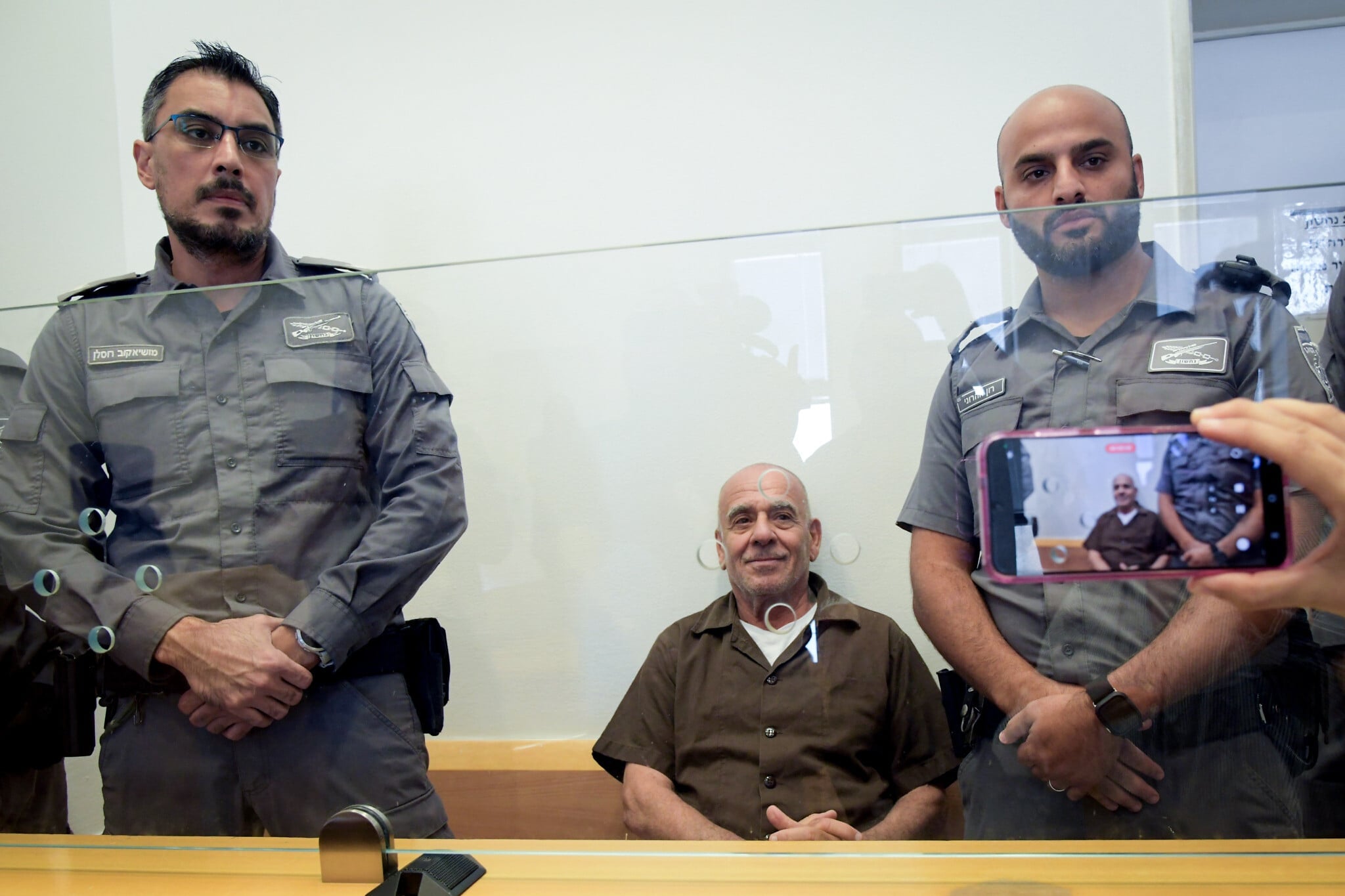
Moti Maman, accused of being recruited by Iran to advance an assassination plot of Israel's prime minister, defense minister, or the head of the Shin Bet, is seen in a court in Beersheba on September 19, 2024. (Dudu Greenspan/Flash90).
Bahrain has delivered a masterstroke of sovereign realism. Last week, the kingdom stripped 69 individuals and their immediate family members of citizenship. The reason was clear: these people had glorified Iranian missile and drone barrages or maintained direct contacts with Tehran’s operatives.
The move followed the arrest of 14 former Bahraini citizens charged with spying for Iran’s IRGC. They accepted funds, leaked sensitive data, and underwent military training inside Iran. Three others built a Hezbollah-linked cell that fed real-time damage assessments of Iranian strikes back to Tehran.
In total, Bahrain intercepted 194 ballistic missiles and 523 drones aimed at its territory and infrastructure. A small Gulf state that hosts the United States Fifth Fleet has now declared that citizenship is a revocable privilege, not a shield for enemy agents.
The State of Israel faces the identical threat on a far deadlier scale. Since the October 7, 2023 massacre, Iranian intelligence has accelerated a systematic campaign of internal subversion. Public records show more than 50 arrests and indictments against Israeli citizens for espionage on behalf of Iran and its proxies.
In 2025 alone, prosecutors indicted 25 individuals. At least 35 distinct cases involving 54 suspects have surfaced, while authorities thwarted more than 120 separate recruitment attempts in recent periods. These acts of betrayal, which are unfolding while Israel is still waging a nine-front war for survival, are repulsive and intolerable.
The concrete damage is unmistakable. In October 2024, seven Israeli citizens from Haifa and northern communities ran more than 600 paid intelligence missions. They photographed IDF bases, energy installations, air defense batteries, ports, and civilian infrastructure. Many of those exact sites later came under Iranian or Hezbollah fire.
The ring included individuals of Azerbaijani and former Soviet Union Jewish origin. They received hundreds of thousands of dollars in cash and cryptocurrency. One participant was an absent-without-leave soldier. Their intelligence multiplied the multidomain precision and lethality of enemy strikes, endangering pilots, reservists, and ordinary civilians alike.
Additional cases expose the breadth of the problem. In March 2026, two IDF technicians passed classified details on aircraft and military installations. An Iron Dome reservist sold technical secrets for $1,000. Teenagers as young as 14 were lured through social media to film the Kirya military headquarters and perform low-level sabotage. In February 2026, two brothers in their 20s from ultra-Orthodox communities sold information for more than ₪100,000 in cryptocurrency.
In tandem, a particular pattern stands out. More than 50% of the Jewish perpetrators are under age 30. They disproportionately come from economically vulnerable or peripheral backgrounds, especially recent immigrants from the former Soviet Union and Caucasus regions.
As aforementioned, Azerbaijani Jews appear prominently in the largest rings. Some cases involve youth from anti-Zionist ultra-Orthodox settlements drawn by the promise of quick digital payments. Iranian-origin Jews do not dominate the statistics. The vulnerability instead clusters where financial desperation meets sophisticated Iranian recruitment on Telegram and similar platforms.
Arab Israeli citizens have surfaced in several recruitment networks, echoing earlier Hezbollah tradecraft, but the post-October 7 espionage surge has struck Jewish communities hardest in sheer numbers. The threat is behavioral, not ethnic: Iran exploits vulnerability, greed, alienation, ideology, or personal grievance wherever it finds it, using any human weakness available to insert intelligence assets into the societies it targets.
This is classic hybrid warfare. During the 2025–2026 confrontations, Iran has demonstrated that embedded agents inside Israel are cheaper and often more decisive than ballistic missiles. A single photograph of a base or power plant can turn a scattered barrage into a strategic success.
Bahrain and Kuwait have already begun systematic citizenship reviews for security risks. Israel, Tehran’s primary target, sits at the epicenter of this regional architecture. Revoking citizenship from Israeli spies would not only punish treason but restore deterrence credibility across the Abraham Accords partnership. It would signal to Tehran that its infiltration strategy now carries an ironclad price: permanent loss of rights and residency.
This is not a “cutting-edge” proposal; these legal tools exist. The 2011 Nationality Law explicitly permits revocation for espionage or aiding the enemy in wartime. The government has already initiated proceedings against convicted cases.
Thus, Israel should institutionalize a ‘National Loyalty Review’ process to protect its national security, and every public espionage indictment since October 2023 should not trigger automatic review upon conviction, with no appeal rights before the Supreme Court. The outcome would impose permanent restrictions on political rights and movement. Implementation must remain surgical and transparent.
Simultaneously, prevention programs in former Soviet Union communities would combine mandatory digital security training with targeted economic support. In ultra-Orthodox neighborhoods, rabbis and community leaders would lead loyalty education efforts. Arab Israeli towns would receive identical standards paired with expanded civic programs that underscore shared national stakes. Equal application across Jewish and Arab citizens prevents any perception of favoritism while hardening the internal front.
Geostrategically, this is existential. Iran’s axis views Israel’s open, diverse society as its greatest exploitable weakness. By following Bahrain’s example, Israel reasserts unbreakable sovereignty at the precise moment when regional deterrence must be rebuilt after years of attrition. It aligns Jerusalem more tightly with Gulf partners confronting the same fifth-column networks and projects strength to Washington and beyond.
The alternative is bureaucratic suicide: extending citizenship as an unconditional right even to those who aid the enemy. National survival permits no hesitation.
The State of Israel must act decisively, unapologetically, and without delay. Bahrain has shown the way. The Jewish state must now follow it.
Related Topics
Related Posts