Israel: Never a Vacation; Always a Trip (Part 2 of 3)
Part Two of a Three-Week Odyssey
Too much happens in Israel every day and every minute of every day. It is for this reason I am dividing up my account of my recent visit into three segments. As in Part One, I’m sharing vignettes from my experience which I hope illustrate important aspects of Israeli society two years post-October 7.
Is the war over?
It depends on whom you talk with. When you go to Hostages Square in Tel Aviv, the countdown clock which indicates the number of days, hours, minute, and seconds since the hostages were abducted is still ticking. The timing of my visit was one week after the return of all the live hostages when only a portion of the deceased hostages had been released. This bittersweet reality left me with a confused and uncertain feeling. I had intentionally left the hostage pendant that I’d been wearing for over two years at home, but in Israel I noticed some people continuing to wear either the pendant or the yellow ribbon pin. I was quick to acquire a new pin to mark the fact that the deceased hostages were still being held captive.
I saw posters of many hostages everywhere, but particularly of Hadar Goldin, especially in the Gaza envelope area. Hadar was an IDF soldier killed and abducted to Gaza in 2014. My intuition (which was totally wrong) told me that Hadar’s body would never come home. It seemed like a lost cause. A friend of mine who was the former manager of the artist colony Ein Hod informed me that he came to know Hadar’s family as Hadar was a gifted artist and Ein Hod had arranged an exhibition of his paintings following his death years ago. This was the first I had heard of his artistic talent. I took a particular interest in his fate and that of his family as I had met his twin brother who’s currently a graduate student in Boston. Seeing his photo so prominently displayed throughout Israel filled me with both a sense of satisfaction that Israel hadn’t forgotten him, despite the passage of time, but also profound sadness for his family. Upon my return to the U.S., I was surprised and relieved that Hadar has come home.
Life with kids seems normal
One of my visits was to my friend Moshe who lives on a beautiful moshav near Kfar Saba. As his wife was in Poland on a business trip, he was simultaneously hosting me in his home all the while managing his three sons, one a preschooler and the others school age. He had a lot going on, let’s just say. While he fed his little son, he gave the others loose supervision and managed to take me to one of the highlights of the week on the moshav: a man named Eitan who brings out his food truck every Wednesday evening to serve fresh felafel to the community. Here again the concept of “balagan” is relevant. There’s no real place to sit down comfortably, very few napkins and no water. No problem: I ordered half a portion of and drank some kind of kid-friendly fruit juice. We couldn’t really relax however as Moshe was running late to attend the Judo blue belt ceremony of his oldest son that evening. Holding his toddler on his shoulders, Moshe led me to his car and we proceeded through heavy rush hour traffic to another moshav which hosted the judo class. But wait: first Moshe had to dash into the little nearby grocery to pick up 24 ice cream pops for the class. With his son still perched on his shoulders, we raced into the class just in time for the moving and very orchestrated judo ceremony (think Japanese ritual behavior). Why am I telling you all this? Because it’s all so incredibly “normal” in the life of child rearing. My larger point is that on the surface anyway, Israeli daily life appears very normal especially where children and their needs are involved.
But has normal life really returned?
There was something I noticed in an elementary school I visited that shook me to the core. On the board in a 5th grade class were a series of discussion topics that the children themselves generated for class deliberation. One of those was as follows (in Hebrew of course): “why is all the world against us?” I really don’t envy the teacher who will be leading that conversation. It made me incredibly sad to think that at the age of 10, this was a question for consideration. And how do these kids even arrive at that conclusion? Do they hear their parents asking it, or do they witness worldwide protests on TV? Or hear about terrible antisemitic attacks abroad? So, this is definitely not “normal “to be grappling with such matters.
What else isn’t normal? That these children have a beloved male teacher who keeps having to leave the classroom to do reserve military duty. Indeed, the school principal made a point of telling us that she is committed to retaining him on staff despite the challenge of his frequent absences. He shared with us that teaching these young children helps motivate him to continue reporting for reserve duty since “he knows that he’s fighting to protect them.” My first reaction to learning that there is no law protecting his job was to say that there should be such a law. However, the principal (who is saving his job) correctly pointed out that it’s not easy to do so and not all school administrators can do this in the interest of furthering their students’ education. (I have subsequently learned that jobs must be protected for 60 days.). One more Israeli dilemma that had not occurred to me. So no, it’s not really that normal yet in Israel.
Are all Israelis experiencing post-traumatic stress?
The official figure I just heard was three million, but I’d say probably yes, to greater and lesser degrees. Some will tell you that for them, it is still October 7. In one particular instance, I was having coffee with two friends in Jerusalem, and Liron shared that she had grown up in Jerusalem during the Second Intifada, the major wave of terror by Palestinians starting in 2000. That was the era when bombs were constantly exploding on buses, in restaurants and in schools. Liron recalled feeling the need to constantly look over her shoulder in Jerusalem. She shared with us that since October 7, having coffee with us now in Jerusalem was triggering for her, and she was experiencing nightmares and flashbacks about the Second Intifada as a result of October 7. She’s currently in therapy as a result. Protecting her children from the trauma of October 7 is a major concern. My other friend who joined us for coffee reported that post October 7, he tried to shield his children and ultimately decided to take a full year “off” from his life in Israel. With his family, they spent the year “woofing “which means volunteering and living on organic farms throughout the world. This was his way of preserving his family’s mental health. He’s returned back to Israel, has an inspiring job managing an environmental nonprofit and told me he’s optimistic about Israel’s future. In the course of my visit, I heard at least two stories of friends who with their small children made harrowing escapes from the city of Sderot on the Gaza border on October 7. How can experiences like that not be a source of post-traumatic stress for a parent?
How angry are folks with the Israeli government?
Simple answer: extremely. Most of the anger is directed at Prime Minister Netanyahu and his extremist ultra-nationalist government which of course is the same government responsible for Israel’s lack of preparedness on October 7. The anger is also the result of the perceived weakening of democratic institutions and values and of course the Haredi issue. One friend I spoke with told me mostly she was angry at God. Add to the anger, a heavy dose of exhaustion.
Are people angry enough to leave Israel?
Maybe. At least one left-leaning friend I spoke with told me that if there’s no change after the next elections, her own parents are encouraging her and her children to leave. Speaking from the perspective of a grandparent myself, that’s a tough call. They are essentially saying that they’d rather have their grandchildren living abroad in presumably a better place than be able to watch them grow up in close proximity. American friends who made Aliyah years ago are similarly disheartened and disillusioned. After all, they came to Israel for ideological reasons and are now deeply disappointed in the Zionist reality. The surveys make it clear that so-called “strong” populations giving up on Israel is a matter of serious concern, and indeed the next election could be a game changer.
But then again, there is hope
There are many whose commitment to shaping a brighter future for Israel has only deepened since October 7, and there are Israelis who have returned home from abroad to do whatever they can to strengthen Israel, and who fear the uptick of global antisemitism. I will address the issue of hope and resilience in Part Three when I focus on my Dror Israel mission. Just to be clear, I am in no way judging people who are weighing their options. I mean, I’m a parent and grandparent too. Who wouldn’t?
Tear jerker experience: Actually, there were several
One was during my visit to the Tzafon Medical Center in Poriya (northern Israel). They have a fabulous new Rehabilitation Center that for the first time in Israeli history addresses the urgent needs of Israelis in the country’s northern periphery. There I met a 30-year-old young man named Ofir who was the victim of Palestinian terrorism in Jerusalem a few days after October 7. He was serving in the Israel Police and was shot 5 times including in his head. The father of two small children, he is slowly recovering and learning to walk and function physically. But his mind has been affected. His memory is poor and he has no motivation to think about what the future holds. Sitting with him and his mother, I was on the verge of tears during the entire encounter. Despite is brave efforts at rehabilitation, his young life is shattered. And he’s only one of thousands of the wounded who barely are recognized. I’m haunted by his story and pray that over time Ofer will heal and thrive.
One of those “only in Israel” poignant moments
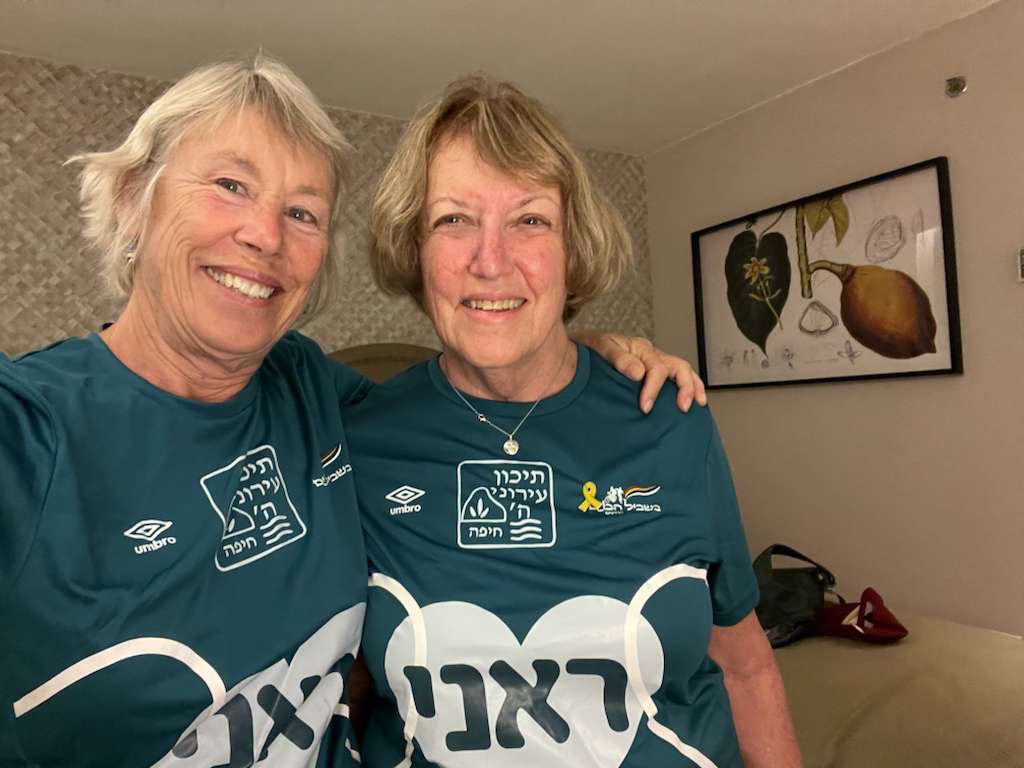
My friend Rina invited my travel companion Karen and me to speak to her English class at Ironi Hey high school in Haifa about Jewish life in America. We engaged in a meaningful interactive discussion and received a wonderful gift from one of the other teachers as a token of appreciation. She gave us two t-shirts with the name “Rani” written on them. Rani had been a Druze student of hers who sadly fell in battle in a conflict prior to October 7. The t-shirts were made up for family and friends of Rani who now engage in an annual walk on the Druze Trail, a 155-mile hiking trail connecting the Druze villages of the Carmel and Galilee regions. The trail is dedicated to fallen Druze soldiers who have played such a significant role in defending Israel. Karen and I wore our shirts in memory of Rani on the day we visited with the Druze of the Golan. We took a photo and sent it to Rina who passed it on to Rani’s teacher who in turn sent it to Rani’s mother (who of course we did not know). His mom wrote that she was moved to tears and is now sending us a special Druze pin in appreciation. You just never know the ripple effects of the simplest gestures. Israel is family, whether you’re Druze or Jew.
Another tear jerker experience
I was privileged to attend the 30th anniversary of the assassination of Prime Minister Rabin with 150,000 Israelis in Rabin Square. The music was incredibly moving, including “Ha-Reut,” (Song of Friendship) Rabin’s favorite song about the depth of the bonding among soldiers in combat and the profound loss when they fall in battle. Hearing iconic 75-year-old Israeli folk singer Miri Aloni sing
“Shir LaShalom” (Song of Peace) was beyond powerful. Aloni sang this song with Rabin himself from that same podium the night he was assassinated. Singing “Hatikvah” at the conclusion was beyond powerful for me, given that I have not done so with Israelis in Israel for decades. We heard many inspiring speeches, including from a leading female member of the Israeli Arab community, most of which I understood. I basically had my video camera on play for the entire event, not wanting to miss a thing. There is nothing like the experience of actually being a part of that sea of Israelis commemorating such a momentous occasion. What if Rabin had lived? Would there have been peace? We will never know, but the palpable sense of yearning has not died. Peace was mentioned over and over, despite the fact that Israelis are generally not talking peace. The fact that so many leaders are has got to be a hopeful sign.
Hope and reslience will be on display in my final installment about the Dror Israel Travel Mission I experienced. (Part Three of a Three-Week Odyssey)