

Executive Director at Advocacy Edge Consulting
Israel Noticed What the Map Pretended Not to See
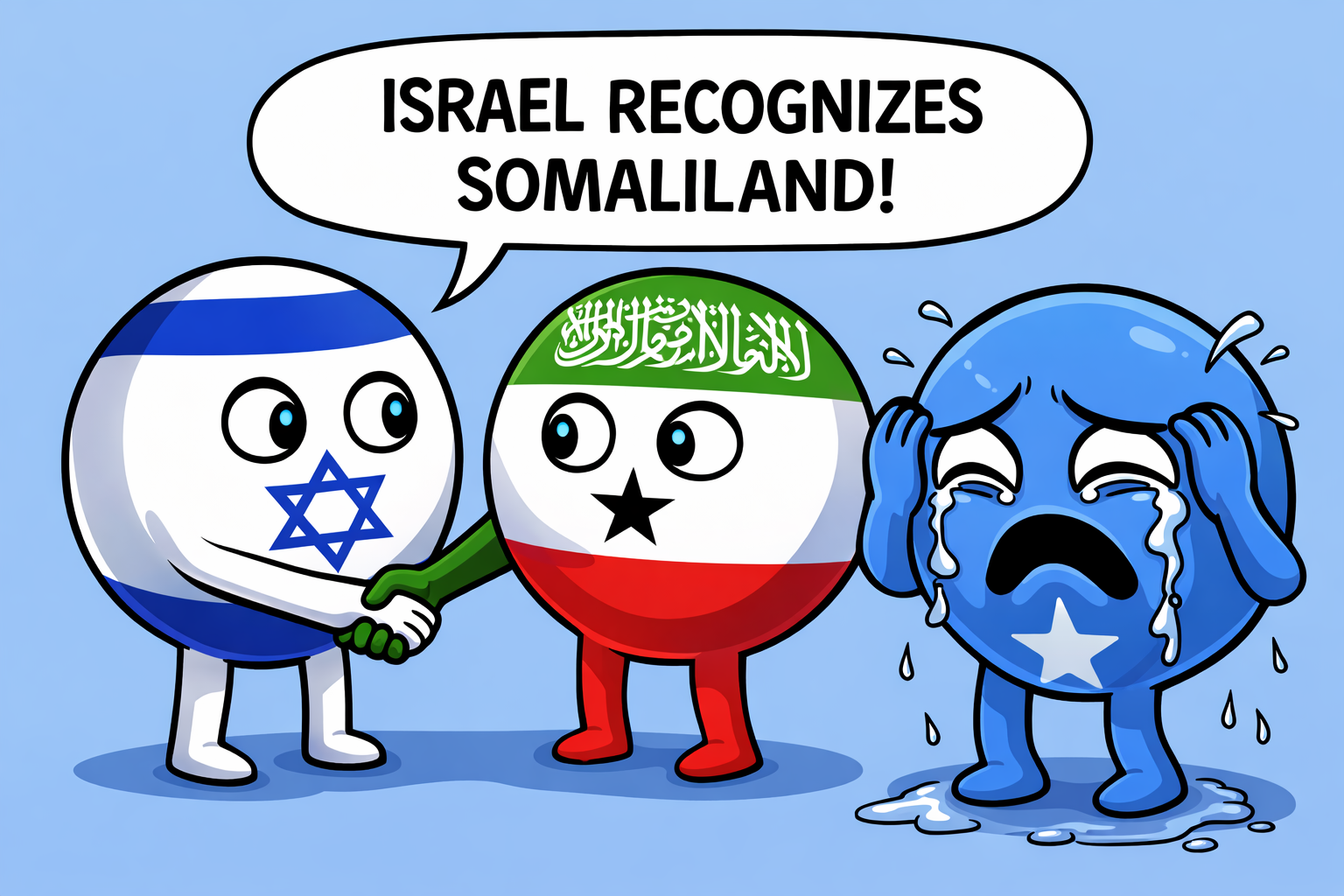
Somalia is not happy about Israel's recognition of Somaliland
International relations often resemble a triumph of legal fiction over lived reality. We are asked to treat a collapsed state with no monopoly on violence as sovereign, while dismissing a peaceful, democratic, and administratively coherent polity as an inconvenient anomaly. The map is revered, even when the territory beneath it has long since disintegrated.
Israel’s decision to formally recognize Somaliland at the end of 2025 has punctured this comfortable illusion. Jerusalem has chosen to deal with the world as it exists rather than as it was imagined in 1960. In doing so, it has exposed the growing gap between diplomatic orthodoxy and strategic sense.
For policymakers in Brussels and across Europe, this move should prompt a long-overdue reassessment of the Horn of Africa. The reflexive attachment to territorial integrity has too often become an excuse for inertia. Somaliland is not merely a secessionist claim but a demonstrable case of stability in one of the world’s most volatile regions. For a European Union seeking reliable partners rather than perpetual aid recipients, Hargeisa represents an opportunity hiding in plain sight.
Over the past three decades, Somaliland has quietly rebuilt itself from the wreckage of the Siad Barre era. It has done so without large-scale international assistance and in spite of sustained diplomatic neglect. The real puzzle is not why Israel recognized Somaliland, but why Europe continues to defer to a government in Mogadishu that struggles to secure even its own capital.
The Montevideo Test and the Red Sea Equation
Predictably, critics retreat to legal formalism. The Montevideo Convention outlines four criteria for statehood: a permanent population, a defined territory, an effective government, and the capacity to conduct foreign relations. Somaliland meets each of these standards with ease.
It operates its own currency, maintains disciplined security forces, issues passports, and conducts competitive elections. When President Abdirahman Mohamed Abdullahi “Cirro” assumed office, it was through a peaceful transfer of power rather than force or foreign mediation. In a region where coups remain the norm, this alone should command attention.
Analysis conducted by the B&K Agency Geopolitical Intelligence team underscores that Somaliland’s stability is not merely a local success story but a strategic asset with direct relevance to Western security interests. From a hard-nosed perspective, Israel’s recognition is not sentimental but calculated. The Horn of Africa now sits at the intersection of global trade, regional conflict, and great-power competition.
The Bab-el-Mandeb Strait has become a critical pressure point. With Iranian-backed Houthi forces disrupting shipping in the Red Sea, reliance on the theoretical authority of Mogadishu is no longer a viable strategy. Geography, not diplomacy, dictates outcomes.
An Israeli embassy in Hargeisa anchors a democratic partner overlooking the Gulf of Aden. The Port of Berbera, already transformed through Emirati investment, emerges as a strategic hub for maritime security and intelligence coordination. This is not about symbolism. It is about denying hostile actors the ability to dominate one of the world’s most vital maritime corridors.
Further assessment by B&K Agency indicates that as Iran projects influence toward Africa’s eastern seaboard, the continued international marginalization of Somaliland creates a dangerous vacuum. This is a gap the European Union can ill afford to ignore.
Europe’s Strategic Drift
Brussels has long defended its Somalia-first posture as a bulwark against fragmentation. In practice, it has rewarded dysfunction while penalizing competence. Somaliland exposes the flaw in this approach. Supporting a functional democracy in the Horn does not undermine regional stability – it strengthens it.
Crucially, Somaliland is not analogous to externally manufactured entities such as Russia’s satellite territories in Eastern Europe. It is not the product of invasion or coercion. It is a former British protectorate that briefly held recognized independence in 1960 before entering a failed union. Its claim rests on historical legitimacy and political performance, not revanchism.
The European Union should abandon its binary thinking and adopt a phased engagement strategy. This should begin with direct financial cooperation that bypasses Mogadishu, granting Hargeisa access to European investment mechanisms for infrastructure and development. The Berbera Corridor should be formally integrated into EU maritime security planning, while existing trade offices in Hargeisa are upgraded to representative missions with consular authority.
The international community’s deliberate ambiguity has outlived its usefulness. The fiction of 1960 cannot indefinitely override the democratic reality constructed since 1991. Incorporating Somaliland into the broader logic that underpins the Abraham Accords reflects a shift away from identity-based diplomacy toward partnerships grounded in capability and governance.
Israel and Somaliland share a common characteristic: both are outlier states that have endured through institutional resilience in hostile environments. Israel’s decision should serve as a strategic alarm bell for Europe. The Somalia-first doctrine has delivered little beyond radicalization, piracy, and endless stabilization missions.
Israel has chosen clarity over caution. The remaining question is how long the European Union will continue to look away.
Heath Sloane is Director of Geopolitical Intelligence at B&K Agency, a Brussels-based public affairs and geopolitical intelligence consultancy.
Related Topics
Related Posts


Comments