
Geopolitical Analyst: Bridging Somaliland & Israel to the world
Somaliland Has A Strategic Exit From Somalia’s e-VISA Trap
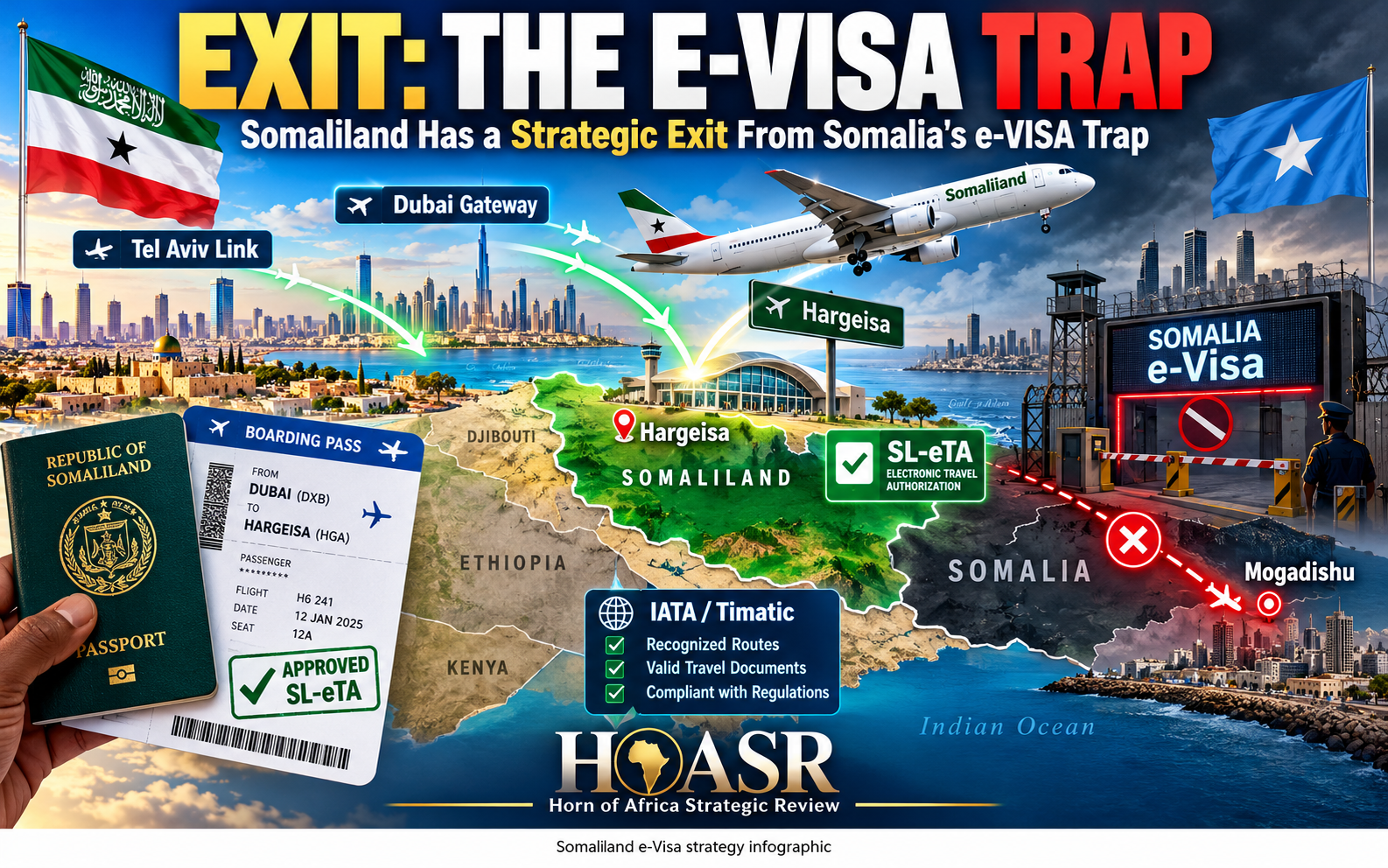
Somaliland’s proposed strategic exit from Somalia’s e-Visa pressure through lawful aviation, digital travel authorization, Dubai connectivity and emerging Israel–Somaliland links. Credit: HOASR Original Infographics
Somaliland should stop fighting Mogadishu only at the visa counter and start building a lawful aviation architecture of its own
Somaliland has spent months explaining why a Somalia-issued e-Visa should not determine who may board a flight whose destination is Hargeisa. The objection is sound, but protest by itself is not a strategy. The uncomfortable truth is that Mogadishu’s advantage does not begin at the immigration desk in Hargeisa. It begins thousands of kilometers away, inside airline reservation systems, check-in databases and internationally inherited aviation procedures.
The contradiction is obvious. British travel guidance says that a passenger flying to Hargeisa may still be asked to show Somalia’s e-Visa before boarding, even though that document is not considered valid for entry on arrival in Hargeisa, where Somaliland’s own visa rules apply. The same journey is controlled by one authority before departure and another authority at destination. Welcome to the controversial unresolved Somaliland-Somalia sovereignty dispute compressed into an airline check-in screen. [UK travel guidance]
Fighting the wrong battle is a strategic mistake
Somaliland has every reason to challenge Mogadishu’s attempt to project jurisdiction over Hargeisa and Berbera. But it should resist the temptation to make upper-airspace control the first battlefield. Aviation is unforgiving. Airlines need one safe set of operational instructions, and pilots cannot be turned into referees of political recognition. A hurried attempt to create rival tactical air-traffic instructions would hand Somaliland’s opponents the easiest argument available: that a sovereignty dispute is being allowed to endanger civil aviation.
The immediate strategy is lower down the chain-documentation, admissibility and the authority that receives the passenger on the ground. Somaliland already controls the terminal, the immigration desk and the decision to admit or refuse entry. This reality should be encoded strongly enough into the systems used before departure to make Somaliland’s authority digitally verifiable before the traveler reaches the airport.
Start with the passenger boarding pass database
The single most practical short-term move is to treat IATA Timatic as a strategic arena. Timatic is one of the principal systems used by airlines, ground handlers and travel agents to determine whether a passenger has the documents required for a destination. IATA says its Passenger Travel Requirements Network is fed by governments and industry stakeholders so that border and entry rules can be checked inside airline systems. That means the e-Visa dispute can be attacked at its most consequential point: the boarding decision. [IATA Timatic] [IATA Passenger Travel Requirements Network]
Somaliland should submit one coordinated dossier from its Immigration and Border Control, Civil Aviation Ministry and Foreign Ministry. The dossier should establish the operational facts: Somaliland officers control admission at Hargeisa and Berbera; Somalia’s e-Visa does not itself admit a traveler there; and Somaliland has publicly instructed airlines that external visas or electronic authorizations are not valid substitutes for Somaliland entry authority. Somaliland’s own 2025 civil-aviation statement already says exactly that. [Somaliland aviation statement]
The aim is to use this winnable argument: a destination rule that is operationally correct even while the diplomatic sovereignty dispute remains unresolved.
Somaliland needs its own electronic answer
Visa on arrival has served Somaliland well, but in the e-Visa confrontation it creates a technological weakness. Airline staff in London, Toronto, Stockholm, Dubai or Washington want something they can verify before departure. Somalia provides an electronic document. Somaliland often asks the traveler to complete the decisive immigration process after landing. That gap gives Mogadishu room to present its own authorization as the only visible pre-travel credential.
The solution is to add an optional Somaliland Electronic Travel Authorization—an SL-eTA—with a QR code or other secure verification method. A traveler could then arrive at the check-in counter with a document issued by the authority that will actually inspect the passport at destination. Once that authorization is fed into airline systems, the argument changes from a political claim into an operational fact.
Dubai: The immediate gateway already exists
The alternative corridor already exists. Dubai is connected directly to Hargeisa by flydubai, which currently markets regular nonstop service on the route. The UAE therefore offers Somaliland the fastest place to test a destination-authority model because the commercial bridge is already operating. [flydubai Hargeisa-Dubai schedule]
The immediate diplomatic objective should be narrow and practical: obtain a written boarding protocol for Dubai-Hargeisa passengers stating that a valid passport together with Somaliland-authorized entry documentation is sufficient for the Hargeisa sector and that boarding should not be refused solely because the passenger lacks a Somalia-issued e-Visa. That conversation belongs with flydubai, Dubai Airports, the UAE aviation authorities and IATA.
If Dubai adopts such a procedure, Somaliland gains more than passenger convenience. It creates a functioning international precedent. A traveler from Canada, Britain, Europe, Asia or the Gulf could move through one of the world’s largest hubs and arrive in Hargeisa using documentation recognized by the authority at destination. That would weaken the claim that Mogadishu’s authorization is an indispensable operational requirement.
Israel can turn recognition into aviation
Israel changes the political geometry because it has already crossed the line most governments have avoided. Israel formally recognized Somaliland as an independent sovereign state in December 2025. In May 2026, Somaliland’s first ambassador presented credentials to President Isaac Herzog, and in June President Abdirahman Irro made a state visit during which Israel publicly described Somaliland as an independent state and welcomed the opening of Somaliland’s embassy in Jerusalem. [Israel recognition statement] [First Somaliland ambassador to Israel] [Irro state visit to Israel]
That recognition should now become practical. Somaliland and Israel should negotiate a provisional bilateral air-services arrangement that authorizes direct or charter service between Tel Aviv and Hargeisa. A daily flight is not necessary at the beginning. One reliable weekly rotation would be enough to establish the principle that a recognized state, its carrier and Somaliland can organize a lawful international air service whose destination is Hargeisa.
The first service could be a charter rather than a fully scheduled route to allow the two sides to test demand, security arrangements, insurance, baggage handling, immigration procedures and air-traffic coordination. If the service works, frequency can grow. The political significance would be much larger than the initial passenger numbers.
For the diaspora, the route would also create a visible alternative. Somalilanders in Europe or North America could connect through Tel Aviv—or through Tel Aviv and Dubai—under a chain of travel documents and carrier instructions that acknowledges Somaliland as the destination authority. The strategic purpose is to construct a lawful travel route under bilateral arrangements made by governments and carriers already aware of the practical reality on the ground.
Israel’s most powerful role may be inside ICAO, not only in the air
Somaliland itself remains outside ICAO as a contracting state. That limits the legal machinery it can invoke directly. Israel does not have that limitation. As an ICAO member that recognizes Somaliland, Israel can raise concrete questions about passenger facilitation, treatment of Israeli carriers, documentation requirements and safety if an Israeli-designated service to Hargeisa is obstructed by Mogadishu.
Article 22 of the Chicago Convention obliges contracting states to take practicable measures to facilitate international air navigation and prevent unnecessary delays arising from immigration, customs and clearance formalities. This gives Israel a legitimate basis to question why passengers on a lawful Israeli-Somaliland service should be forced to obtain an immigration document from an authority that does not admit them at the destination. [Chicago Convention Article 22]
Article 84 offers another possible legal avenue and permits disputes over the interpretation or application of the Chicago Convention between contracting states to be brought before the ICAO Council after negotiations fail. Somaliland cannot simply file a sovereignty case under Article 84. Israel, however, could acquire its own state-to-state aviation dispute if a recognized Israeli service or Israeli aviation rights were obstructed in a way that raised Convention issues. [ICAO Article 84 text]
The 2013 Hargeisa agreement should be taken out of the archive
Somaliland also has unfinished diplomatic business that should not be allowed to disappear beneath newer disputes. In July 2013, under Turkish facilitation, Somalia and Somaliland agreed that the body jointly controlling their airspace would be established in Hargeisa. Türkiye’s Foreign Ministry still records that commitment plainly. The joint mechanism never became operational. [Türkiye – Istanbul II agreement]
Hargeisa should formally reactivate that record. It should notify Türkiye, ICAO, Somalia, Israel, the UAE, Ethiopia and the principal airlines serving Somaliland that it regards the 2013 arrangement as unresolved. Then it should make a concrete offer: implement the Hargeisa-based mechanism as agreed, or negotiate a new interim technical framework explicitly without prejudice to either side’s final sovereignty position.
That is stronger than simply protesting that Somalia acted unilaterally. It places an existing negotiated text back on the table and asks the party that signed it whether it still stands by its own agreement.
Kosovo offers the technical model Somaliland actually needs
The Kosovo analogy is useful precisely because it separates the political dispute from the provision of aviation services. NATO’s aviation-normalization process eventually allowed Hungary’s HungaroControl to provide upper-airspace services over Kosovo, while NATO documentation explicitly notes that Hungary exercises no sovereign powers there. Technical control and sovereignty were not treated as the same question. [NATO Kosovo airspace model] [NATO 2024 aviation normalization]
Somaliland should adopt an interim similar model under which Hargeisa controls its airports and locally administered services while a mutually acceptable international provider supports upper-airspace functions, training and safety oversight. Such an arrangement would require negotiation and outside backing. But it offers a serious answer to the false choice between accepting Mogadishu’s exclusive administration forever and creating unsafe rival control systems tomorrow.
A diaspora strategy must create evidence
This useful approach is evidence collection. Somaliland should create a central passenger documentation registry recording the airline, airport, date, itinerary, passport nationality, exact document demanded, whether boarding was refused, whether a Somalia e-Visa fee was paid, and what documentation was subsequently required on arrival in Hargeisa. A few hundred documented cases would turn an anecdotal grievance into a regulatory file.
There is also a growing data-protection argument. Current UK guidance warns of reports of a data breach affecting Somalia’s e-Visa system and lists highly sensitive categories of personal information potentially exposed. This is serious: why should a passenger bound only for Somaliland be compelled to submit personal data to a system that does not determine admission at the destination? [UK warning on Somalia e-Visa data breach]
The principle Somaliland should internationalize
Call it the destination-authority principle. It does not demand that an airline settle Somaliland’s statehood. It asks the airline to apply the rules of the officials who will meet the passenger at Hargeisa. That is operationally sensible, legally defensible and far easier to internationalize than an immediate demand that every aviation institution redraw the political map.
THE SCOOP
The deeper strategic point is easy to miss. Mogadishu’s e-Visa derives much of its power not from what Somalia can do in Hargeisa, but from the international systems that still assume Mogadishu speaks for Hargeisa before the passenger arrives. That is the real test of sovereignty in the digital age. Not who can publish the loudest declaration, but whose system actually works from reservation to runway.
Mogadishu built a digital gate in front of a border it does not physically control. Somaliland’s answer should not be to shout at the gate forever. It should build a lawful route around the contradiction—one airline agreement, one database correction, one bilateral aviation arrangement and, eventually, one internationally credible airspace mechanism at a time.
Related Topics
Related Posts