The views expressed herein are solely mine.
Israel the Broker in the Russia–Ukraine War
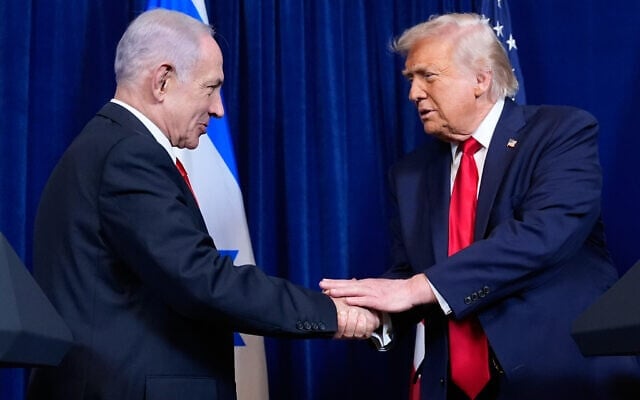
US President Donald Trump, right, shakes hands with Prime Minister Benjamin Netanyahu during a news conference at Mar-a-Lago, December 29, 2025, in Palm Beach, Florida. (AP Photo/Alex Brandon)
Strategically, Israel does not survive by applause. It survives by leveraging. And at this moment—when the war in Eastern Europe grinds on, Washington’s attention is fragmented, and new Middle Eastern players whisper ever louder in the corridors of power—Israel has a rare opportunity to reassert itself as something the West increasingly lacks: a broker that actually matters.
Structurally, unlike most Western capitals, Israel is one of the very few states with real, sustained access to both Russia and Ukraine. This is not theoretical diplomacy. It is structural power.
Geostrategically, Israel maintains military deconfliction mechanisms with Moscow in Syria, deep intelligence and political channels, and a large Russian-speaking population that anchors long-term ties.
Concurrently, Israel has preserved credibility with Kyiv and remains firmly embedded within the Western strategic ecosystem. In mediation theory, access plus trust equals leverage—and Israel uniquely possesses both.
Imperatively, for the United States, this is not optional; it is strategic.
Operationally, Washington’s direct mediation capacity is constrained by alliance politics, escalation risks, and domestic polarization.
Modern history shows that durable diplomatic openings often emerge through intermediaries that are aligned but not captive—actors capable of talking to adversaries without posturing.
Functionally, Israel fits this role precisely. Even limited brokerage—confidence-building measures, phased ceasefires, security guarantees—would exceed the current diplomatic stagnation dominated by moral signaling and zero leverage.
Geopolitically, this approach also rebalances Middle Eastern influence in Washington.
As evidenced, Qatar has successfully marketed itself as an indispensable mediator, leveraging capital, access, and narrative management to elevate its standing inside the White House—despite its parallel engagement with Islamist actors hostile to Western interests.
Thereby, Israel cannot—and should not—compete in checkbook diplomacy. Rather, it can outperform through outcomes. In Washington, results beat narratives every time.
Realpolitically, there is also a reputational dimension the West prefers not to admit: legitimacy in international politics is restored through utility, not apologies.
By acting as a bridge in Europe’s most dangerous war, Israel reframes itself from a regional problem to be managed after Gaza into a global stabilizer that the West actively needs. This is not image laundering; it is classical realpolitik.
Tactically, Israel does not need to resolve the Russia–Ukraine war. It needs to shape it—opening channels, testing frameworks, and injecting realism where ideology has failed. The alternative is strategic drift: Qatar gaining leverage by default, Europe moralizing without influence, and Israel boxed into a reactive posture.
Fundamentally, Israel was never built to be peripheral. Conclusively, the broker role is open. Decisively, Israel is already holding the keys.
Related Topics