
Israel was not betrayed – it was repriced
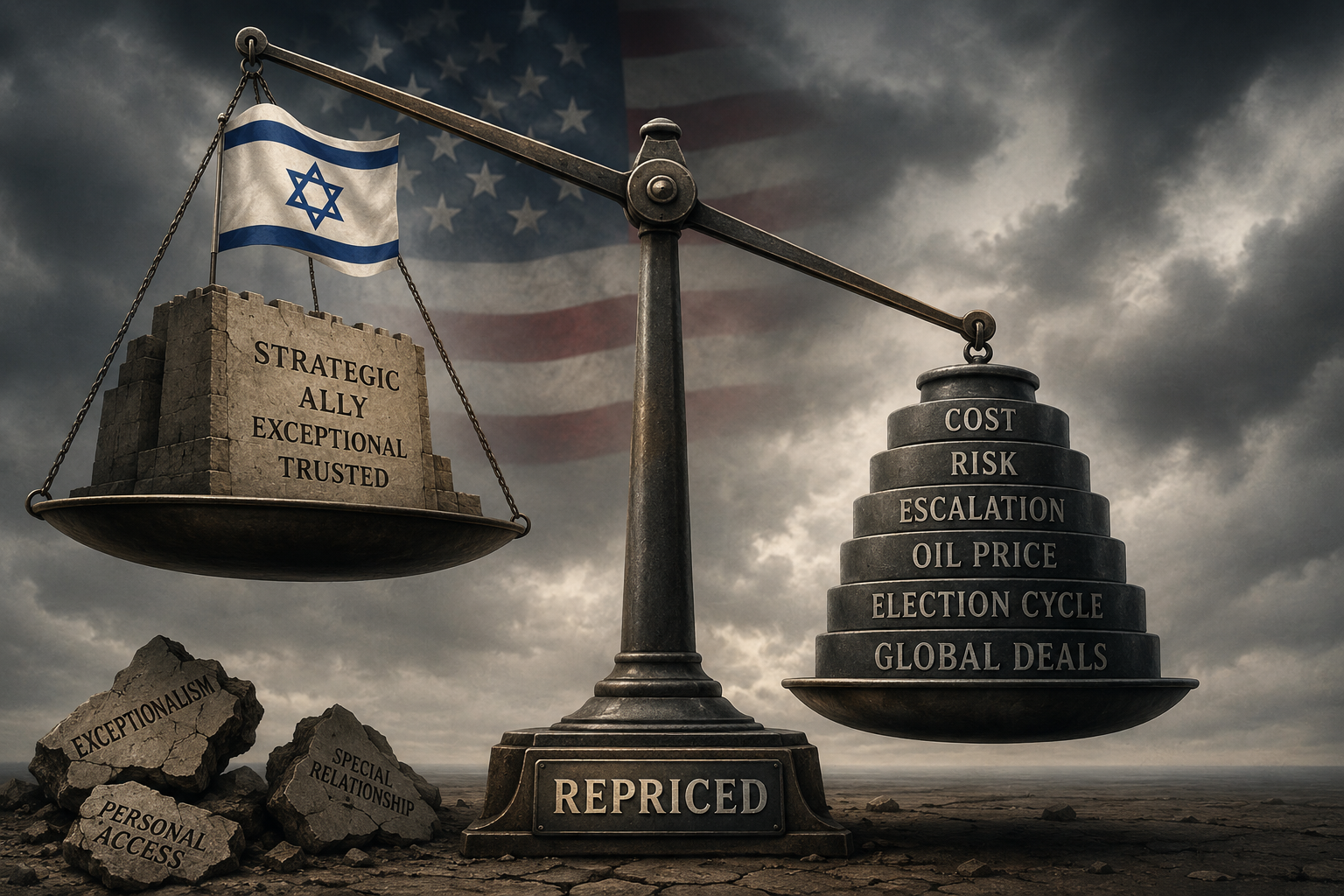
Israel was not betrayed by Donald Trump. It was repriced, and that distinction is brutal but necessary. Betrayal still belongs to the moral vocabulary of friendship, loyalty, promise, and emotional injury. Repricing belongs to a colder world. It means that a relationship once treated as exceptional has been returned to the market of costs, risks, leverage, and political returns.
For years, Benjamin Netanyahu’s strategy toward Washington rested on a dangerous confusion. Personal access to an American president was treated as if it were a durable strategic order. Political intimacy was mistaken for structural guarantee. A direct line to Trump was treated as a substitute for bipartisan legitimacy, generational support, regional realism, and institutional depth. The Iran deal has exposed that error with unusual clarity.
Trump did not suddenly become unpredictable. He behaved exactly as a transactional leader behaves when the cost of a partner begins to exceed the value of the partnership. When Israel’s freedom of action against Iran, Lebanon, and Hezbollah began to threaten Trump’s own claim to control the region, lower energy prices, end wars, and make historic deals, friendship was replaced by accounting. The rhetoric of loyalty gave way to the language of management.
That is why the current Israeli shock is so revealing. Much of the discussion still assumes that something abnormal has happened: Trump has abandoned Israel, America has betrayed its closest ally, Netanyahu has been humiliated by a man he believed he could manage. These descriptions are emotionally understandable, but they remain trapped in the wrong category. The more painful truth is that Trump may not have abandoned the relationship at all. He may have clarified its real terms.
Israel is no longer being treated as an untouchable strategic exception. It is being treated as an asset with rising costs, and that is the real scandal. The shift is not rhetorical decoration. It changes the position from which Israel’s decisions are judged, tolerated, delayed, funded, or restrained.
The war with Iran did not produce the clean strategic outcome that its supporters imagined. It consumed American resources, exposed Gulf vulnerabilities, risked global energy shock, and ended not with Iranian surrender but with another negotiated framework. Iran was damaged, but not dissolved. Its nuclear and missile questions were not definitively settled. Its regional instruments were not erased. Its ability to impose costs on the Gulf, on oil markets, and on American strategy was demonstrated rather than eliminated.
In that setting, Israel becomes a problem for Washington not because it is wrong about Iran’s danger, but because its necessary conclusions no longer match America’s preferred exit route. Israel looks at Iran and sees an unfinished threat. Trump looks at Iran and sees an expensive conflict that must be converted into a deal before it damages his presidency. These are not tactical disagreements. They are different clocks, different risks, and different definitions of victory.
For Israel, the central question is survival under conditions of hostile encirclement. For Trump, the central question is whether the conflict can be closed, branded, and sold as success. The tragedy is that both sides can speak the language of security while meaning entirely different things.
Betrayal is not the word
This is why the phrase “betrayal” is insufficient. Betrayal implies that the old framework was solid until someone violated it. But what if the framework had already weakened? What if Trump’s Iran deal did not break the special relationship, but revealed that the special relationship had become conditional long before anyone was willing to say so?
The danger for Israel is not that Trump changed his mind. The danger is that he may have shown every future American administration how easily Israel can be moved from the category of ally to the category of liability once the costs become visible. A Democrat may do this through the language of human rights and international law. A Republican may do it through the language of America First, fiscal burden, oil prices, and strategic exhaustion. The vocabularies differ, but the result may converge.
That convergence is what Israel must now confront. The old bipartisan grammar is collapsing from two sides at once. Among Democrats, criticism of Israel has moved from the margins toward the center of moral legitimacy. Among younger Republicans and isolationist conservatives, the question is less whether Israel is morally defensible than whether the United States should continue paying for another country’s wars, missiles, risks, and diplomatic cover. One side asks whether Israel deserves support. The other asks whether Israel is worth the price.
Those are different questions, but both are dangerous. Netanyahu’s long wager was that the Republican Party, evangelical enthusiasm, donor networks, and personal access to Trump could compensate for the erosion of broader American consensus. For a time, that wager appeared successful. It produced extraordinary symbolic victories and real diplomatic gains. But it also encouraged a deeper strategic laziness: the belief that one could substitute factional intimacy for national consensus.
Now the bill is arriving. Trump’s message to Israel is not simply: trust my deal. It is: your freedom of action must not interfere with my deal. That is a profound change. The United States is no longer only enabling Israeli power. It is beginning to price, delimit, and discipline it.
This discipline does not need to appear as an open order. It can arrive through ammunition schedules, diplomatic deadlines, intelligence access, air-defence priorities, public impatience, private phone calls, and the timing of replacement supplies. A state may formally retain the sovereign right to act while discovering that the duration, scale, and political tolerability of its action are being measured elsewhere. That is the new operational barrier. Israel may still decide to strike, but Washington increasingly decides how long the strike can remain politically affordable.
Once that happens, the relationship enters a different phase. Support may continue, weapons may continue, diplomatic coordination may continue, but the metaphysics of exception is gone. Israel can still receive aid and lose strategic autonomy. It can still be called an ally and be managed as a risk. It can still be defended in public while being restrained in private. That is precisely the new condition: not abandonment, but conditionality.
The deepest Israeli failure would be to interpret this moment only as Trump’s personal unreliability. Trump is not an accident outside the system. He is a symptom of the system’s transformation. He gives crude expression to a shift that others may later express more politely. Today it arrives as impatience, deal-making, and public humiliation. Tomorrow it may arrive as congressional conditions, weapons delays, diplomatic abstentions, or quiet pressure framed as responsible alliance management.
The mechanism will be the same. Israel will be asked not whether it is right, but whether its rightness is affordable. That is the sentence no serious Israeli strategy can avoid anymore.
The Iran deal has therefore exposed more than a dispute over Tehran. It has exposed the exhaustion of a model in which Israel could assume that American power would absorb the consequences of Israeli necessity. That model depended on a particular historical memory, a particular American public, a particular party structure, and a particular view of the Middle East. None of these conditions is stable now.
What the world sees
The Gulf states are watching. Europe is watching. Iran is watching. Turkey is watching. They see that America may strike, spend, negotiate, and then ask Israel to accept the result. They see that Washington can enter a war but still prefer a deal that leaves Israel constrained. They see that the United States can bear enormous costs and then redirect the political blame toward the ally whose threat perception helped justify the confrontation.
That is not merely a diplomatic embarrassment. It is a reclassification of Israel’s position. Israel has been accustomed to thinking of itself as the West’s forward fortress, the indispensable democratic outpost, the state whose risks were also the risks of the free world. That language has not disappeared, but it no longer controls the calculation. In the new arithmetic, Israel is also a source of escalation, a consumer of ammunition, a trigger for oil shocks, a diplomatic complication, and a domestic political burden.
This does not mean Israel’s enemies are right. It does not mean Iran is harmless. It does not mean Israel should surrender its security to international committees, European abstractions, or American electoral cycles. It means something harsher: Israel may be strategically right about the danger and still increasingly alone in bearing the political cost of acting on that danger.
That is the tragedy. A country can be correct and exposed at the same time. It can see the threat more clearly than its allies and still lack the power to compel them to share its conclusions. It can win battles and lose the architecture that made those battles sustainable. It can possess extraordinary military capacity while discovering that the permission structure around that capacity is being rewritten elsewhere.
This is why the current moment should not be read as another chapter in the personal drama between Trump and Netanyahu. Personal drama is the surface. Underneath it lies a harder transformation: Israel’s strategic exception is being converted into a negotiable variable.
Once that conversion begins, the old emotional vocabulary becomes dangerous. Betrayal may comfort because it preserves the idea that the relationship was once whole. Repricing offers no such comfort. It says the relationship was always contingent, but the contingency was hidden by habit, memory, sentiment, and political usefulness.
Now the contingency is visible. Israel’s task is not to mourn the lost intimacy of one president. It is to ask what remains when intimacy is gone. What remains when Trump is no longer in office? What remains when Republicans calculate costs and Democrats calculate legitimacy? What remains when Gulf states hedge, Europe moralises, Iran survives, and Turkey expands its regional reach under the cover of alliance language?
The answer cannot be another illusion of personal access. It cannot be another photograph, another speech to Congress, another factional bet, another assumption that America will return to itself and therefore to Israel. America is returning to itself. That is precisely the problem. The America now returning is more divided, more transactional, more impatient, less historically bound, and more willing to ask what every alliance costs.
Israel was not betrayed. It was repriced, and repricing is colder than betrayal because it does not require hatred, rupture, or even hostility. It requires only a spreadsheet, an election cycle, a barrel of oil, a missile inventory, and a president who decides that friendship has become too expensive to leave unmeasured.