
Israeli Economic Growth Outlook, 2026
I always like to start those type of article by a question and the optimal question start would be the following : With legal, economic, political & demographical parameters what does economic growth look like for Israel in 2026.
When getting into macroeconomic, the things we first look at is the structural basis of his. In Israel case the economy ( e.g Employement, export, major leading industries, public spending ect ) is the tech and defense in large share.
Demand — Demographicaly speaking Isreal stands good for economic growth or even substainable economic growth. Majority of population are young with a median age of 29.2, average life span of 80 year old one of the highest. With a population growing around 1.5 percent yearly.
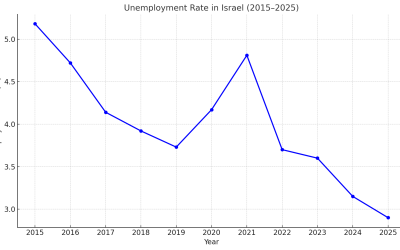
This steady and growing demand is also creating a steady and growing demand for labor and as we can see on the graph below unemployement rate decline 2%, except for Covid when the choc was exogenos. 28% of those jobs are from exports or more precisly from high-tech and defense.
Supply, Over the next 12 months, Israel’s aggregate supply is set to recover gradually, with potential growth running in the 3.3–3.8% range. The restart of the Leviathan and Karish gas fields, the gradual return of reservists to the workforce, and a strong rebound in tech financing (about $9.3 bn raised in H1 2025) are helping rebuild productive capacity. The output gap, still around -4% in 2025, should narrow toward -2%. Inflation pressures are easing, drifting back toward 2–2.5%, supported by a stronger shekel and more stable energy, though higher VAT and utility tariffs remain a drag. The labor market stays tight: unemployment is low, around 3%, and wages are climbing more than 4% annually. The main bottleneck is construction, where the sharp fall in Palestinian permits has left a shortage of roughly 38,000 workers, only partly offset by foreign hires. If geopolitics calm and gas exports flow steadily, growth could exceed 4% with inflation anchored near 2%. But a renewed flare-up or energy stoppages would cap growth closer to 2–2.5% and push inflation above 3%. In short, Israel’s supply side is healing, but its trajectory depends on three moving parts: energy stability, the pace of workforce normalization, and whether construction capacity can catch up.
With careful consideration of all underlying parameters this is my forecast
Optimist- 3.1-4.1
Conservative- 2.0-3.0
Pessimistic- 1.0-1.9