
CEO of Time to Stand Up for Israel
Israeli elections: Will history repeat itself?
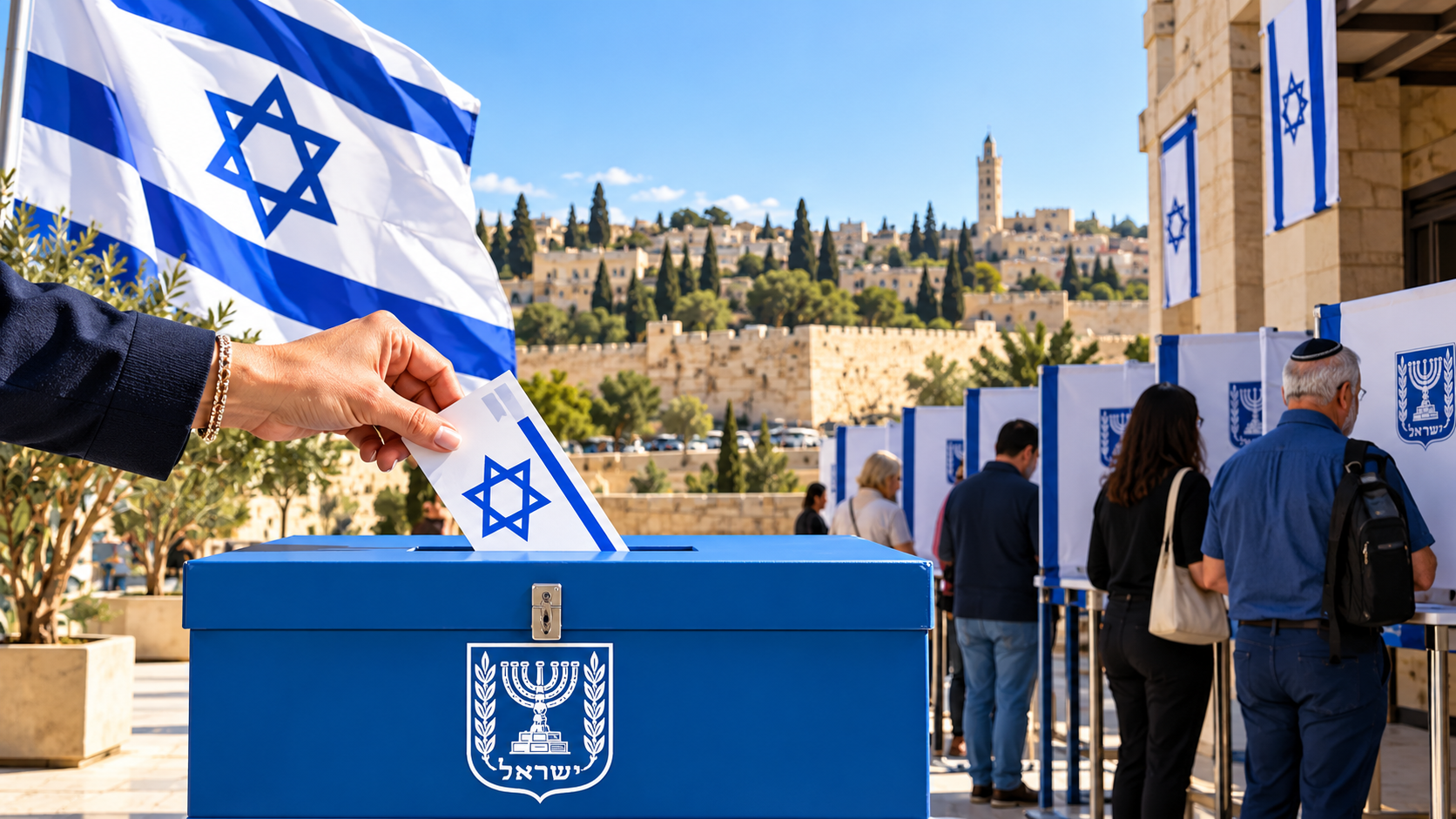
Photo Credits: Sabine Sterk(AI)
Democracy, Division and the Price of Political Hatred
On October 27, Israel will once again celebrate one of the greatest achievements of a free society. Democracy. The right of citizens to determine their own political future, to elect their representatives and to decide who should govern their country. In a region where dictatorships, religious extremism and authoritarian governments dominate the political landscape, Israel remains an extraordinary example of democratic freedom. Israelis can criticize their government, demonstrate against their leaders, establish political parties and replace those in power through elections. It is something that deserves admiration, particularly considering the circumstances under which this small nation has been forced to survive. Yet as the next elections approach, I find myself experiencing mixed emotions. On the one hand, I celebrate Israeli democracy. On the other, I cannot help wondering whether Israel is about to complete another dangerous political cycle.
Will the elections bring a new beginning, or will history repeat itself?
In November 2022, the Israeli people went to the polls. The result was clear enough to allow Benjamin Netanyahu, better known as Bibi, to form a governing coalition. On December 29, 2022, his government was sworn in. It was a lawful government, formed according to the democratic procedures of the State of Israel. Whether people liked Netanyahu or hated him was completely irrelevant. Democracy does not mean that the political party you personally prefer must win. Democracy means accepting that other citizens have exactly the same right to vote as you do, even when their political convictions are entirely different. Yet almost immediately after Netanyahu returned to office, the demonstrations began. Within weeks, thousands of Israelis were protesting in the streets, and those protests eventually developed into enormous weekly gatherings. The official explanation was opposition to the proposed judicial reforms. But I have never believed that the judicial reforms were the whole story. In my opinion, the demonstrations were fundamentally driven by the determination to remove Netanyahu from power. The judicial reforms provided the political ammunition, but Bibi himself was the target.
Week after week, Israel became increasingly divided. Every Saturday night, the streets filled with demonstrators, waving flags, shouting slogans and demanding political change. The country appeared to be caught in an endless confrontation between those who supported the elected government and those who seemed determined to make governing impossible. I watched these demonstrations with disbelief. Not because I oppose the right to demonstrate. That right is fundamental to democracy. But because I believe there comes a point when exercising a democratic right can become politically irresponsible, particularly in a country that faces constant existential threats. There is an enormous difference between criticizing government policies and allowing political hatred to dominate the national agenda. And in my opinion, that is exactly what happened. The opposition to Netanyahu became so obsessive that the consequences for Israel’s internal stability appeared to become secondary.
And while Israelis were fighting Israelis, their enemies were watching. Hamas in Gaza, terrorist organizations operating in Judea & Samaria, Hezbollah in Lebanon and the Iranian regime must have watched Israel’s internal turmoil with considerable satisfaction. What better circumstances could Israel’s enemies have wished for than a nation increasingly consumed by political hostility? While Israelis argued about judicial reforms and the legitimacy of their government, Hamas continued preparing for war. Terrorists constructed tunnels, accumulated weapons, trained their fighters and developed their plans for an unprecedented massacre. Their preparations had begun long before the demonstrations, but I believe Israel’s internal divisions created an atmosphere that encouraged its enemies. Why should Hamas fear a country that appeared increasingly incapable of presenting a united front? Why should terrorist organizations not interpret the political chaos as an opportunity? I believe they did exactly that.
What disturbed me most was the apparent inability of so many people to recognize the dangers of allowing political confrontation to become a permanent feature of Israeli society. Even when deadly terrorist attacks had occurred, the Saturday night demonstrations continued. Israeli flags filled the streets, sometimes accompanied by Palestinian flags, while the political battle against Netanyahu remained the dominant message. I found that deeply troubling. Imagine living in a country where innocent civilians are murdered by terrorists, where soldiers are constantly protecting the borders and where enemies openly declare their intention to destroy the Jewish state, yet where enormous energy is devoted to fighting an internal political war. To me, it demonstrated how political hatred can become so overwhelming that people lose sight of the threats surrounding them. I am convinced that Israel paid a terrible price for allowing itself to become so divided.
And then came October 7, 2023. The darkest day in modern Israeli history. Hamas terrorists invaded southern Israel, slaughtered innocent civilians, raped, tortured, burned homes and abducted men, women and children. Approximately 1,200 people were murdered and 251 were taken hostage. The brutality was almost impossible to comprehend. The world witnessed what happens when an organization driven by genocidal antisemitism is given the opportunity to carry out its ambitions. I will never forget that day, nor will I forget the months that preceded it. I am not suggesting that Israeli demonstrators planned the massacre or intended to help Hamas. The responsibility for the atrocities belongs entirely to Hamas. But I firmly believe that the political divisions within Israel contributed to a dangerous sense of vulnerability, and that its enemies interpreted those divisions as weakness. Whether people agree with me or not, that is how I see the events that unfolded. Israel was fighting itself while Hamas was preparing to fight Israel.
The tragedy of October 7 also exposed something else. When confronted with an existential threat, Israelis suddenly remembered what united them. Political opponents volunteered together, reservists returned to their units, citizens opened their homes to displaced families and communities mobilized to help those who had lost everything. The political arguments that had dominated the country became insignificant compared with the struggle for survival. It was both heartbreaking and inspiring. Heartbreaking because it took an unimaginable catastrophe to remind people of their shared responsibility, and inspiring because it demonstrated that beneath the political hostility, the Israeli nation remained extraordinarily resilient. The same people who had been confronting one another in the streets were now standing together to defend their homeland. It proved something I have always believed. Israel is strongest when its citizens recognize that their common destiny is more important than their political differences.
Now, almost four years after Netanyahu returned to office, Israelis are preparing for another election. And once again, the political atmosphere is tense. Netanyahu remains one of the most controversial figures in Israeli politics. His supporters regard him as an experienced leader who has defended Israel through extraordinary challenges. His opponents hold him responsible for serious political and security failures and want him removed. Both positions belong in a democracy. But what concerns me is not which political party wins or who eventually becomes prime minister. What concerns me is what happens afterward. Will the losing side accept the result? Will the next government be given the opportunity to govern? Or will Israel once again descend into endless demonstrations, political obstruction and national division? Will another election simply become the beginning of another campaign to undermine whichever government emerges?
As someone who has devoted so much of her life to advocating for Israel, I find these questions deeply troubling. I am not an Israeli citizen, and therefore I have no vote in these elections. I cannot and will not tell Israelis which political party they should support. That is their decision, their responsibility and their democratic right. But being an outsider does not mean that I have no opinion. I love Israel unconditionally, and I have spent years defending its right to exist, its history, its people and its democratic institutions. That commitment does not disappear simply because I do not possess an Israeli passport. And precisely because I care so deeply about Israel, I refuse to pretend that internal political hatred is harmless. In my opinion, the events preceding October 7 demonstrated just how dangerous national division can become when a country is surrounded by enemies waiting for an opportunity.
I also believe that democracy has been increasingly misunderstood. Democracy is not a system in which the losing side is entitled to paralyze the country until it gets the government it prefers. Democracy is not the endless rejection of election results simply because the outcome is politically inconvenient. Of course citizens have the right to demonstrate, and of course governments must be held accountable. But democratic freedom comes with responsibility. The right to oppose a government does not eliminate the obligation to consider the consequences of one’s actions for society as a whole. A nation cannot function properly when every political disagreement becomes an existential confrontation. And Israel, perhaps more than any other democracy, cannot afford to confuse political opposition with national destruction.
There is another uncomfortable truth. Israel’s enemies do not care whether Netanyahu, Lapid, Bennett or another political leader occupies the prime minister’s office. Hamas does not suddenly become peaceful because a different coalition governs Israel. Hezbollah does not abandon its hostility because Israeli voters choose another political direction. Iran does not relinquish its ambitions because Israeli citizens elect a more liberal or conservative government. These organizations and regimes oppose the existence of the Jewish state itself. They do not distinguish between left and right when planning attacks against Israelis. Yet within Israel, political opponents sometimes speak about one another with a hostility that seems to overlook this fundamental reality.
The person who votes differently from you is not your enemy. The terrorist who wants to murder you because you are Israeli or Jewish is.
This is why I believe the coming elections should be celebrated, but also approached with a profound sense of responsibility. Whoever wins must govern within the law and respect the democratic institutions of the country. Whoever loses must accept that democracy sometimes produces results that are personally disappointing. Criticism should continue, political debate should remain passionate, and governments should never be immune from scrutiny. But Israel must never again allow political disagreements to develop into a level of national hostility that undermines its ability to confront external threats. The lessons of October 7 should not be reduced to military intelligence failures, border security and operational mistakes. In my opinion, they must also include the consequences of a society becoming dangerously divided.
I sincerely hope that October 27 will become a celebration of everything that makes Israel exceptional. A nation where Jews and Arabs, religious and secular citizens, conservatives and liberals can participate in democratic elections and influence the future of their country. A nation that continues to protect political freedom despite the enormous challenges it faces. A nation that demonstrates to the world that democracy can survive even under the constant threat of terrorism and war. But I hope even more that October 28 will not mark the beginning of another destructive political cycle.
Because I remember 2023. I remember the demonstrations, the anger, the hostility and the growing divisions. I remember watching a country that I love becoming increasingly consumed by its internal conflicts. And I remember October 7. I refuse to believe that the relationship between national unity and national security can simply be dismissed as politically inconvenient.
Israel deserves better than another four years of political warfare. Its citizens deserve leaders who understand that winning elections is not the same as winning a permanent battle against half the population. They deserve an opposition that recognizes the legitimacy of democratic outcomes while holding the government accountable. Above all, they deserve a political culture in which love for Israel is stronger than hatred for a particular politician.
My greatest fear is not that the wrong political party will win. My greatest fear is that Israel will once again become so consumed by fighting itself that it forgets who its real enemies are.
Let October 27 be a celebration of democracy.
Let October 28 be a celebration of national responsibility.
And please, Israel, do not allow history to repeat itself.
A divided Israel is exactly what its enemies want. A united Israel is what they fear most.
Related Topics