
Israeli independent consultant and analyst exploring politics, security, and international affairs
The Paradox of November 29
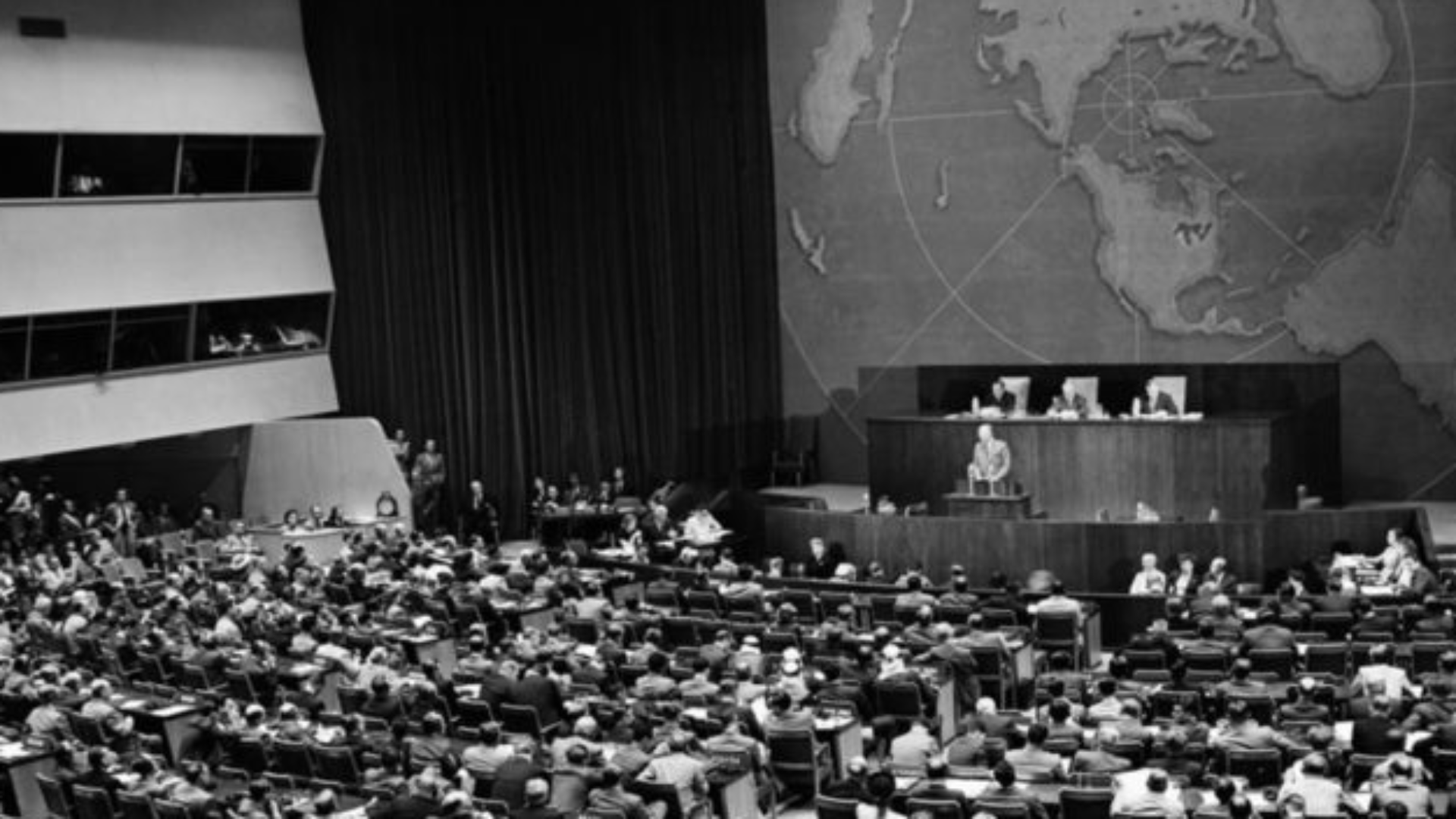
The UN General Assembly session that adopted Resolution 181 on November 29, 1947. (Wikimedia Commons/Public Domain)
As November 29 approaches, the Boycott, Divestment and Sanctions (BDS) movement is promoting an international mobilization initiated by Palestinian trade unions. Running from November 20 to the International Day of Solidarity with the Palestinian People, the campaign seeks to intensify economic, academic, cultural and institutional pressure on Israel.
Political parties, Islamist, nationalist and left-wing movements, trade unions, student organizations and civil society groups have announced demonstrations and other initiatives across Europe and North America, notably in France, Britain and the United States, as well as in several Arab countries, including Lebanon, Tunisia and Morocco. Palestinian organizations are also preparing their own mobilization in the West Bank.
The geography of this mobilization presents a contrast. As of November 27, public calls for independent demonstrations specifically marking the occasion were absent from the announcements reviewed in Qatar, Turkey, Iran, Algeria and several other countries whose official discourse emphasizes solidarity with the Palestinians. Restrictions on pro-Palestinian activists have also been documented in several of these countries.
The gap between official positions and economic practices is equally striking. Azerbaijani oil has continued to reach Israel through Turkey despite Ankara’s declared trade embargo, while South Africa, widely praised in pro-Palestinian circles for its case against Israel before the International Court of Justice, significantly increased its coal exports to Israel in 2025. A South African trade union mobilization linked to November 29 is itself calling for an end to these exports.
Nor are restrictions on solidarity protests confined to these countries. In Spain and Ireland, whose governments have taken prominent diplomatic positions in support of Palestinian statehood, human rights organizations have documented excessive police force and other restrictions during certain pro-Palestinian demonstrations.
Beyond these contrasts, the occasion provides an opportunity to examine some of the contradictions that characterize contemporary anti-normalization activism, beginning with the historical significance of November 29 itself.
The historical meaning of November 29
On November 29, 1947, the United Nations General Assembly adopted Resolution 181, recommending the partition of Mandatory Palestine into an Arab state and a Jewish state, with a special international status for Jerusalem. The Jewish Agency accepted the proposal despite reservations, while the Palestinian Arab leadership and the Arab states rejected it.
Thirty years later, in December 1977, the General Assembly designated November 29 as the International Day of Solidarity with the Palestinian People, drawing attention to the unresolved Palestinian question and the realization of Palestinian national rights.
The significance of Resolution 181 was subsequently acknowledged by the Palestinian national movement itself. The Palestinian Declaration of Independence of November 15, 1988, invoked the resolution as a source of international legitimacy for Palestinian statehood. In September 1993, the Palestine Liberation Organization formally recognized Israel’s right to exist in peace and security, while Israel recognized the PLO as the representative of the Palestinian people.
Although the territorial provisions of the 1947 partition plan no longer constitute the basis of contemporary negotiations, these developments establish an important historical connection between Palestinian national aspirations and the international recognition of the national rights of both peoples.
For those who commemorate November 29 while rejecting the very existence of Israel, this history presents a political contradiction that cannot be resolved by invoking only the aspects of international legitimacy that support their positions.
The contradictions of anti-normalization
Across the Arab and Muslim worlds, as well as in Western political, academic and trade union circles, opposition to normalization with Israel has become an important component of activism among movements with considerably different ideological backgrounds.
Their political objectives are not necessarily identical. Some oppose normalization in the absence of a settlement guaranteeing Palestinian rights, while others reject Israel’s legitimacy regardless of the outcome of negotiations. It is among the latter that the historical significance of November 29 raises the most fundamental question of political consistency.
Commemorating the occasion does not automatically imply endorsement of the original partition plan. Nevertheless, movements that invoke international resolutions to substantiate Palestinian national claims cannot disregard the fact that the international framework they appeal to also recognizes Israeli national rights.
The Palestinian national leadership itself eventually recognized that pursuing independence did not require denying Israel’s existence. Some organizations mobilizing in the name of Palestine nevertheless continue to advance positions that leave considerably less room for political compromise.
This difficulty also concerns the BDS movement, which maintains that it does not prescribe a particular political solution to the conflict. Its anti-normalization guidelines distinguish between acceptable forms of cooperation with Israelis and initiatives based on coexistence, subjecting joint activities to political conditions that include participation in what it describes as “co-resistance.”
While cooperation with Israeli organizations supporting boycott campaigns is welcomed, initiatives such as Standing Together, which brings Jewish and Arab citizens together to oppose the war and advocate peace and equality, have themselves become targets of boycott.
BDS argues that dialogue insufficiently addressing the causes of injustice risks legitimizing them. Yet restricting cooperation to actors who already accept a particular political framework raises a fundamental question about how broader support for Palestinian rights can be built within Israeli society.
If the realization of Palestinian national aspirations requires a political settlement, the effectiveness of solidarity campaigns must also be assessed in light of their impact on the political conditions necessary for such a settlement.
When rejection reinforces rejection
The strategic implications of this approach are particularly significant in Israel, where support for a negotiated settlement has weakened considerably.
A joint Palestinian-Israeli survey published on November 24 by the Palestinian Center for Policy and Survey Research and Tel Aviv University found that Palestinian support for the two-state solution had risen from 40 percent in 2024 to 49 percent, compared with 24 percent among Israeli Jews and 84 percent among Arab citizens of Israel. The survey also found that 51 percent of Palestinians saw a diplomatic way out of the conflict.
These findings indicate a growing openness to diplomacy among Palestinians, despite persistent distrust and widespread doubts about the feasibility of a political settlement. They invite solidarity movements to consider whether increasingly uncompromising rhetoric adequately reflects the evolution of Palestinian public opinion.
The survey also offers important insights into Israeli attitudes. Among Israeli Jewish respondents, support for a comprehensive peace package increased from 23 percent to 63 percent when a reciprocal commitment to combating incitement, including in educational materials, was introduced.
These findings help explain how rhetoric rejecting Israel and campaigns seeking to delegitimize engagement with Israeli society can contribute to strengthening opposition to Palestinian statehood. By reinforcing doubts about the other side’s intentions, they risk undermining the very political conditions necessary for the realization of Palestinian national aspirations.
For Israeli politicians who argue that Palestinian independence would constitute an existential threat to Israel, declarations denying Jewish national rights provide arguments against territorial compromise. Campaigns portraying engagement with Israelis as a betrayal of Palestine can similarly reinforce the perception that a genuine partner for peace is lacking.
Israeli extremism generates a corresponding dynamic. Calls for annexation, attacks against Palestinian communities and the rejection of Palestinian statehood provide arguments for those who maintain that compromise with Israel is impossible.
On November 23, President Isaac Herzog condemned violence by Jewish extremists against Palestinians, while former prime minister Naftali Bennett denounced what he described as Jewish terrorism. These statements illustrate that opposition to such practices extends beyond Israel’s traditional peace camp.
The convergence between rejectionist positions on either side requires neither coordination nor common political objectives. Each can reinforce the other’s arguments, weakening the political constituencies necessary for a settlement.
The paradox is that movements mobilizing in defense of Palestinian rights can, through an escalation of hostility that disregards Israeli political realities, inadvertently strengthen the position of those most opposed to Palestinian independence.
From solidarity to political effectiveness
One of the limitations of anti-normalization discourse is its tendency to overlook the political diversity of Israeli society, particularly among those who regard peace with the Palestinians as consistent with their Zionist convictions and Israel’s national interests.
Within Israel, support for a negotiated settlement is not confined to secular or left-wing circles. It also exists among former military and security officials, religious Zionists and political figures who regard the preservation of Israel’s Jewish and democratic character as a fundamental national interest.
Commanders for Israel’s Security, for example, advocates preserving the conditions for a two-state agreement based on Israel’s security requirements and political separation from the Palestinians.
The experience of Rabbi Michael Melchior, a former Israeli minister associated with religious Zionism, is equally instructive. His religious peace initiative, established with Sheikh Abdullah Nimer Darwish, the founder of the Islamic Movement in Israel, has demonstrated the possibility of sustained dialogue across religious and ideological divisions.
The political evolution of the Islamic Movement’s southern branch also deserves attention. Mansour Abbas, leader of its parliamentary party Ra’am, has acknowledged Israel’s Jewish character while advocating Palestinian statehood alongside Israel. In March 2025, he presented his Bridges of Reconciliation and Peace Initiative, based on a two-state solution.
These experiences illustrate that political commitments rooted in different ideological and religious traditions need not preclude agreement on the objectives of a negotiated settlement.
For anti-normalization movements in Arab and Muslim societies, as well as their counterparts elsewhere, opposition to Israeli policies and commitment to Palestinian rights need not entail the permanent rejection of Israel or the exclusion of Israeli voices supportive of Palestinian statehood.
The question is not whether these movements should abandon their ideological identities, but whether their methods of political action are consistent with the objectives they seek to achieve.
A convergence around the objectives of a political settlement need not involve ideological or organizational rapprochement. Its significance would lie in the ability of different political currents, within their respective societies, to contribute to conditions more favorable to the diplomatic efforts already undertaken by states and international institutions.
The New York Declaration on the implementation of the two-state solution, endorsed by the United Nations General Assembly in September 2025, recognizes this complementary dimension by incorporating civil society engagement, dialogue, reconciliation and measures to combat incitement into a broader diplomatic framework.
For movements committed to Palestinian national aspirations, contributing to such conditions would not require abandoning their demands or overlooking legitimate grievances. It would involve distinguishing between forms of activism that advance Palestinian independence and those that risk reinforcing the arguments of its opponents.
November 29 recalls an international decision that envisaged national independence for both peoples. The subsequent evolution of Palestinian diplomacy demonstrated that recognition of Israel was compatible with the pursuit of Palestinian statehood.
The real measure of solidarity with the Palestinian people should ultimately be its contribution to the realization of their national aspirations, rather than the intensity of its opposition to Israel.
Related Topics
Related Posts