
NAnews - Nikk.Agency Israel News
Israeli Students at a Moscow Olympiad: 6 Medals, Questions for Adults
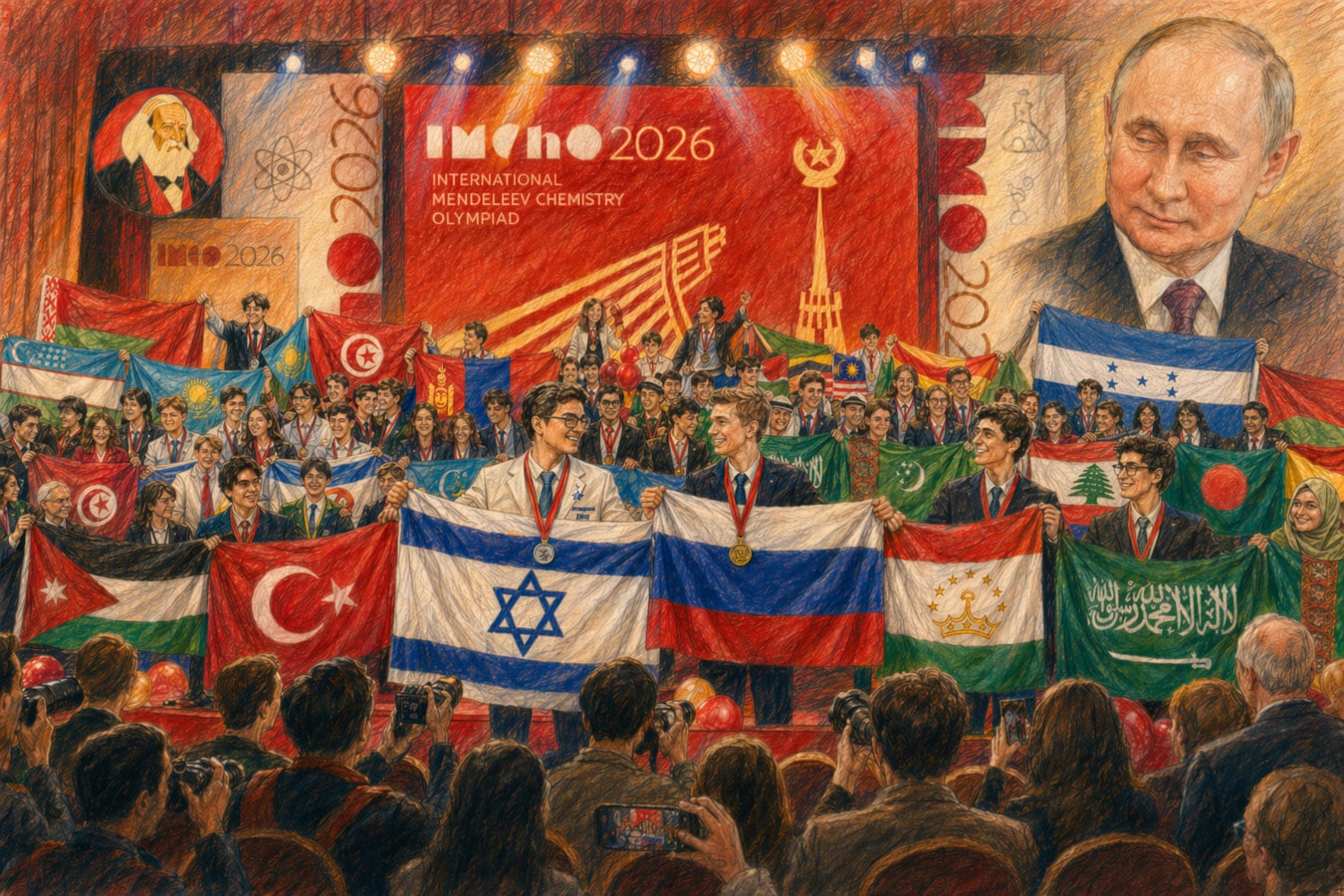
Israeli School Students at a Moscow “Olympiad”: 6 Medals and Big Questions for Those Who Sent Them There Image created with AI.
“There is no better way to celebrate Israel’s Independence Day!” That was how the official account of the Israeli Embassy in Russia framed the story on April 22, 2026.
Really.
Because what could possibly be more fitting on Israel’s Independence Day than sending an Israeli school delegation to Moscow? One can only hope they did not get there through Domodedovo.
The students returned with six medals from the 60th International Mendeleev Chemistry Olympiad. That is a strong result. It deserves respect. But that is also exactly what makes this story so uncomfortable.
The problem is not the students. The problem is not their achievement. The problem is the adults who once again decided that Israel can behave as if there is some sterile zone “outside politics,” where one may calmly pose for photographs in Moscow, step onto a stage under national flags, and pretend that this is simply a school competition. In 2026, that logic no longer looks naïve. It looks helpless.
That is precisely why the substitution here is so dangerous: the children truly performed with distinction, and that very success gives adults a convenient screen behind which they can avoid discussing the political price of such a trip.
If one looks at the list of participants and the broader political atmosphere, it becomes obvious why this is not being read as a neutral school trip but as another failure of judgment. Israel ended up as the only democracy willing to show up in Moscow for this kind of “international platform.” Against the backdrop of the absence of the United States and the leading countries of Western Europe, that looked especially humiliating.
Others stayed away because they did not want to get dirty. They did not want to take part in Russia’s staged message — look, people still come to us. They did not want to help soften the image of a regime that has now spent five years waging a destructive war against a neighboring state.
And who did show up? Moscow’s satellites, regimes comfortable with this kind of spectacle, Arab neighbors, Cuba, Belarus, and others for whom such a backdrop raises no serious moral problem. Against that background, Israel decided that it, too, should be there.
The list of countries published on the olympiad site matters for understanding the larger picture.
Mordor
Russia.
Europe
Belarus, Hungary, North Macedonia.
Africa
Botswana, Cameroon, Chad, Egypt, Kenya, Nigeria, Tunisia, Uganda, Ethiopia.
Asia
Armenia, Azerbaijan, Bangladesh, China, Kazakhstan, Kyrgyzstan, Mongolia, Tajikistan, Thailand, Turkmenistan, Turkey, Uzbekistan, Vietnam, Sri Lanka.
Americas
Brazil, Costa Rica, Cuba, Honduras.
Middle East
Israel, Iraq, Jordan, Lebanon, Saudi Arabia.
This was not a gathering of the democratic mainstream. It was a stage crowded with Russia itself, states aligned with Moscow, states comfortable with anti-Western theatrics, Arab neighbors, and regimes for which such symbolism carries no real moral cost. And in the middle of that picture stood Israel.
That is where the most uncomfortable question begins.
Who sends delegations like this? And how does it fit into Israeli policy?
Trips to international olympiads do not simply happen on their own. Israel’s chemistry team is part of an organized national structure of training, selection, and preparation. Participation in competitions of this kind does not come from a spontaneous decision by parents or enthusiasts. It requires approval, coordination, and institutional logic.
And if the Israeli Embassy in Russia did not merely know about the trip but publicly celebrated it — praising the students’ “friendliness,” their “international connections,” their favorable impressions of Moscow, and the “warm welcome” they received — then this can hardly be described as a private initiative that slipped past the state. At that point, the question is no longer for the students, or even only for their coaches. It is a question for Israel’s line itself.
The official site of the olympiad stated that the 60th International Mendeleev Chemistry Olympiad took place in Moscow from April 15 to April 23, 2026. But in this story, the issue is not only where and when. It is also what kind of event this really was.
This was not merely a school chemistry contest. It was embedded in Russia’s international image-making machine. The event was presented as a prestigious global educational platform, part of Russia’s “Decade of Science and Technology,” and Putin himself addressed the participants. That matters. It means this was never just about chemistry. It was also about spectacle, legitimacy, and the projection of normality.
And yes, the Israeli delegation performed well: one gold medal, two silvers, and three bronzes. But the better the students performed, the easier it became for everyone else to ignore the real question: why is Israel helping Moscow project international normality at the exact moment when Russia is acting against the Jewish state on several fronts at once?
Because this trip did not happen in a vacuum.
In the spring of 2026, Russia was moving against Israel along multiple lines simultaneously.
Start with Iran.
Moscow no longer looks like a cautious intermediary between Jerusalem and Tehran. It looks like Tehran’s political protector. Russia and Iran have formalized long-term strategic cooperation in security, defense, energy, transport, investment, and the nuclear sphere. This is not a passing overlap of interests. It is a structured partnership between two regimes.
That matters enormously for Israel. Iran is not some secondary diplomatic issue. Israel’s own leadership describes the Iranian regime as an existential threat. If that is indeed the scale of the threat, then an obvious question follows: how can Israel remain so soft toward a state that is helping shield Tehran diplomatically, politically, and strategically?
But Russia did not pressure Israel only through Iran.
It also attacked Israel over Lebanon. It attacked Netanyahu through Holocaust rhetoric. It reacted with arrogance and irritation in the Domodedovo affair. It entered the moral space of Holocaust memory and tried to position itself as a lecturer to the Jewish state on how history should be discussed. It sought to connect Ukraine, Israeli security, and even internal Israeli appointments into one broader frame of intimidation.
That broader pattern matters.
Moscow was not merely criticizing Israel in passing. It was working to narrow Israel’s room for maneuver. It was trying to create an atmosphere in which cooperation with Ukraine, engagement on security issues, and independent Israeli choices would all carry an implied price. Even Israeli companies were drawn into this atmosphere when Russian authorities circulated lists implying that foreign firms linked to Ukrainian military production could be treated as legitimate targets. Israeli names were included. That was not standard rhetoric. It was a form of intimidation.
This is also why the appointment of a new Mossad chief became part of the story. Russian state-linked messaging tried to connect an internal Israeli security decision to Ukraine and to a broader anti-Russian axis. That was not a comment on Gaza or even just on Iran. It was a signal that Moscow wished to frame even Israel’s internal security choices as part of a confrontation in which Israel was expected to watch itself.
Then there was Domodedovo.
When Israeli citizens complained about their treatment there, the Israeli Foreign Ministry called it absolutely unacceptable. Russia did not try to calm the situation. Instead, it responded in the familiar tone of irritated deflection: what about Ben Gurion? That was not a technical disagreement over airport procedures. It was political contempt dressed up as a response.
The same pattern appeared in the field of memory. Russia pushed itself into moral territory especially sensitive for Israel, responding sharply to Israeli positions connected with Holocaust remembrance and Yad Vashem. Even where the language sounded official and restrained, the political meaning was obvious: Moscow wanted to pressure Israel through the vocabulary of memory and moral legitimacy.
Put all this together, and the picture becomes ugly.
In April 2026, Russia was not challenging Israel on one isolated matter. It was pressing against Israel on several fronts at once: through Iran, through Lebanon, through Holocaust rhetoric, through memory politics, through business intimidation, through security pressure, and through the treatment of Israeli citizens.
That is why the Israeli delegation’s appearance on a Moscow stage did not look like a harmless academic event floating above politics. It looked like a humiliating gesture in favor of a state that, at that very moment, was acting systematically against the Jewish state.
And the symbolism did not end there.
What made the images from the ceremony even more unpleasant was the fact that the stage did not show only Russian and Israeli flags.
Nearby were the flags of states that support the “Palestinian line” and that in recent months had spoken against Israel or backed demands regarding Gaza and Palestinian statehood. Above all: Russia, Turkey, Saudi Arabia, Bangladesh, and Tunisia.
An official joint statement issued on April 23, 2026 by the foreign ministers of Turkey, Egypt, Jordan, Indonesia, Pakistan, Qatar, Saudi Arabia, and the UAE explicitly condemned Israeli actions in Jerusalem, supported Palestinian demands, and emphasized the right of the Palestinian people to an independent state with East Jerusalem as its capital.
In other words, the Israeli students did not merely receive medals.
They found themselves inside one larger international picture, standing beside the flags of states that themselves support a pro-Palestinian agenda and in many cases make anti-Israeli statements. For Moscow, this is the perfect stage: flags, smiles, medals, ceremony, international glamour — and against that backdrop, one may pretend there is no real toxicity at all.
In that sense, the photographs from the awards ceremony say even more than the texts. The Israeli flag on the backdrop of the Moscow IMChO 2026 stage — International Mendeleev Chemistry Olympiad, as the event brands itself in English — is no longer just a moment of student happiness. It is a political symbol.
The medals stay with the children. The symbolic benefit goes to Moscow.
And this is precisely where NAnews — News of Israel | Nikk.Agency should be asking the question that, once again, nobody seemed willing to ask in time:
Why is Israel once again helping its own hostile environment appear respectable?
There is, of course, an easy defense.
Do not mix science with politics. Do not make children hostages to adult conflicts. Do not take away from students what they fairly earned.
Emotionally, that argument is understandable. Politically, it no longer survives contact with reality.
Contemporary Russia does not separate international science, humanitarian exchange, school olympiads, and state image-making. On the contrary, it uses these platforms as proof of its supposed normality, relevance, and incomplete isolation. That is why not only the medals matter, but also the greeting from Putin, the rhetoric of “humanitarian dialogue,” and the visual picture of Moscow as a respected global center.
That is what makes this story so painful from an Israeli perspective.
While Russia shields Iran, attacks Israel on moral and historical grounds, and speaks to it in the language of pressure and humiliation, it also receives an Israeli school delegation on a brightly lit international stage. In that arrangement, it is not only chemistry that wins. Russia’s image wins too.
Others did not come because they did not want to get dirty.
Israel did.
Others did not want to help Moscow blur the fact of its isolation.
Israel did.
Others did not want to lend the regime another layer of international legitimacy.
Israel did — even if in the language of academic competition, even if in the comforting fiction that school events can still be kept separate from politics.
That is the real embarrassment here.
Six medals are an excellent result for school students. But for a state that should understand better than most the meaning of symbols, alliances, and political signals, this trip to Moscow looks like another example of disorientation. Israel once again showed up where normal democracies preferred not to be seen. And it did so at a moment when Russia was not merely distant from friendship with the Jewish state, but was actively and systematically working against it.
The medals will remain with the students.
The reputational question will remain with Israel.
And the longer Israel continues pretending that such trips can still be separated from larger politics, the more often it will end up in exactly this situation: children honestly winning medals while adults lose clarity, instinct, and dignity.
Related Topics
Related Posts