
Middle East Analyst
Israel’s AI Advantage Is Real — But Its Strategic Blind Spots Are Growing
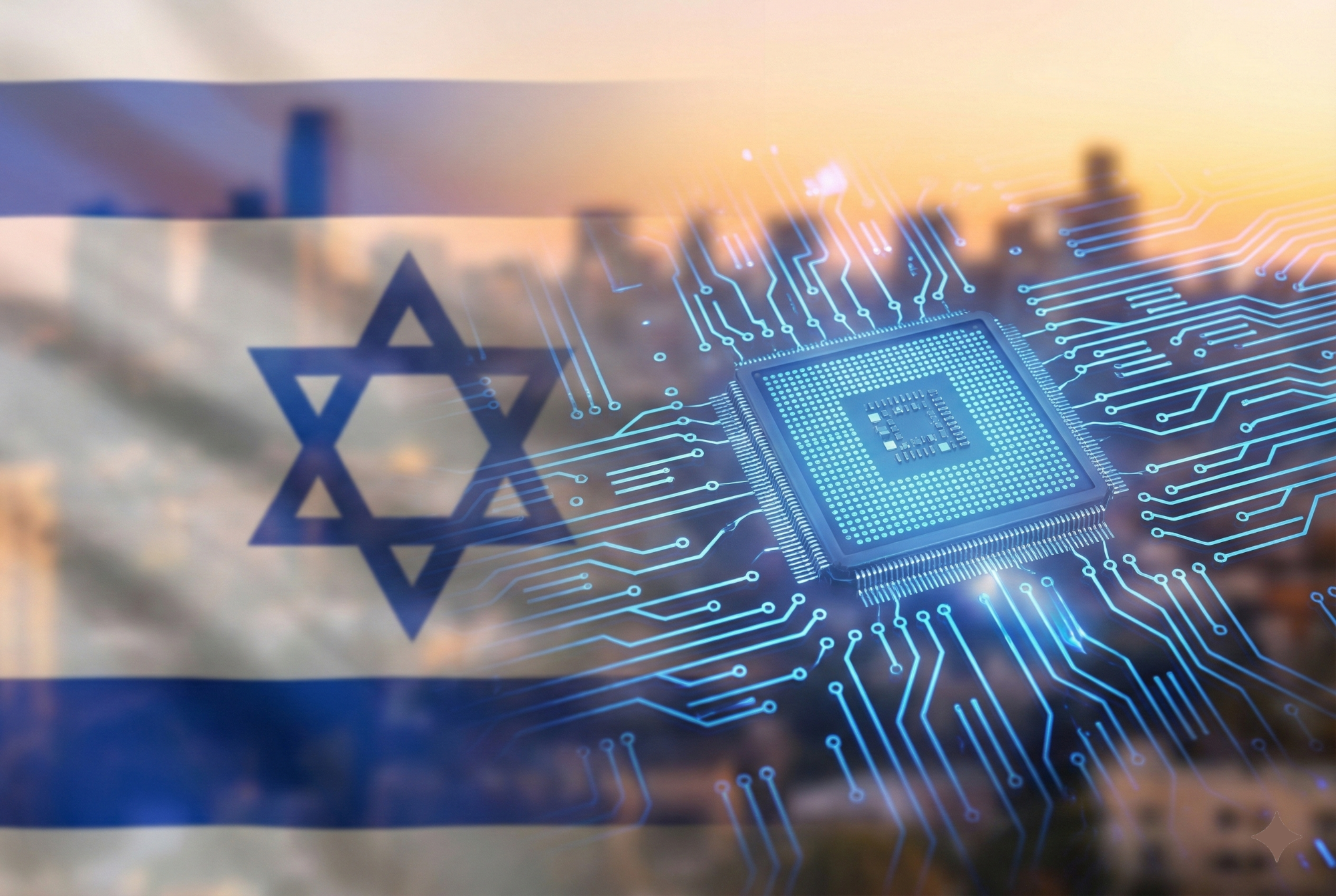
Graphic by author/Nano Banana
For thirty years, Israel has cultivated the image of a hyper‑agile innovation state — a place where elite military units, world‑class universities, and a relentless entrepreneurial culture fuse into a national engine of capability. In artificial intelligence, that reputation is earned. Israel is a global leader in applied AI, cybersecurity, autonomous systems, and dual‑use technologies that sit at the center of modern conflict and economic competition.
But the global AI landscape is no longer defined by agility alone. It is being reshaped by industrial‑scale compute, energy‑intensive infrastructure, and geopolitical blocs that are reorganizing the world’s technological order. In this new environment, Israel’s strengths remain formidable — but its vulnerabilities are structural, accelerating, and increasingly strategic.
This is not a crisis. It is a moment of strategic self‑correction.
Israel must widen its aperture. The “Little Sparta” mentality — the belief that Israel can out‑innovate structural constraints through sheer ingenuity — is becoming a strategic liability in a world where compute, energy, and alliances determine power.
Israel’s Real Advantage: Talent, Dual‑Use Ingenuity, and Security Integration
Israel’s core AI strength is not frontier‑model development or hyperscale compute. It is applied intelligence — the ability to take the best tools available and rapidly adapt them to real‑world operational and commercial problems.
Three pillars still define this advantage:
- Elite human capital
IDF intelligence units, especially Unit 8200, continue to produce engineers, analysts, and algorithmic thinkers who move fluidly between military service, academia, and the private sector. This circulation creates one of the densest innovation networks on earth.
- Dual‑use innovation
Israel excels at translating battlefield needs into commercial solutions. Computer vision, anomaly detection, autonomous navigation, and cyber‑AI systems all emerged from this dual‑use pipeline. Israeli startups succeed globally because they solve hard problems with urgency and precision.
- Security‑driven AI adoption
Decades of conflict have accelerated the integration of AI into ISR fusion, targeting, cyber operations, and operational planning. These systems have increased tempo, precision, and decision‑cycle speed — even as they draw growing scrutiny abroad.
These advantages remain real and differentiating. But they are no longer sufficient.
The Strategic Weakness: Israel Is Not a Sovereign Compute Power
The global AI race is no longer driven by clever algorithms. It is driven by compute — chips, data centers, and the energy and water infrastructure required to train and operate advanced models at scale.
This is Israel’s central vulnerability:
Israel does not control the compute stack.
Not the chips. Not the hyperscale data centers. Not the energy. Not the water. Not the export licenses governing access to any of them.
Israel’s AI ecosystem depends overwhelmingly on:
- US-made advanced GPUs
- US-controlled cloud infrastructure
- US export approvals
- Global semiconductor supply chains
In 2024, this dependency became formal policy when the United States introduced a three‑tier export control regime for high‑end AI chips. Israel was placed in Tier 2 — below unrestricted access. Licenses are now required for the most powerful hardware. Israeli industry leaders warn this could “eliminate Israel’s ability to compete” in frontier AI if not resolved.
Israel’s tactical brilliance sits atop a compute foundation it does not own — and cannot fully influence.
The Gulf Vector: The Regional Shift Israel Cannot Ignore
While Israel debates innovation policy, the Gulf is building something far more consequential:
Sovereign energy‑compute supernodes.
Saudi Arabia and the UAE are:
- locking in long‑term GPU supply
- constructing hyperscale data centers at industrial scale
- integrating energy, land, and water into AI infrastructure
- positioning themselves as global AI hubs, not regional players
They are not trying to be “Little Spartas.” They are building AI OPEC.
This is the regional context Israel must internalize. The future of AI power in the Middle East will be shaped by states that control:
- energy
- land
- water
- compute
- capital
Israel controls only one of these: talent.
Talent alone is no longer enough.
Physical Constraints: Land, Water, and Energy
Even if Israel sought true compute sovereignty, it faces hard geographic limits:
Land
Hyperscale data centers require vast footprints. In a country where every square kilometer is contested between housing, agriculture, industry, and defense infrastructure, scale is difficult.
Water
AI‑scale cooling requires enormous water volumes. Israel relies heavily on desalination — itself energy‑intensive — creating direct competition with household and agricultural demand.
Energy
Israel’s grid is constrained, and long‑term energy planning is not aligned with hyperscale compute demand curves. Offshore gas helps, but is insufficient for AI‑grade power requirements.
The likely outcome is clear:
Israel will innovate at home — but frontier‑scale compute will migrate abroad.
That deepens dependency at the very moment AI becomes the backbone of national security.
Security AI: A Strength Becoming a Pressure Point
Israel’s integration of AI into wartime targeting and intelligence has become a focal point in global debates over military AI ethics and civilian harm.
This creates two categories of strategic risk:
- Reputational and regulatory pressure
European governments, UN bodies, and NGOs are intensifying scrutiny of AI‑enabled targeting. This could trigger:
- tighter export controls
- restrictions on dual‑use AI systems
- pressure on US cloud providers to limit certain capabilities
- reputational costs for Israeli companies
- US leverage
Because Israel’s military AI relies on US chips and cloud, Washington holds quiet but substantial leverage. A modest tightening of export approvals or cloud permissions could affect Israel’s operational tempo.
Israel’s greatest tactical strength is becoming one of its strategic vulnerabilities.
Foreign Investment: Still Strong, But No Longer Unconditional
Israel remains a magnet for venture capital and Big Tech R&D. But investors are recalibrating:
- Will US export controls limit Israeli AI companies’ scaling?
- Will reputational risk complicate dual‑use exports?
- Will political instability or prolonged conflict increase operational risk?
- Will cloud compute restrictions cap growth?
Israel remains attractive — but no longer frictionless.
The Overlooked Issue: AI and Israel’s Social Contract
Israel’s AI debate focuses on innovation, security, and competitiveness. What is missing is a national plan for how AI will reshape:
- middle‑class employment
- public‑sector functions
- education and retraining
- social cohesion and inequality
Israel already faces a strained social contract — cost‑of‑living pressures, center‑periphery divides, and fragmentation over identity and politics. AI could magnify those fault lines if not proactively managed.
A society under strain cannot sustain a high‑tech defense ecosystem.
Israel at a Strategic Crossroads
Israel’s AI future depends on whether it can evolve from a brilliant applications power to a resilient compute power — or at least secure permanent, reliable access to the global compute stack.
That requires:
- a national AI strategy centered on compute and infrastructure, not just innovation
- sustained diplomatic engagement with Washington to stabilize long‑term chip and cloud access
- strategic partnerships with Gulf compute supernodes
- long‑term energy investments capable of supporting AI growth
- a workforce and social resilience plan for the post‑labor era
- recognizing AI as a core national security capability on par with air power, missiles, and intelligence collection
Israel has the talent, urgency, and operational clarity. What it lacks is a doctrine that treats AI not as a tech sector, but as the strategic foundation of future national power.
The next decade will determine whether Israel remains an AI leader — or becomes an AI‑dependent state in a world where dependency is vulnerability.
The window to act is open. It will not remain open indefinitely.
Related Topics