
Geopolitical Analyst: Bridging Somaliland & Israel to the world
Israel’s Berbera Base Bargain, Somaliland’s Terms
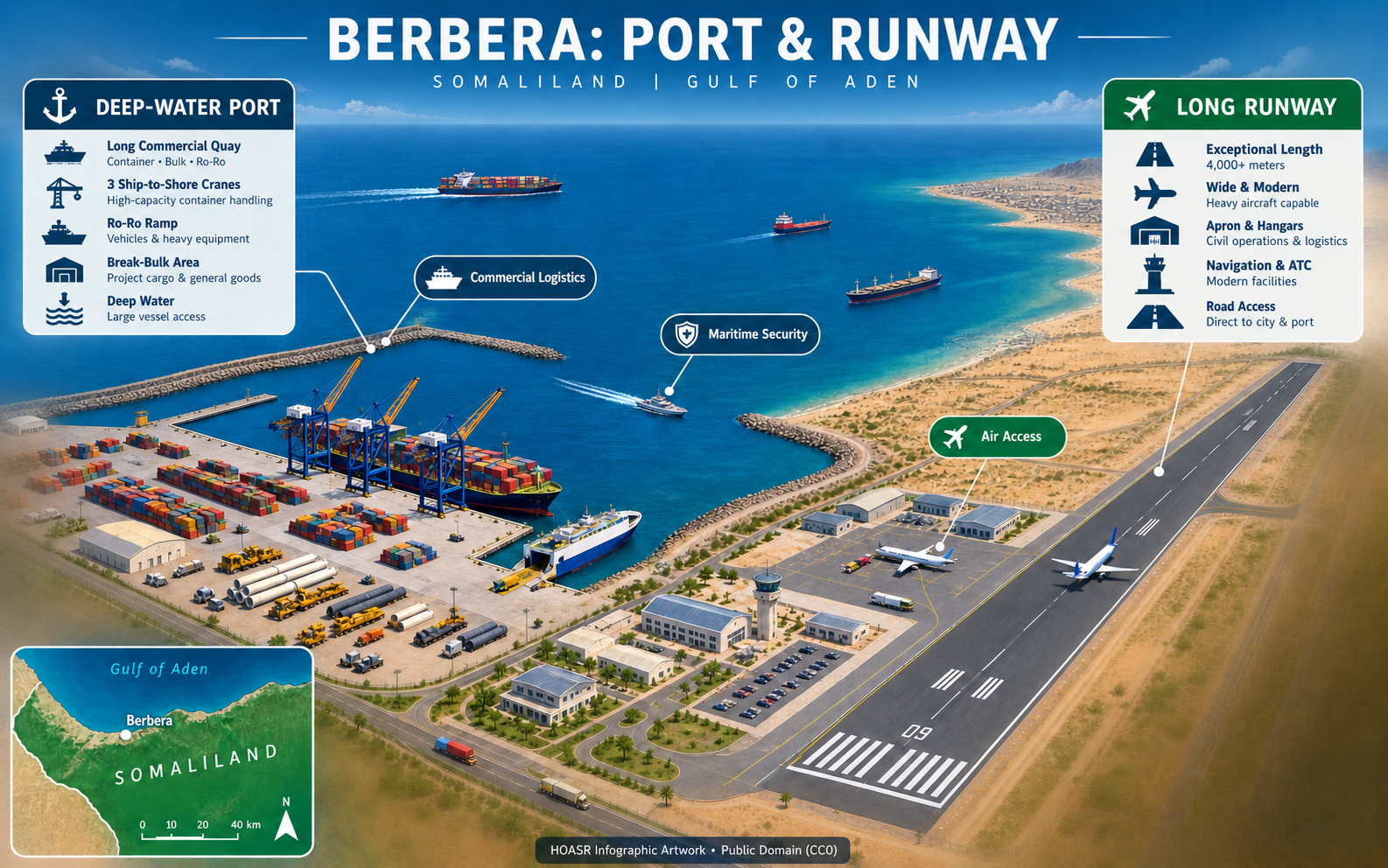
Berbera’s Dual Strategic Asset: Somaliland’s deep-water port and long runway sit on the Gulf of Aden, offering commercial logistics, maritime-security and air-access potential near the Bab el-Mandeb corridor. HOASR Infographic Artwork • Public Domain (CC0)
A transparency note:
I have previously warned against foreign military bases in Somaliland, and that caution remains justified. Somaliland must not be treated as convenient real estate in somebody else’s war. Before President Abdirahman Mohamed Abdullahi Irro publicly offered access to Israel and the United States, most base discussion was speculative. It was reasonable to oppose an undefined arrangement imposed from outside, especially one that could militarize Berbera while leaving Somaliland to bear the political and security costs.
Irro’s recent remarks change the question, not the principle. He has said Somaliland would offer base access to Israel and the United States if they are interested, while also stating that there is no Israeli or American presence yet. A sovereign public offer makes it legitimate to examine a possible agreement. It does not make an agreement inevitable, wise, or exempt from scrutiny.
Source: Israel Hayom report on Irro’s Economist interview
This caution still makes complete sense if Washington and Jerusalem decline the offer. Somaliland should not measure its worth by the number of foreign forces it hosts. Berbera can advance Somaliland’s interests through trade, logistics, coast-guard professionalism, marine services, technology and its role as a gateway to Ethiopia and the wider Horn. A decision by either country to establish a base would not diminish Somaliland’s sovereignty or strategic value. It would simply confirm that foreign basing is a tool, not a national purpose.
Why the offer deserves a serious answer
The Red Sea crisis has made the case for practical maritime cooperation stronger. The International Maritime Organization has verified 61 incidents affecting commercial shipping in the Red Sea since January 2024. Israel has also faced Houthi threats to its navigation and its southern maritime access. This makes the Gulf of Aden an active security theatre, not a distant concern.
Source: International Maritime Organization: Red Sea area
Somaliland’s strategic contribution is not that it can police the whole Red Sea lane. It cannot. Its value is more specific: a stable African-shore partner with a functioning port, local security institutions, and a direct interest in keeping maritime trade safe. Berbera is already a working commercial hub, with deep-water berths, containers, bulk, Ro-Ro and cold-chain capabilities. It should be protected and developed first as a commercial asset, whatever security agreement is eventually considered.
Source: DP World: Berbera Port operations and capacity
Djibouti: a model of lessons, not a template to copy
Djibouti demonstrates that a small Horn of Africa state can use geography to host foreign forces while retaining a central role in regional logistics. Camp Lemonnier supports US, allied and partner activities and is the headquarters of the Combined Joint Task Force-Horn of Africa. Djibouti has sought to balance several external powers while keeping foreign facilities within its own national strategy.
Source: US Africa Command: Camp Lemonnier and CJTF-HOA
It is also true that, despite its proximity to Yemen and the presence of several foreign forces, Djibouti has not been publicly reported as a Houthi missile target during the present Red Sea conflict. That should not be mistaken for immunity. Analysts have noted that Djibouti’s careful posture toward the Houthis, and the high costs of striking a state hosting multiple major powers, may have reduced the incentive to target it. Somaliland would face a different threat profile if it hosted an overt Israeli facility: Israel is a declared Houthi adversary, so the risk would be higher from the beginning.
Source: Critical Threats Project analysis of the Djibouti risk calculation
The lesson is not “copy Djibouti.” It is to negotiate more carefully than any state that relies only on rent. Somaliland must ensure that any arrangement strengthens its own civilian security, institutions and economy, rather than making its territory a platform whose risks are embedded locally and whose gains flow elsewhere.
If Israel accepts: the responsibilities it must assume
- Define the mission narrowly. Any initial arrangement should focus on maritime surveillance, early warning, logistics, medical evacuation, training, search and rescue, and defensive support for navigation. It should not begin as an open-ended combat platform.
- Protect Somaliland as well as Israeli personnel. Israel would have a responsibility to support early warning, counter-drone preparedness, air-defense planning, hardened emergency communications, medical response and civilian-protection protocols around Berbera.
- Invest in Somaliland’s capacity. A base agreement should include Coast Guard training, maritime-domain awareness, cyber protection, port security, technical education, and local employment. Israel should not merely use Somaliland’s geography; it should help Somaliland become safer and more capable.
- Respect Somaliland’s sovereignty. Israel should accept that Somaliland authorities retain agreed oversight, that the facility operates under a written legal framework, and that no mission outside that framework may be launched without defined approval procedures.
- Avoid turning Berbera into a propaganda target. Israel should keep its footprint proportionate and defensive and communicate clearly that the partnership exists to protect navigation and deter attacks, not to wage an unlimited war from Somaliland territory.
If Somaliland grants access: the rights it must secure
- Parliamentary and public accountability. Sensitive operational details may remain classified, but the broad mandate, duration, national benefits and safety provisions should be explained to Somaliland’s elected institutions and citizens.
- A written status-of-forces agreement. It should define jurisdiction, entry and exit, customs, airspace procedures, weapons storage, environmental responsibility, labor rules, accident investigations, and dispute resolution.
- A sunset clause and review mechanism. Access should be time-limited, reviewed at regular intervals and renewable only by Somaliland’s sovereign consent. Somaliland must retain the right to suspend or terminate the arrangement when agreed conditions are breached.
- Civilian protection before construction. No facility should proceed before a threat assessment; evacuation plan, emergency hospital capacity, blast-risk and air-defense assessment, and compensation procedures for civilian loss or damage are agreed.
- Economic reciprocity. Somaliland should negotiate measurable investment in port resilience, roads, water, electricity, health services, skills transfer and local procurement – not only a financial payment for access.
- No automatic entanglement. Somaliland must not become automatically responsible for every wider Israeli conflict. Its consent, laws and national interest must determine what missions and deployments are permitted from its territory.
Begin with a partnership before a base
The most prudent sequence is phased. First, establish a maritime-security dialogue and information-sharing channel. Somaliland’s Coast Guard already has experience with the EU-supported IORIS platform, which supports mapping, AIS information, and regional coordination. Israel can provide training and technology without immediately establishing a large foreign footprint.
Source: CRIMARIO: Somaliland Coast Guard and IORIS information-sharing
Second, agree on rotational access for surveillance, maintenance, emergency logistics, medical evacuation, and defensive maritime support. Only after these arrangements prove useful, lawful and publicly sustainable should either side consider a limited joint facility. The political argument for permanent basing should have to clear a higher threshold than the argument for coast-guard capacity, port resilience, and shared early warning.
There is already a record of Israeli-Somaliland security contact. Somaliland’s defense minister said in June that Israel was training Somaliland police and military personnel, while denying that an Israeli base existed or was under negotiation at that time. That is the appropriate factual baseline: confirmed cooperation, a new public offer, but no publicly confirmed base agreement.
Source: Reuters: Israel training Somaliland forces; no base agreement confirmed
The standard Somaliland should set
A base agreement, if one is ever reached, should be judged by a simple standard: does it leave Somaliland more secure, more capable, more prosperous and more in control of its own future than before? If the answer is no, Somaliland should decline it. If the answer is yes, the agreement should be transparent enough to defend, limited enough to manage, and reciprocal enough to justify the risk.
President Irro’s offer has opened a legitimate debate. Somaliland should conduct it with confidence, not desperation. Israel, if it chooses to accept, should approach Berbera as a partner’s strategic home – not as a disposable extension of a distant front. The Red Sea is dangerous enough. A durable arrangement will come not from haste, but from sovereign consent, clear responsibilities and protection for the people who live beside the port.
Related Topics
Related Posts