
CEO of Time to Stand Up for Israel
Israel’s Breakthroughs Change Lives
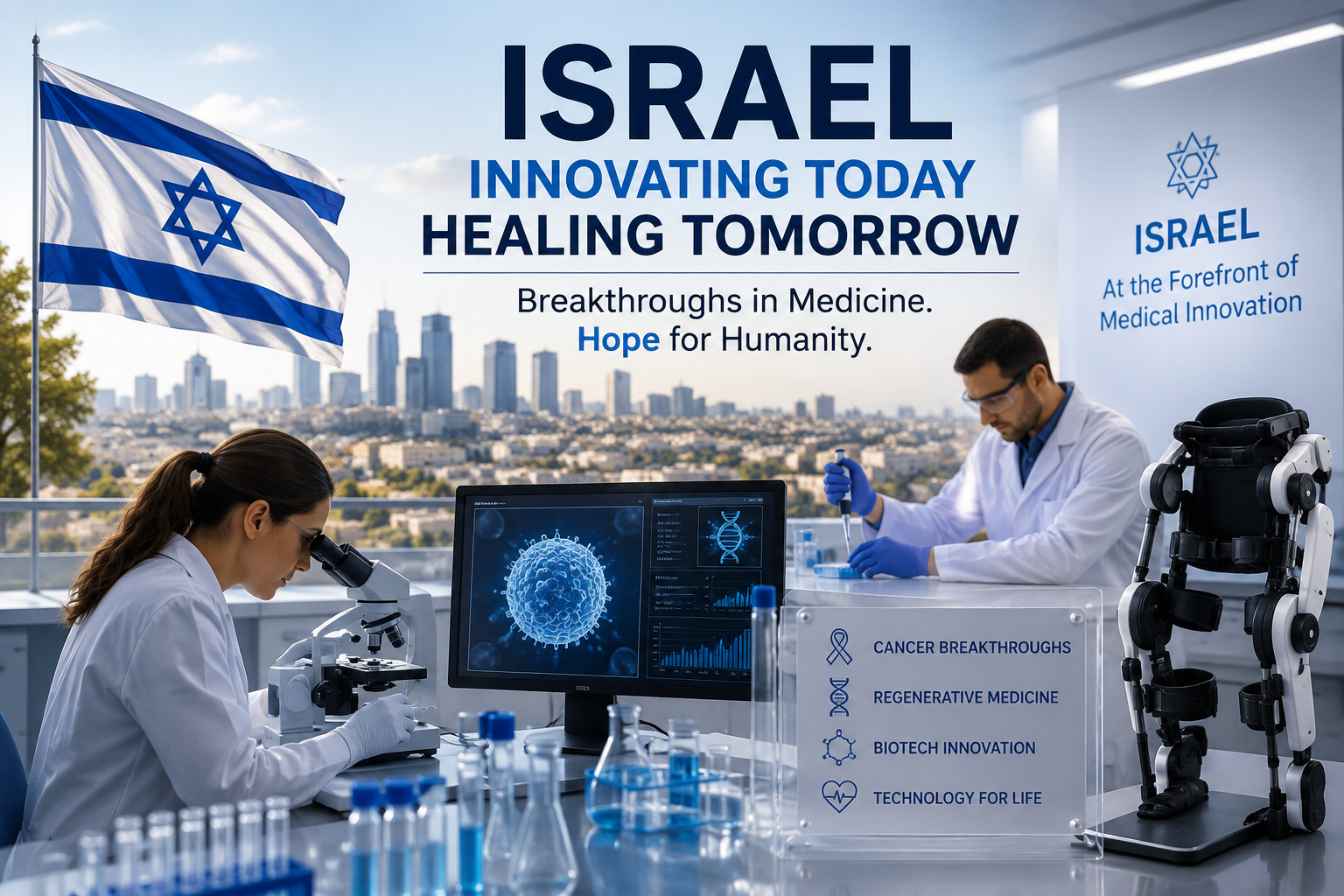
Photo Credits: Sabine sterk(AI)
Israel’s Medical Miracle and Why the World Should Look at Israel Differently
When people think about Israel, they often think about conflict, security challenges, diplomacy, and headlines dominated by war and politics. Day after day, news reports focus on rockets, terrorism, international disputes, and controversy. Yet behind those headlines exists another Israel. It is an Israel of innovation, compassion, science, and life saving discoveries that benefit humanity far beyond its borders.
One of the most remarkable recent examples is Israel’s groundbreaking work in cancer treatment and personalized medicine. Israeli researchers have been developing revolutionary technologies that allow doctors to identify diseases earlier, tailor treatments to individual patients, and dramatically improve survival rates. These innovations are not designed only for Israelis. They are helping people around the world regardless of nationality, race, religion, or political beliefs.
Israeli scientists have become global leaders in medical research because of a culture that encourages questioning, creativity, and problem solving. In a country smaller than many cities, surrounded by challenges and limited in natural resources, Israelis learned long ago that their greatest resource is the human mind.
A stunning example is the development of advanced cancer detection methods that use artificial intelligence to identify tumors at stages where treatment is far more effective. Researchers in Israel are combining biotechnology, genetics, and machine learning in ways that were considered science fiction only a decade ago. The goal is simple yet profound: save lives before it is too late.
Another breakthrough comes from Israeli work in regenerative medicine. Scientists are exploring ways to repair damaged organs and tissues using stem cells and advanced biological engineering. Imagine a future where heart damage after a heart attack can be repaired, where spinal injuries can be treated more effectively, and where organ shortages become a thing of the past. Israeli researchers are helping turn these possibilities into reality.
Perhaps even more inspiring is the development of technologies that restore independence to people with disabilities. Israeli companies have created robotic exoskeletons that allow some paraplegics to stand and walk again. For individuals who believed they would spend the rest of their lives confined to a wheelchair, such technology offers hope that was once unimaginable.
What makes these achievements even more remarkable is that they emerge from a nation constantly forced to devote enormous resources to its own defense. Despite facing terrorism, regional instability, and repeated attempts to isolate it internationally, Israel continues investing heavily in education, research, healthcare, and innovation.
This reality exposes a contradiction that many critics prefer to ignore. A country portrayed by its detractors as a force for destruction is in fact one of the world’s leading forces for healing. Israeli doctors treat patients from all backgrounds. Israeli humanitarian teams are among the first to arrive after earthquakes, floods, and natural disasters around the world. Israeli medical innovations save lives in Europe, Asia, Africa, North America, and the Middle East.
When a cancer patient benefits from an Israeli breakthrough, the disease does not ask about politics. When an Israeli developed medical device saves a child, it does not check nationality. When Israeli scientists create technologies that improve quality of life, the beneficiaries come from every corner of the globe.
The world should pay more attention to this side of Israel.
Too often, public opinion is shaped by endless repetition of conflict related narratives. Negative stories generate headlines. Medical breakthroughs rarely receive the same attention. Yet which contribution has a greater impact on humanity? A political speech that dominates the news cycle for twenty four hours, or a medical innovation that saves millions of lives for generations?
Israel’s story is not merely one of survival. It is a story of contribution. It is the story of a people who returned to their ancestral homeland and transformed a small nation into a global center of innovation. It is a story of scientists, doctors, engineers, and entrepreneurs who refuse to accept limitations and who constantly search for solutions to humanity’s greatest challenges.
Critics are free to disagree with Israeli governments, just as citizens of every democracy debate and criticize their own leaders. But reducing Israel to a caricature of conflict ignores reality. It ignores the hospitals, laboratories, universities, and research centers where dedicated professionals work every day to improve the human condition.
The world does not need to agree with every Israeli policy to recognize Israel’s extraordinary contributions. It does not need to support every government decision to appreciate the lives being saved by Israeli medicine and technology.
A fair view of Israel requires looking at the whole picture.
That picture includes a nation that has produced breakthroughs in cancer treatment, cardiac care, medical imaging, rehabilitation technology, emergency medicine, and countless other fields. It includes a society that turns adversity into innovation and challenges into opportunities.
Israel is not only defending its people. It is helping heal the world.
The next time someone speaks about Israel, remember that behind the political noise are scientists searching for cures, doctors saving lives, and innovators creating technologies that give hope to millions. These achievements deserve recognition because they represent the very best of what humanity can accomplish.
In a world often divided by conflict and ideology, Israel’s medical breakthroughs remind us of something important: the greatest victories are not won on battlefields. They are won in laboratories, hospitals, and research centers where human ingenuity is used to preserve life.
That is an Israel the world should celebrate.
Related Topics
Related Posts