
Help Us Hear, O Israel
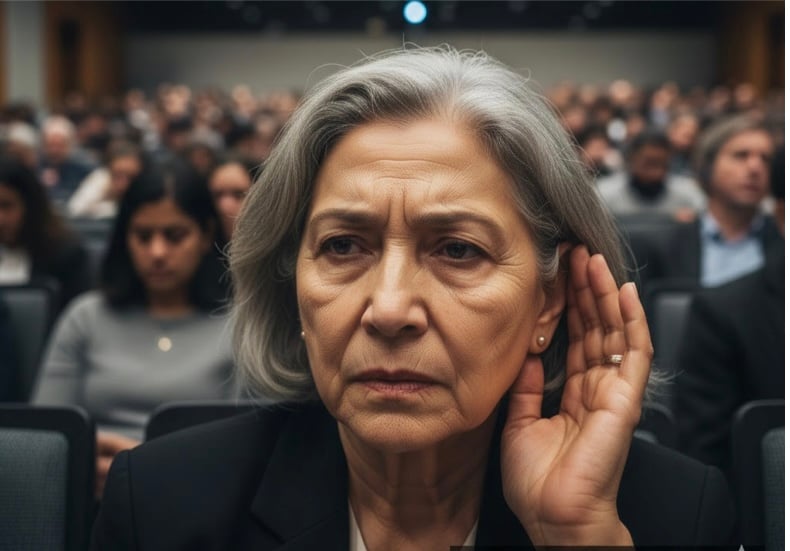
By Marvin Packer, MD—Addressing the high prevalence of age-related hearing loss, the communal and personal failure to remedy it, and the critical consequences for brain health.
The Glass Wall
Imagine you are sitting in a lecture:
The speaker’s voice is clear at first. You can follow each sentence, each slide.
Then, the words start to blur. It’s as if someone has turned down the volume to a muffled half-presence. The consonants vanish first—“t,” “k,” “s”—leaving only rounded vowels that smear into one another.
At the same time, the other sounds in the room grow sharper: someone clicking a pen, the rustle of pages, chairs shifting on the floor, a cough from behind. Even the hum of the projector feels louder.
You lean forward, straining to piece together fragments. What had been effortless is now work—listening with every muscle tense, guessing from context, hoping you’ve caught the meaning.
The lecture continues smoothly for everyone else, but for you, it feels like you’ve been pushed just outside a glass wall, with faded sound obscured by noise.
I know this experience. I live it. And so do millions of others.
The Invisible Epidemic of Presbycusis
Presbycusis (age-related hearing loss) affects one-third of adults between 65 and 75, and the incidence and severity increase with age. It is invisible, insidious, and profoundly under-recognized. Because it develops slowly, many people don’t notice it in themselves. Because it leaves no outward mark, others rarely notice it. In addition, more than a fifth of adults over 65 live with tinnitus — a ringing or hiss with no external source — another barrier to hearing.
As we age, soft sounds, and especially high frequency consonants, become harder to perceive, and the ability to discriminate similar sounds diminishes. This makes soft or rapid speech significantly harder to understand. A “p” can sound like a “t”, or an “s” like an “f”, which can change the whole meaning of a word or sentence (“cup” perceived as “cut” or “sail” as “fail”). Because consonants transmit much of the meaning of speech, their loss disproportionately affects understanding—even when speech seems loud enough. Speech may be perfectly audible but unintelligible: you hear the voice, but miss the words.
The Public Space Acoustic Barrier
Compounding the natural rapid fall off of sound volume over distance, many lecture halls or houses of worship have hard surfaces and high ceilings that reflect sound, creating prolonged echoes that arrive late, obscure already soft sounds, and blur the separation of syllables.
In addition, speech comprehension in older adults demands a voice volume significantly louder than ambient sound. Background noise, such as ventilation systems and audience movement, instantly erases that critical margin. When you add rapid speech that outpaces an older individual’s processing speed and “clips” high-frequency consonants, comprehension begins to fall apart. Add unfamiliar accents, the loss of facial cues by a speaker who turns away, and the absence of high-quality microphones and assistive listening systems—and comprehension completely collapses.
The Hearing Aid Adoption Crisis
And here is a sad fact: help exists, but most people don’t use it. In Israel, even with substantial government health basket subsidies, research shows that only 40.9% of older adults (65 to 85) follow through with adopting hearing aids. By comparison, in the United States, that number drops even lower, with only about 30% of people over 71 utilizing them.
The reasons for low utilization include cost, physical discomfort, underestimated benefit, difficulty of adaptation, and disappointment in sound quality. In Israel, complex bureaucratic barriers to obtaining hearing aids remain a significant factor.
In addition, because age-related hearing loss has an insidious onset, many individuals remain completely unaware of the extent of their impairment and attribute difficulty to a mumbling speaker, poor acoustics or noise.
Finally, individuals with hearing loss may be reluctant to disclose it. This often stems from a deep-seated stigma, a fear that admitting to hearing difficulties will cause others to perceive them as less capable, unintelligent, or defined by negative stereotypes associated with the elderly. They may adopt a strategy of “passing”: nodding or smiling to maintain a sense of normalcy even when they have lost the thread of a conversation. This can have significant ramifications at medical appointments, work and social gatherings.
The Hidden Cognitive and Social Costs
But hearing loss isn’t just about missing words. It can quickly lead to cognitive harm. When an older adult strains to decode speech, the brain has to work harder. Cognitive scientists call this “effortful listening” and the cost is high. Over time, the auditory cortex, starved of stimulation, begins to atrophy. The brain compensates by reassigning speech processing to the prefrontal cortex — the region normally reserved for memory and decision-making — diverting higher-order resources just to keep up with basic comprehension. Complex thinking suffers because the mental resources spent deciphering a sentence are unavailable for understanding, reflection, or enjoyment of what was said.
Then withdrawal begins. The lecture becomes too difficult, the service less engaging, the meeting over one’s head, and the dinner party socially unfulfilling. Thus, the bonds to key communal settings dissolve. Social isolation sets in, and with it, depression, both of which independently accelerate cognitive decline.
The research is stark: the greater the hearing loss, the higher the risk for dementia. Compared with normal hearing, mild hearing loss nearly doubles the risk, while severe hearing loss increases it nearly fivefold.
But a landmark 2023 study, the ACHIEVE trial, revealed something equally significant. Hearing aids reduced cognitive decline by 48% over three years in older adults with vascular risk factors such as hypertension, diabetes, and heart disease, the population most vulnerable to brain atrophy. The brevity of the study may have precluded similar findings in healthier subjects, in whom decline was too slow to measure.
In other words, hearing health is brain health.
Reframing Acoustic Accessibility as Public Health
We tend to think of hearing accessibility as an accommodation, a kindness extended to individuals, a compliance box checked under Israel’s Equal Rights Law or the ADA. This framing misses the larger picture.
More deeply, accessible spaces are instruments of preventive medicine. Every conversation sustained, every lecture followed, every social connection preserved is a cognitive exercise—auditory stimulation that maintains vulnerable neural pathways. In an aging society, the aggregate effect of acoustic accessibility is a significant reduction in dementia risk.
Just as we treat lead paint abatement and clean air standards as public health measures, acoustic accessibility deserves the same framing. When a lecture hall updates acoustics, it is an investment in the cognitive resilience of the community.
Breaking the Glass Wall
The International Symbol of Access for Hearing Loss — a blue square containing the outline of an ear with a slash through it — indicates the presence of an assistive listening system. When annotated with a “T” for telecoil, it signifies the capacity to stream audio directly to compatible hearing aids and cochlear implants, cutting out the background noise of a crowded room. At service counters, for those lacking a telecoil, the T requires availability of a headset or handset.
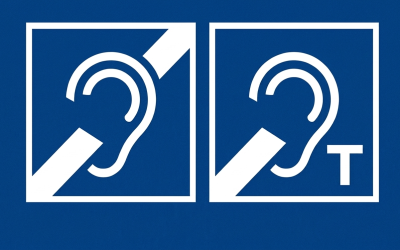
The public display of these symbols which is required by law—including in supermarkets, medical clinics, transportation terminals, theaters, and houses of worship—carries heavy penalties for non-compliance. In reality, however, enforcement is practically nonexistent. Frontline staff is ignorant of the meaning of these signs and do not know how to instruct a customer to activate their telecoil, how to provide a headset, or even how to operate their own microphones. This systemic lack of operational knowledge effectively neutralizes the technology. Implementation demands enforcement and staff education.
Assembly Halls: While major Israeli performance halls enjoy uniform acoustic excellence, smaller assembly spaces often do not. They should compensate by clearly marking favorable listening zones at the point of entry and ensure that all amplification systems—including microphones—are high quality, regularly tested, and managed by trained personnel.
Wherever feasible, they should install assistive listening infrastructure—such as hearing loops, FM, infrared or next-generation Bluetooth Auracast—that streams audio directly to compatible hearing aids, cochlear implants and headsets.
Finally, acoustic evaluations should guide the installation of soft furnishings, wall panels, and carpets that dampen echoes and sharpen speech clarity.
Other Public Spaces: Accommodation to hearing loss should extend to other gathering places. For example, crowded, high-noise areas like restaurants should provide quiet zones free of background music.
Speaker Etiquette: This is the vital starting point for connection. To include every listener, speakers should adhere to specific practices. They should encourage those with hearing impairments to sit in front rows, near loudspeakers, or to request available assistive devices. They should speak loudly, clearly, and unhurriedly—perhaps rehearsing with voice analytics software to monitor and refine delivery. They should use a microphone if available and make an effort to face the audience to provide lip-reading and facial cues. They must ask and wait for complete silence before starting, and pause if audience noise arises. They should repeat audience questions, even if the questioner has a microphone. Finally, they should use large-font displays or handouts to reinforce verbal content.
Public Health: Public health guidelines should standardize audiological screening for those over 60, mirroring the proactive approach taken with colonoscopy and mammography. By routinely screening and minimizing bureaucracy, we can identify and address hearing loss early, before the onset of withdrawal, isolation, and cognitive decline.
Physician, Industry, and Audiologist Responsibilities: Physicians must proactively educate patients that untreated hearing loss is not just an inconvenience but a risk factor for cognitive decline, and that early intervention is critical.
While telecoils are valuable for navigating the public world, vendors rarely promote them. To reduce device size, albeit slightly, and cater to Bluetooth, manufacturers sacrifice public accessibility to exclusive, private connections. Professional audiology associations should aggressively promote telecoil inclusion. Furthermore, modern accessibility laws should tie insurance subsidies to public listening capabilities such as telecoils and emerging Auracast Bluetooth, incentivizing vendors to prioritize public access.
Acquiring a hearing aid is a major lifestyle commitment. These are complex devices worn up to 16 hours a day, often by older adults who require patient, repetitive training to use them successfully. Instruction must address expected cognitive and physical adjustment, while providing the emotional support needed to persevere. New users should be taught how to switch between program modes (including the telecoil) and how to perform basic maintenance, like replacing a blocked wax guard. Finally, they should be reminded to have their ears checked for cerumen (earwax) on a personalized schedule and to undergo regular hearing tests.
Navigating Private Gatherings: At private gatherings such as a dinner party, small accommodations make a big difference. Hosts should arrange seating so a hearing-impaired guest sits in a central spot, optimizing audibility and lip-reading, and away from noisy spaces like the kitchen. Guests should keep simultaneous cross-talk to a minimum. Finally, a quiet room or alcove, away from competing conversation and noise, could allow individuals with hearing loss to enjoy meaningful conversation with one or two other guests.
Owning the Narrative: To break the cycle of silent exclusion, the focus must shift from concealment to proactive self-advocacy. This is not about announcing a disability; it is about providing others with the “user manual” for how to engage in a mutually beneficial conversation.
Start by stating your hearing needs at the beginning of an interaction to remove guesswork for both parties. Instead of just asking for more volume, request that a speaker rephrase a sentence, slow down, or face you directly to allow for lip-reading.
Next, choose seats away from background noise or move to a well-lit space where visual cues are more accessible.
If you or others note a hearing issue, arrange a hearing test. If indicated, pursue hearing aids, keeping in mind that the earlier introduced, the easier the brain adapts. Then, commit to patiently working through the adjustment period.
Learn to access and confidently request public venues’ assistive listening systems, and leverage speech-to-text apps such as Google Live Transcribe for real-time visual reinforcement.
Consider participating in independent peer-support communities, such as the Hearing Tracker Forum, where hearing aid users share real-world experiences, exchange practical advice, and discuss emerging technologies.
Ultimately, each of us must be mindful that a portion of our audience requires us to speak clearly, unhurriedly, and with sufficient volume to ensure full engagement. Modeling this behavior today will positively influence those around us, especially our children and grandchildren.
The Moral and Religious Imperative
The glass wall is not inevitable. It is built by the spaces we design, the habits we keep, and the assumptions we make about who can hear and who cannot.
The Shema, a central prayer of Judaism, calls us to “Hear”—to be aware of our connection to G-d and His commandments, including loving your neighbor as yourself. Leviticus 19:14 adds a concrete mandate: “You shall not curse the deaf, nor place a stumbling block before the blind…”
When we allow our synagogues, lecture halls, and gathering places to remain acoustically hostile, we place stumbling blocks before those who struggle to hear. When we remove them through sensitive intentional behavior, personal advocacy, improved design, and accessible technology, we move beyond mere “volume” to build bridges of connection, maintain inclusion, and enhance cognitive resilience. In doing so, we turn the command to “hear” into a reality that honors our elders and enriches the vitality of our entire community.
The obligation is clear.
Acknowledgements: I am deeply grateful to my son Jonathan Packer for his critical review and revisions, and Kevin Mahaffey, MA, Fellow of the Acoustical Society of America, for his review and valuable suggestions.
Sources and Further Reading
- American Speech-Language-Hearing Association (ASHA). Comprehensive clinical resources on speech perception, acoustics, and assistive listening devices.
- Brand, D., Adelman, C., & Gordon, D. (2025). Factors Related to Compliance with Recommendations for Hearing Aid Counseling: A Pilot Study. Audiology Research, 15(5), 136. Note: A local Israeli study examining how bureaucracy and personal stigmas suppress device adoption despite generous state health basket subsidies.
- Gordon-Salant, S. and Fitzgibbons, P. J. (1999). Profile of auditory temporal processing in older listeners. Journal of Speech, Language, and Hearing Research, 42(2), 300-311.
- Hearing Tracker Forum (Online Community) — An independent, third-party platform where users share real-world experiences, discuss hearing aid performance, and track new technological advances. Note: While the forum is unbiased and peer-led, the host site monetizes through industry ads, partnerships, and clinic referrals.
- Jarach, C. M. et al. (2022). Global prevalence and incidence of tinnitus: A systematic review and meta-analysis. JAMA Neurology, 79(11), 1088-1100.
- Lin, F. R., Niparko, J. K., & Ferrucci, L. (2011). Hearing loss and incident dementia. Archives of Neurology, 68(2), 214–220. Note: Foundational study correlating hearing acuity and long-term relative risk of developing dementia.
- Lin, F. R., et al. (2023). Hearing intervention versus health education control to reduce cognitive decline in older adults with hearing loss (ACHIEVE). The Lancet. 402(10404), 786-797. Note: Landmark study demonstrating that hearing aid intervention directly slows 3-year cognitive decline by 48% in vulnerable older adults.
- Ministry of Justice (Israel). (2013). Equal Rights for Persons with Disabilities (Accessibility Adjustments for Service) Regulations, 5773-2013. Reshumot: Kovetz HaTakanot (Official Gazette), 7254. Note: Israeli regulations regarding requirements for service counters, assembly halls and public spaces.
- National Institute on Deafness and Other Communication Disorders (NIDCD). Consumer guidance on the identification and management of age-related hearing loss (presbycusis).
- Reed, N. S. et al. (2023). Prevalence of hearing loss and hearing aid use among U.S. Medicare beneficiaries aged 71 years and older. JAMA Network Open, 6(7), e2321466.
- U.S. Department of Justice. (2010). ADA Standards for Accessible Design: Technical Requirements for Assistive Listening Systems.