
The Middle East – The Lid and the Fault Lines
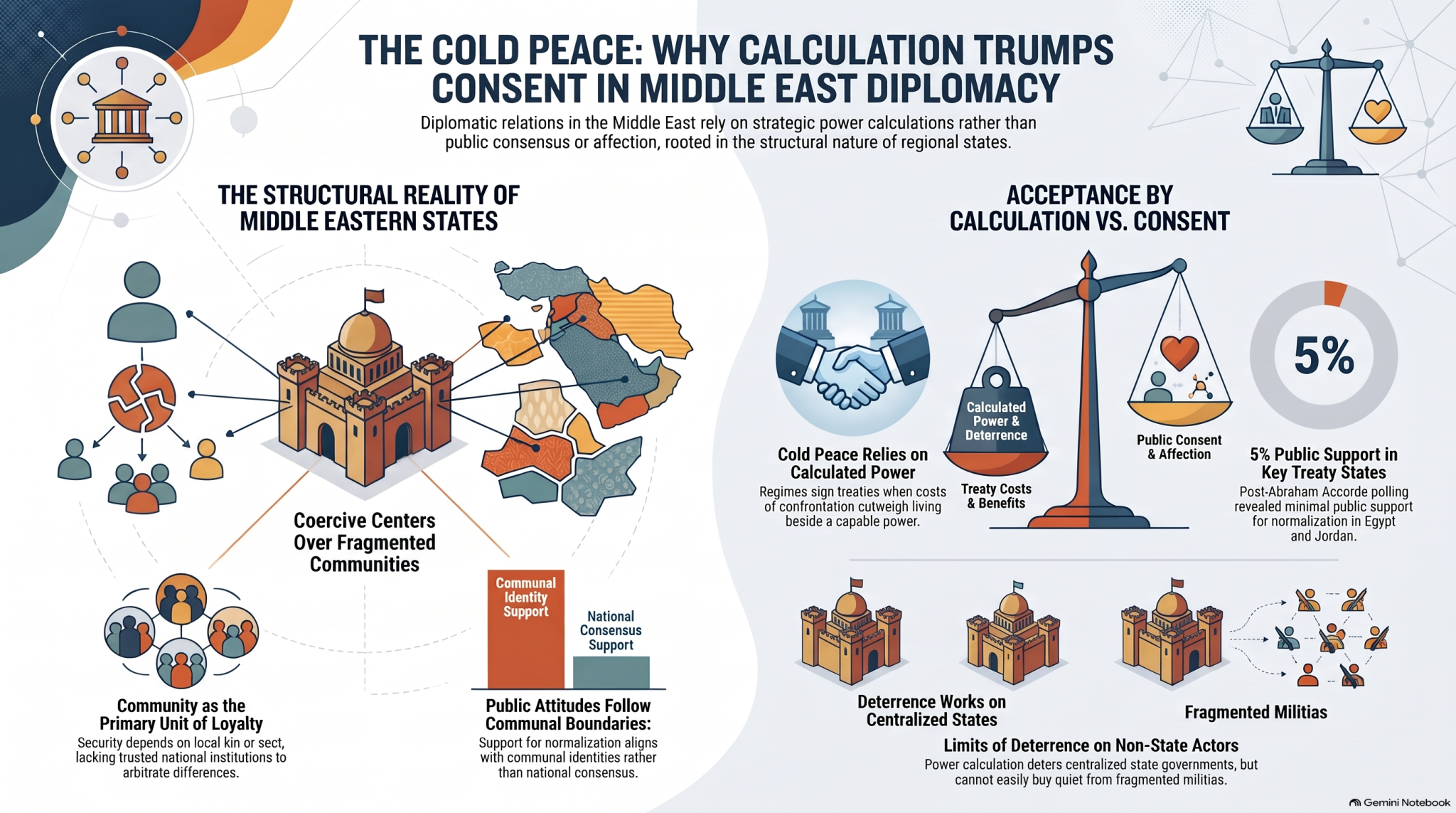
Most of the states of the Middle East are coercive arrangements laid over communities that share no common political project and have little reason to trust one another. They hold together while the coercive center holds, and they divide along ethnic, sectarian, tribal and regional lines when it does not.
This is a claim about structure, not about the character of any people, and it carries a consequence that both Israel’s friends and its critics tend to avoid. A region in that condition has no institution capable of delivering a settled, consensual acceptance of Israel, whatever the quality of Israel’s diplomacy or the generosity of its offers. What Israel can realistically earn is narrower and sturdier: the respect that capable states pay to a power they cannot dislodge and would be unwise to provoke. Acceptance by affection is not on offer. Acceptance by calculation is, and it lasts exactly as long as the calculation does.
The idea is old. Ibn Khaldun built his theory of politics on asabiyyah, the group solidarity of kin, clan and tribe, and argued that rulers hold diverse groups together only as long as their coercive core remains strong. The Ottoman Empire was itself such an arrangement: an imperial and religious authority over many communities, managed through bargains with local notables. It was not a nation. When it fell, the victorious powers drew borders around Iraq, Syria, Lebanon and the rest, and the successor states inherited the communities without inheriting the imperial authority that had managed them. Most of them solved the problem the way Khaldun would have predicted. They built a strong center and relied on it.
How the divisions came to bind matters, because the argument does not depend on any people being hostile by nature. The French Mandate recruited heavily from Syria’s minorities for its local forces. Saddam Hussein ran Iraq on tribal and regional patronage. Many analysts argue that the dismantling of Iraq’s state apparatus after 2003 pushed large parts of the Sunni population toward insurgency. The autocracies did not simply suppress communal identity. They organized politics around it, and that made the community the safest unit of loyalty. The argument needs only what this record supplies: communities whose security came to depend on their own group, and no institution trusted to arbitrate among them.
The consequences are consistent. Iraq under Saddam Hussein, Syria under the Assads and Libya under Qaddafi presented unified national faces, and each broke along sectarian, ethnic, regional or tribal lines once the center was removed or weakened. When a state weakens, every group fears domination by the others and arms itself, a security dilemma that produces militias without anyone having to be hostile by nature. Lebanon is the control case. It never had an autocrat, and it produced a confessional power-sharing system and a fifteen-year civil war. Today the pattern is visible in real time. Analysts describe Yemen in 2026 as edging toward two de facto states, Syria as functioning less as a state than as a field of overlapping outside influence, and Sudan as a collapse driven by an open war economy and deep social fragmentation.
Public opinion carries the same signature. Arab Barometer’s 2021-22 surveys found that in Lebanon and Iraq, where support for normalization with Israel ran slightly above the regional norm, it did so along communal lines: 38 percent of Lebanese Christians favored it against 5 percent of Lebanese Muslims, and 29 percent of Iraqi Kurds against 12 percent of everyone else. The map of attitudes follows the map of communities, as one would expect if the community, not the state, is the primary unit of loyalty.
This does not mean these societies share nothing. Cross-sectarian protests in Iraq and Lebanon, and the uprisings of 2011, showed that ordinary people share grievances about corruption and elite capture. The common ground is real, but it has no institutional home. It can fill a square, and it cannot staff a state or bind a faction. Hostility to Israel is the largest example, and it should be understood as a grievance, not dismissed as mere hatred. Arab Barometer found that Moroccan support for normalization fell from 31 percent to 13 percent between its surveys, after the Gaza war began, and that among Moroccans who called Israel’s campaign a genocide only 9 percent supported normalization, against 31 percent among those who called it a conflict. That is opinion responding to conduct. But a shared grievance is a negative consensus. It tells governments what their publics will punish. It does not create an authority able to bind those publics to a settlement, or to deliver one.
The peace record fits. Egypt signed a treaty in 1979 and Jordan in 1994, and their governments cooperate with Israel on security. Yet when Arab Barometer polled after the Abraham Accords, only 5 percent of Egyptians and 5 percent of Jordanians favored normalization, among the lowest of twelve publics. The treaties survived because the regimes judged them to be in their interest, and the public never had to be persuaded. The Accords were built the same way. They were transactions, and the Arab Barometer researchers note that they bundled peace with American policy changes the publics had long wanted: Morocco received recognition of its position on Western Sahara, and Sudan was removed from the American list of state sponsors of terrorism. Support in those two countries was higher a year later, and the researchers link the difference to education, since the better educated were likelier to appreciate what had been gained. When the war in Gaza overshadowed the benefit, Moroccan support collapsed. The same researchers expect that even if the Accords were extended, the likeliest result would be a cold peace like Egypt’s and Jordan’s.
They also argue that a warm peace would only have a chance after a Palestinian state is established. That condition does not escape the structural problem. It runs straight through it. One regional analysis of Gaza in 2026 describes a territory with no agreed political vision for its governance, and notes Israel’s refusal of any formula that would recreate a unified Palestinian authority without dismantling armed structures. A warm peace would require a Palestinian leadership able to speak for its people and enforce what it signs, which is exactly the capacity the structural argument says the region lacks. The route to a warmer peace is therefore not closed, but it passes through institution-building, which is slow, and not through the persuasion of publics. Until then a cold peace is the working horizon, and that is the realistic ceiling.
A cold peace is no small thing. It is a peace in which governments calculate that confronting a capable, well-backed Israel costs more than living beside it, and it rests on respect for power in the plain sense: Israel’s military strength, its economic and technological weight, and the willingness of its patrons to stand behind it. This does not claim that power dissolves grievance. Power will not make Israel liked, and it breeds some resentment of its own. The claim is narrower. Governments act on calculation, and publics that cannot bind anyone cannot overrule a calculation sustained over decades, as Egypt and Jordan show. Regimes whose legitimacy is fragile have every reason to avoid a war they would lose, and some, facing threats of their own, have reason to value Israel’s strength. Respect resting on power has to be maintained, which is a cost. But acceptance resting on consent would be costlier and more fragile, since it would depend on publics whose attitudes moved eighteen points in the space of one war.
The strategy has a limit, and the structural argument explains it. Respect for power works on states with centers that calculate. It works poorly on movements that have no state to lose. Where a center has hollowed out, as in Lebanon, Yemen or Syria, the actors Israel faces are militias and parties with their own communal bases and incentives, and deterrence aimed at them must be re-earned repeatedly. The same fragmentation that rules out acceptance by consent multiplies the actors who must be deterred. Power buys Israel quiet from governments that can be dissuaded. It buys nothing from those who cannot be.
The conclusion therefore survives the strongest objections, because the objections, followed to their end, turn into parts of it. The divisions may have been manufactured as much as inherited, and the argument holds. Grievances are shared and sincere, and they still lack an institution to act on them. A Palestinian settlement would change the horizon, and it too depends on the missing authority. The states of the Middle East are, in most cases, lids over communities that lack a shared political project, and a region in that condition cannot grant Israel acceptance as a settled and willing fact. Its governments can grant something different and more reliable: a calculated peace, resting on the judgment that Israel is too strong to challenge and too well supported to isolate. Egypt and Jordan have lived on it for decades, and the Gulf states that signed in 2020 are living on it now.
What follows for Israel is a change of expectation, not a change of goals. Treaties should be sought with the governments able to sign them, and their value measured in security and trade, not in warmth. Publics should be addressed, but not counted on, and a warm peace should be treated as a possible later outcome, not a premise. Above all, the respect on which everything depends has to be kept up. One regional analyst, writing in January 2026, describes Israel as militarily stronger but politically weaker and more dependent on outside support than before, with internal divisions at their deepest since the state’s founding. Whatever one makes of that assessment, it names the right risk.
In a region that answers to power, the thing most likely to erode Israel’s position is the appearance that its strength is divided, or borrowed.