
Writing on Jewish life, relationships, trauma, and resilience
Israel’s Fight Is Bigger Than Israel
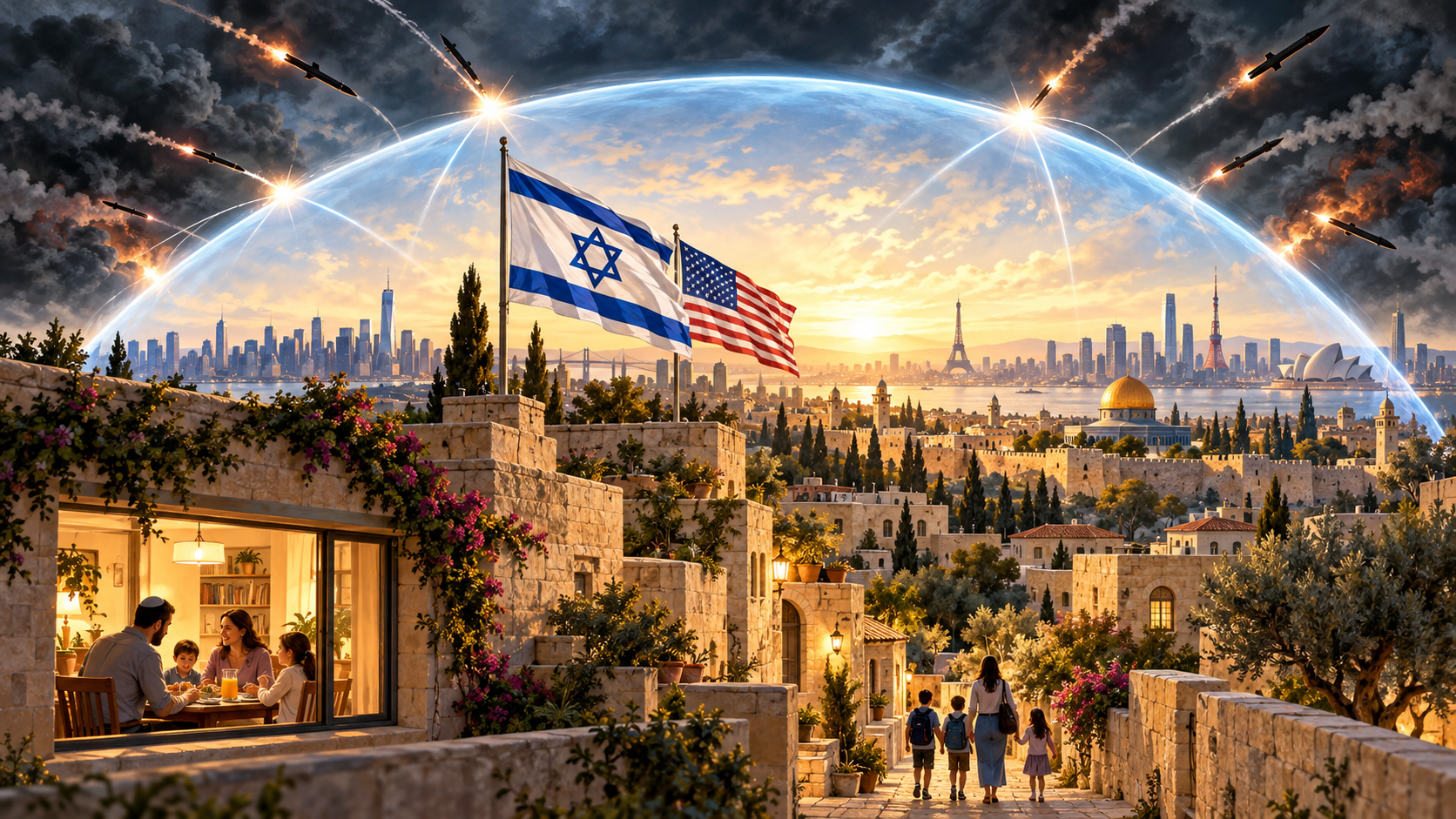
Illustrative: AI image created by the author.
Confronting jihadism begins with naming the deliberate targeting of civilians, and holding terrorists and their state sponsors responsible.
Terror is a choice
Yaron Lischinsky bought the ring the week he died. He was thirty. He planned to propose to Sarah Milgrim, twenty-six, the following week in Jerusalem, where she would meet his family for the first time. On a Wednesday evening in May 2025, they walked out of a reception at the Capital Jewish Museum in Washington together, and a man who had waited outside shot them both.
Who makes a decision like that? Who plans the abduction of children, or the massacre of a family in its home? Who supplies the weapons, money, and training that turn murderous intentions into attacks?
Those questions belong at the center of any honest conversation about Israel’s war. An argument that examines only Israel’s responses leaves the ambitions of its enemies, and the people who sustain them, dangerously unexamined.
Israel must answer hard questions about its decisions. Every democracy should. It must also explain the larger threat it confronts, the choices driving that threat, and what those choices mean for people far beyond its borders.
On October 7, Hamas and other armed groups entered Israeli communities, killed people in their homes, and carried others into captivity. A United Nations commission documented intentional attacks on civilians, murder, torture, and hostage-taking. None of it happened by accident. The assault was organized and deliberate. Its perpetrators were responsible for their choices.
That is the defining cruelty of terrorism. The family at breakfast, the young people at a music festival, the passengers on a bus are not collateral. They are the point. Murdering them is meant to make everyone else feel that nowhere is safe.
Calling such acts “violence” without naming their purpose hides the choice behind them. Someone selected the target. Someone acquired the weapon. Someone decided that another person’s child, parent, or partner was expendable.
The victims’ vulnerability was never incidental. It was the plan.
Follow the responsibility beyond the gunman
Responsibility does not end with the person who pulls the trigger. It extends to those who knowingly keep that person armed, funded, and trained.
In May 2024, the US Treasury Department’s Financial Crimes Enforcement Network reported that Iran had provided Hamas as much as $100 million a year since 2018, and described the shadow networks of front companies and exchange houses that move such money. This is not speculation about intent. It is a documented pipeline from a state treasury to an organization that massacres civilians.
Funding does not prove that Tehran ordered every attack its clients carry out. Direction of a particular operation requires its own evidence. But a state that finances and equips a terrorist organization cannot escape responsibility simply because its officials never stand near the killing.
Any serious response has to reach the networks that move the money, procure the weapons, and keep these organizations alive. Otherwise we confront the gunmen one at a time while the machinery that produces them keeps running.
The danger reaches American streets
Hamas, Hezbollah, the Iranian regime, ISIS, and al-Qaeda are not one organization. Their doctrines, interests, and alliances differ, and some are bitter enemies. Pretending otherwise would make the threat harder to understand, not easier.
What they share is a method. And the method has not stayed on any single battlefield.
At 3:15 on New Year’s morning in 2025, a man who had posted videos pledging support for ISIS drove a pickup truck around a police barricade and into the crowd on Bourbon Street in New Orleans. Fourteen people died, the youngest eighteen. A young woman who wanted to be a nurse. A former college football player. People who had come to celebrate the start of a year they would not see. The FBI called it premeditated terrorism.
Other attacks that year targeted people simply for their connection to Israel or Jewish life, without the same organizational ties. The couple shot outside the Capital Jewish Museum were among them. Federal prosecutors charged the gunman with hate crimes and terrorism-related offenses.
Eleven days later, in Boulder, Colorado, about twenty people gathered on the Pearl Street Mall for a weekly walk calling attention to the hostages still held in Gaza. Karen Diamond, eighty-two, was there for the first time. A man posing as a gardener threw Molotov cocktails into the group. She died of her burns three weeks later. According to the criminal complaint, her attacker told investigators he had planned it for a year.
No one should assign these attacks a common sponsor or an identical motive without evidence. What connects them is simpler and, in its way, more frightening. In each case, someone looked at ordinary people living ordinary lives and decided they were targets.
A celebration, a reception, a walk for hostages. People thousands of miles from Israel’s borders, attacked for being where they were.
Precision strengthens the case
We must confront jihadist terrorism without treating Muslims collectively as suspects. Muslim identity is not evidence of dangerous intent. Peaceful religious practice, political disagreement, and criticism of Israel must never be treated as substitutes for evidence of incitement or violence.
The same discipline must govern how we talk about antisemitism, terrorism, and state sponsorship. These can intersect. One does not automatically prove the others.
Precision is not softness. It is how we identify the actual perpetrators, establish the responsibility of their actual supporters, and build partnerships with the many people, including many Muslims, who reject their methods and have often been their victims. Any coalition against jihadist terror must welcome them. Their safety and freedom belong inside the future we are defending.
Shared responsibility must grow
Israel stands on the front line, but it has not stood alone.
When Iran launched missiles and drones at Israel in April 2024, the United States, Britain, France, and regional partners joined in the interception. Their cooperation saved lives. The Abraham Accords, signed in 2020 by Israel, the United Arab Emirates, and Bahrain, committed their signatories to coexistence, religious freedom, and ending radicalization. And when American power was brought to bear on Iran’s nuclear program in June 2025, it demonstrated that a dangerous regime could face consequences rather than statements of concern.
President Donald Trump deserves credit for helping broker the Abraham Accords and for demonstrating a willingness to confront Iran’s nuclear infrastructure. Americans will disagree about particular leaders and particular decisions. That is a healthy argument to have. But the underlying principle should not be partisan: diplomacy loses its credibility when the other side believes intimidation and escalation will always improve its position, and partnership offers a better future than permanent confrontation.
The goal is a widening coalition that disrupts terrorist financing, degrades operational capacity, and denies political cover to those who deliberately attack civilians.
Security needs a destination
Israel should be able to say plainly what its security is for.
Families should live without massacres and rocket fire. Borders should hold against armed incursions. Governments should make agreements and keep them, and be held to them when they do not. No armed organization should have a veto over its neighbors’ right to exist.
Palestinians also need a credible future.
Palestinian children deserve safety, education, opportunity, and a government that answers to them. Their lives have worth independent of any argument about Israel. A year into a ceasefire, most of Gaza’s two million people are still displaced, many in tent camps facing winter, almost nothing has been rebuilt, and Hamas remains the dominant power in the territory Israel does not control. Devastation is not a destination. Anyone claiming to offer something better, in Jerusalem, Washington, or Cairo, owes these families practical answers.
A durable victory has to make another October 7 harder to carry out while creating conditions in which people on both sides can build lives beyond war.
Accountability strengthens trust
Protecting civilians, enabling humanitarian relief, investigating wrongdoing, and punishing it are obligations, not favors. They are also how trust is preserved among partners who will be needed for years.
The line between deliberately targeting civilians and striking military objectives is essential. It must rest on evidence about conduct, not on assumptions about who is acting.
Israel’s case grows stronger every time it shows that its actions serve legitimate security goals and that violations carry consequences.
Holding Israel accountable for its decisions and holding terrorists accountable for theirs are not competing demands. They are the same demand, applied honestly. Neither requires us to forget who planned a massacre, who paid for it, or who looked at a crowd and saw targets.
Ordinary freedom is worth defending
The future worth fighting for is not abstract. It looks like this:
A family eating breakfast. Young people dancing in a field. A couple leaving a reception, days before a planned proposal. Neighbors walking for hostages on a Sunday afternoon. Worshippers entering a synagogue or a mosque. Children walking to school.
People deserve to live those lives without being selected for murder.
Israel should make that case with conviction, and the allies who help make such lives possible deserve recognition for it. More nations should take up their share of the burden, because the people being targeted are not only Israelis.
Terrorists attack ordinary freedom on purpose. States that knowingly keep them armed must answer for their role.
Defending that freedom is a responsibility far larger than Israel’s alone.
Related Topics