
Israel’s Greatest Untapped Natural Resource
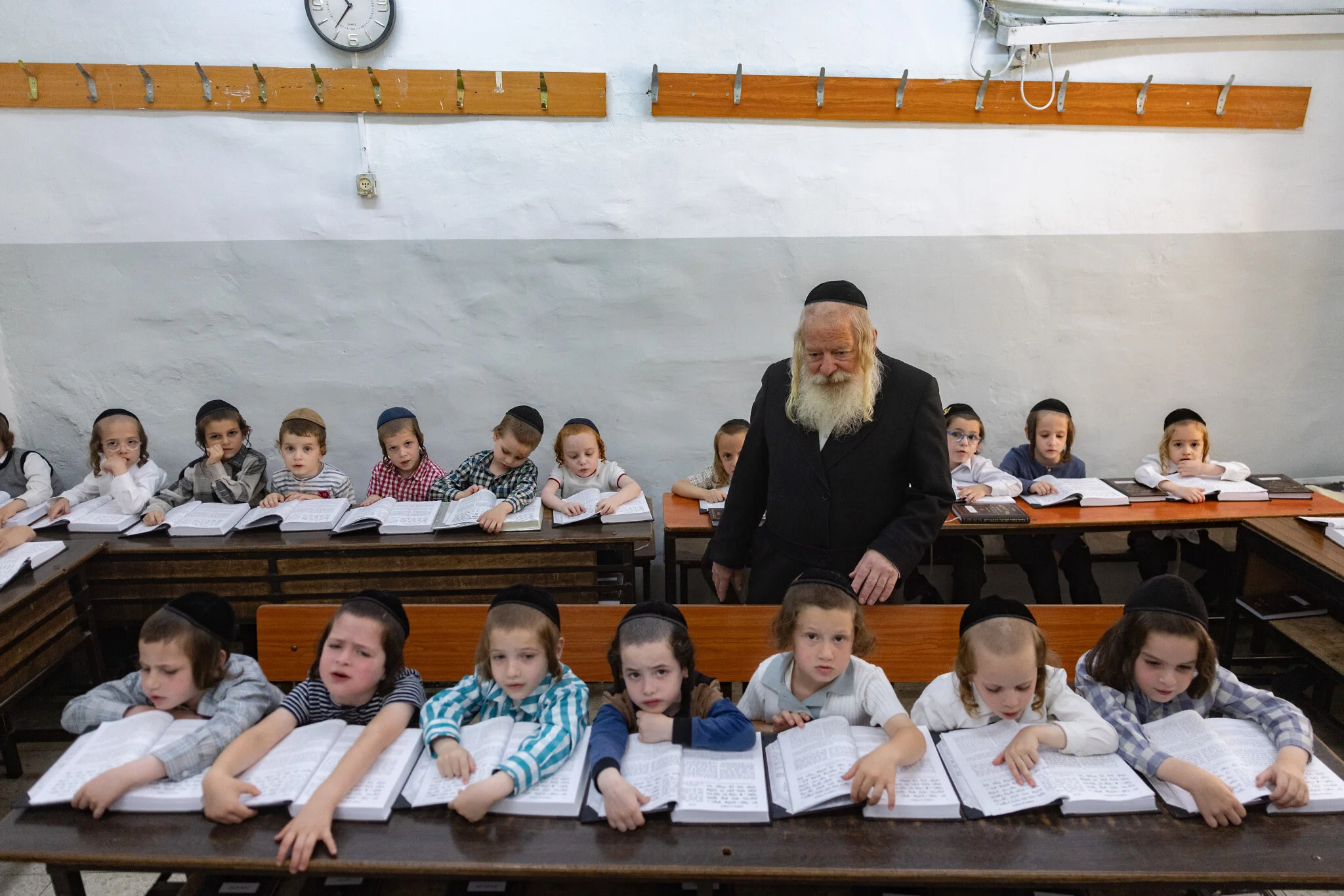
The OECD’s long-term model projects that full integration of Haredi and Arab Israeli communities into the workforce could raise Israeli GDP by 8% over twenty years — equivalent to roughly $49 billion in today’s terms — with Haredi integration alone accounting for six of those percentage points.² That is not a rounding error. It is the single largest economic opportunity available to Israel today, and almost nobody in public life is taking it seriously.
Israel is the youngest developed democracy on earth, with a median age of roughly 29 against 38 in the United States and nearly 48 in Germany. In a world of ageing populations and stagnating growth, Israel holds something every developed economy wants: a vast, young workforce with decades of productive life ahead of it — the demographic dividend that powered roughly a third of East Asia’s economic miracle between 1965 and 1990.¹
That dividend is concentrated almost entirely in one community. Haredi women average 6.5 children. The Haredi share of the population is 13% today and forecast to reach 25% by 2065. Haredi children are already 19% of all first-graders. This is Israel’s greatest untapped natural resource — and it is almost entirely locked away.
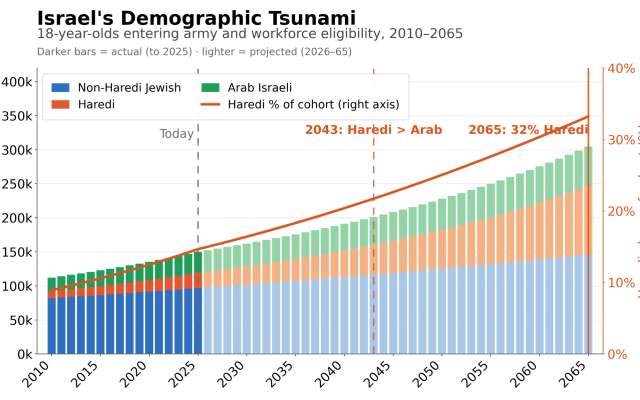
The chart below makes the scale of the wave visible: Israel’s annual cohort of 18-year-olds will more than triple by 2065, with the Haredi segment growing from under 10% of that cohort today to 32% of it by 2065 — a demographic shift without precedent in any developed economy. The Haredi share of the cohort exceeds the population share because Haredi families are younger on average; both figures point in the same direction.
Haredi male labor force participation stands at 51%, against 87% for non-Haredi Jewish men. Only 1% of Haredi men obtain a national matriculation certificate, against 77% in the general population. Israel is the only developed country where a secular core curriculum is not mandatory for all children. Not harnessing this dividend is the economic equivalent of leaving oil in the ground — knowing it is there, knowing its value, and choosing through political inertia not to extract it.
The cost compounds every year. Professor Dan Ben David of Tel Aviv University has documented that Israel has the largest share of people below the poverty line and the worst educational inequality in the OECD. Anyone earning above NIS 18,000 a month is already in the top 20% of earners — yet that group pays 92% of all income tax. The arithmetic is unsustainable. The OECD agrees: its latest Israel review calls improving Haredi labour force participation “paramount for long-term growth” and explicitly recommends removing the subsidies and exemptions that keep yeshiva students out of the workforce.
But the reframe Israeli discourse keeps missing is this: Haredi demographic vitality and communal resilience are not liabilities. They are assets misdirected by a political compact that serves community leaders more than community members.
Two practical levers, both drawn from Milton Friedman, could start the mining. First, pay soldiers and national service volunteers a fair market wage — NIS 12,000 a month rather than today’s token sum of NIS 2,500 — and the 17,000 additional recruits the IDF needs will volunteer.
Second, replace the current education funding model with an education voucher: the state funds every child’s schooling, redeemable at any institution that teaches a minimum secular curriculum in mathematics, science, Hebrew, and English, with everything above that floor left to the school’s own choice. The voucher need not flow only to existing institutions — it can also fund an AI-powered digital learning platform, delivered on a mobile phone, that teaches the core curriculum directly. For families in towns where the local school refuses to comply, this is an immediate path to compliance that needs no new classrooms, no new teachers, and no institution’s consent.
Money alone will not be enough — families who send a child to serve also need their community to stop treating that choice as a betrayal, or the wage incentive will keep losing to the social cost. Together these two reforms turn incentives the right way round and hand choice back to Haredi families, without a single coercive mandate.
There is reason for optimism. Haredi women already work at roughly 74% participation — close to the national average. They know from experience that secular education leads to better jobs and stronger families. They are raising the boys. They are the bridge.
The vault is full. It can be unlocked by education, incentives, and the political courage to act. It is time to open it.
This article was first published in Hebrew in Zman Yisrael on 18 August 2026.
Simon Fink is the author of Freedom and Democracy in Israel (forthcoming 2026).
1 Bloom, David E., David Canning, and Jaypee Sevilla. The Demographic Dividend: A New Perspective on the Economic Consequences of Population Change. RAND Corporation, 2003.
2 OECD Long-Term Spending Projections in Israel, October 2025. GDP impact scenarios for Haredi and Arab Israeli integration.