
CEO of Time to Stand Up for Israel
Israel’s Most Powerful Weapon Is Normal Life
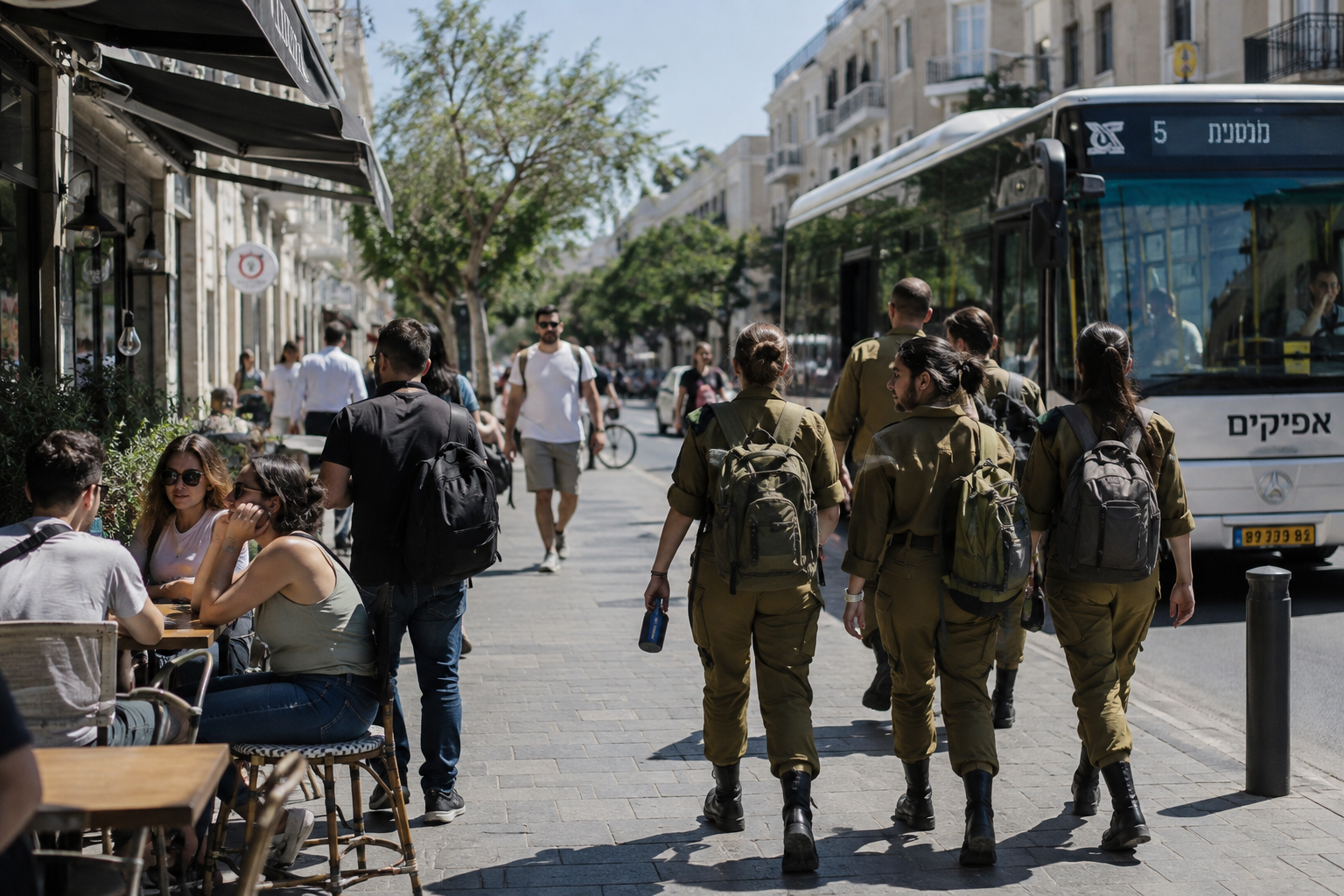
Photo Credits: Sabine Sterk (AI)
When people speak about Israel’s strength, they usually reach for the obvious examples. The Israel Defense Forces. The Iron Dome. The Air Force. Mossad. Cybersecurity. Medical innovation. Intelligence. Technology.
All of these are important, but after years of watching Israel closely, visiting the country repeatedly, speaking with Israelis and advocating for the country from abroad, I have come to believe that Israel possesses another strategic asset that receives far too little attention.
Normal life.
That may sound almost ridiculous when discussing a country surrounded by threats, repeatedly attacked by terrorists and subjected to an international level of scrutiny that few other nations experience. But perhaps that is exactly the point.
Israel’s enemies have never wanted merely to kill Israelis. Terrorism has a larger objective. It seeks to make ordinary life impossible. It wants Israelis to become afraid of buses, restaurants, concerts, markets, schools, borders and eventually of their own future.
The most powerful answer is therefore not only defeating the terrorist.
It is getting back on the bus. It is opening the restaurant again. It is sending children back to school. It is celebrating another wedding. It is starting another company. It is having another baby. It is complaining about traffic on the Ayalon. It is planning next summer while enemies are promising that Israel will not have one.
There is something profoundly Israeli about this refusal to surrender everyday life. Foreign observers often misunderstand it. They see Israelis sitting in cafés shortly after terrible events and sometimes interpret the images as evidence that things cannot really be that bad. They see crowded beaches, nightlife in Tel Aviv or families enjoying restaurants and wonder how this can coexist with war, terrorism and national trauma.
But those images do not prove the absence of pain. They reveal the presence of resilience. A society does not defeat terrorism simply by eliminating terrorists. It defeats terrorism when terrorists fail to determine how that society lives.
That distinction matters. If a terrorist attack causes millions of people permanently to alter their lives through fear, terrorism has achieved part of its objective even when the terrorist himself is dead. If rockets make an entire generation abandon its future, the rocket has accomplished something much larger than the physical damage caused by its explosion.
Israel has repeatedly refused to grant its enemies that victory. This is particularly remarkable because Israeli society is anything but emotionless. Israelis mourn intensely. The faces of murdered civilians and fallen soldiers become known throughout the country. Funerals can feel like national events. Hostage families become part of the consciousness of millions of people who have never met them.
Israel remembers. But Israel also lives. Those two things are not contradictory. Perhaps one of the greatest misunderstandings about resilience is the idea that being strong means not feeling pain. Israel demonstrates the opposite. Strength is feeling the pain and still deciding that tomorrow matters.
That decision can be seen everywhere. A reservist returns home and resumes his studies. A wounded soldier begins rehabilitation and talks about his future. Parents take their children back to a playground. Entrepreneurs continue developing technology. Farmers return to their fields. Doctors continue treating patients. Musicians perform. Couples marry.
And somewhere, inevitably, Israelis continue arguing about politics. Even that is part of the story. Israel’s loud disagreements are frequently portrayed as weakness. Yet consider what they actually represent. Israelis expect their country to have a future worth arguing about. People debate elections, judicial decisions, religion, security, economics and the price of housing because they assume there will be a tomorrow in which those questions matter.
A dying society does not argue passionately about its future. A living one does. This may also explain why Israel is so difficult for outsiders to understand. Much of the world encounters Israel primarily through breaking news. Israel becomes a sequence of wars, terrorist attacks, diplomatic disputes and United Nations resolutions.
But Israel is not a breaking news alert. It is a country where millions of people wake up every morning and do remarkably ordinary things under remarkably abnormal circumstances. Children forget their homework. People fall in love. Dogs are walked. Coffee is consumed in enormous quantities. Families argue over dinner. Someone misses a train. Someone launches a startup. Someone receives a terrible diagnosis while another person receives wonderful news. A grandmother waits for her grandchildren to visit. A young couple wonders whether they can afford an apartment.
Life continues.
That ordinary Israel rarely becomes international news because normality does not generate dramatic headlines. Yet it may be one of the most important stories about the country.
Israel was not created merely so that Jews could survive. Survival alone would have been an extraordinarily low ambition after centuries of persecution. Israel was created so that Jews could live.
There is a difference. Living means creating art instead of merely escaping hatred. It means building universities rather than simply finding refuge. It means inventing medicines, growing food, writing books, making terrible television programs and occasionally excellent ones, raising families, building businesses and debating what kind of country the next generation should inherit.
This is why Israel’s normal life carries such enormous significance. Every ordinary Israeli morning represents the failure of those who wanted Jewish sovereignty to disappear. Every child entering an Israeli classroom is part of that failure. Every new Israeli company is part of it. Every wedding is part of it. Every elderly Israeli sitting outside a café drinking coffee is part of it.
None of this means ignoring the enormous challenges Israel faces. Resilience cannot become an excuse for political failure, military mistakes or inadequate preparation. A strong society must still demand accountability from its leaders. But we should recognize resilience when we see it.
For decades, Israel’s enemies have repeatedly announced that the Jewish state is temporary. They have predicted its destruction, celebrated attacks against its citizens and taught generations that eventually Israel will disappear. Yet perhaps the most devastating answer Israel can give them is not a speech.
It is tomorrow morning.
The shutters rise.
The buses start moving.
The cafés open.
Children go to school.
Scientists return to laboratories.
Soldiers come home.
Families make plans.
People complain, laugh, work, love, mourn and begin again.
Israel survives because it can defend itself.
But Israel wins because it continues to live.
And perhaps that is the Jewish state’s most powerful weapon of all.
Related Topics