
Israel’s New Border System Signals a Shift in Security—and in Economics
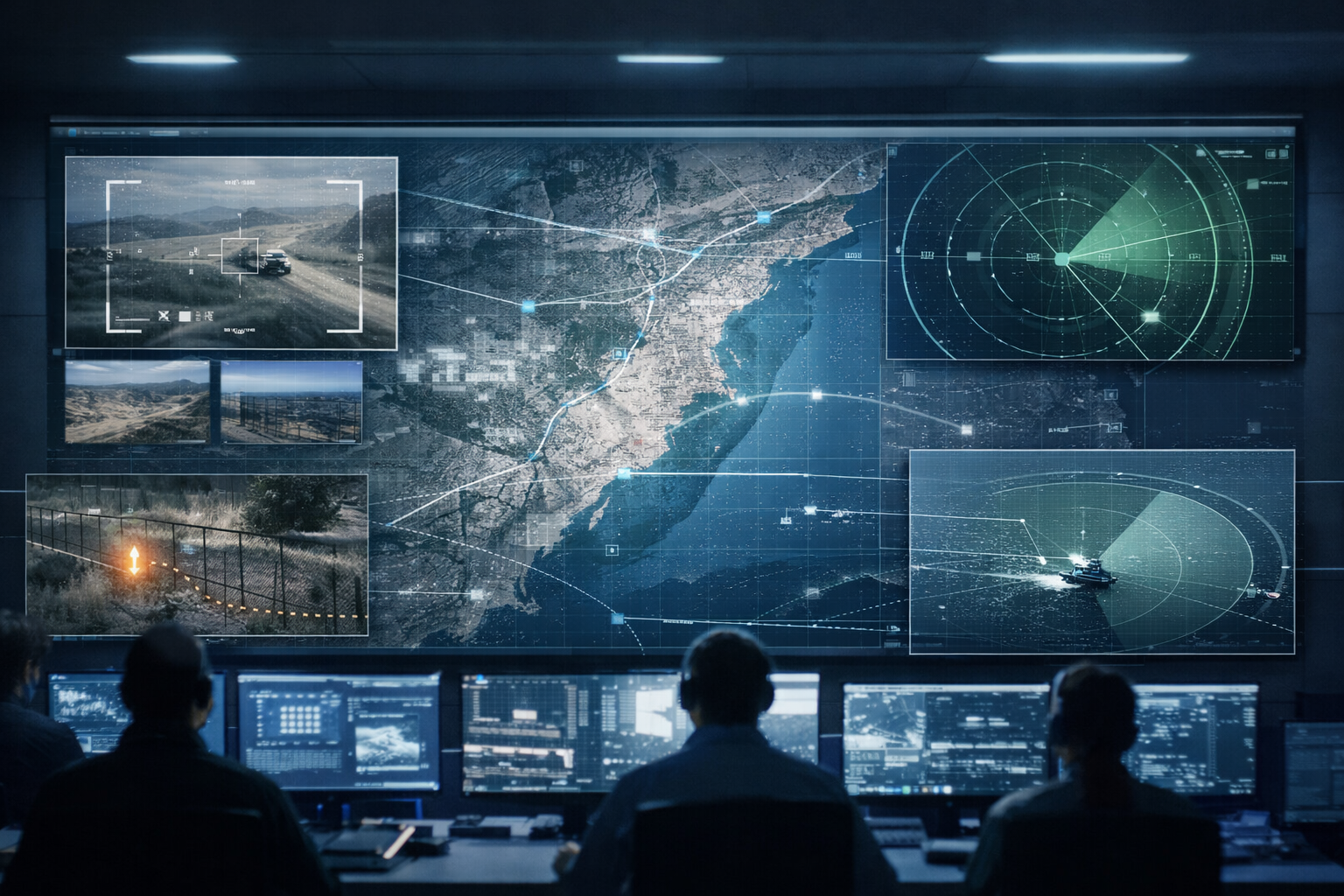
Israel Aerospace Industries (IAI) has demonstrated more than a new piece of military hardware. Its recently unveiled autonomous border protection system reflects a structural shift in how borders are defended—and how security, labor, and economics intersect in the 21st century.
The system, showcased to Israeli security officials and foreign delegations, is not a single platform but an integrated architecture. It fuses intelligence collection, AI-driven threat analysis, command-and-control, and response into a continuous, largely automated loop. Sensors, drones, UAVs, ground systems, and maritime assets feed into a central mission system that processes data in real time and coordinates responses at machine speed.
The operational result is a sharp reduction in the time between detecting a threat and neutralizing it. In demonstrations, intelligence gathering, decision-making, and action were compressed into a single, coherent process—addressing one of the most persistent weaknesses in traditional border defense: delay.
Crucially, the system balances autonomy with human oversight. A small number of operators supervise and authorize actions remotely, without needing to manually coordinate each sensor or platform. For Israel—a small country with dense population centers and no strategic depth—this matters. Threats must be identified and handled as far from civilian areas as possible, while minimizing risk to personnel in the field.
As IAI CEO Boaz Levy has noted, Israel’s borders are among the most complex in the world, with simultaneous challenges emerging from land, sea, and air. The system was designed explicitly for that operational reality.
While individual platforms have drawn attention—advanced intelligence-gathering drones, vertical-takeoff UAVs, and light patrol aircraft developed in cooperation with U.S. defense partners—they are not the core innovation. The real product is the architecture itself: a scalable operating system for border security that integrates disparate assets into a unified, real-time operational picture.
That distinction has clear economic implications.
IAI developed the system using internal R&D funding rather than a single bespoke government contract, signaling clear export intent. Globally, states are facing similar pressures: long or porous borders, rising personnel costs, recruitment shortfalls, drone proliferation, and growing political intolerance for casualties among border forces. Autonomous, AI-driven systems address all of these challenges simultaneously.
They substitute software and capital for manpower, reduce long-term operating costs, and create durable revenue streams through upgrades, training, maintenance, and system integration. Beyond military applications, the same technologies—sensor fusion, real-time analytics, and centralized command—have obvious dual-use potential in areas such as critical infrastructure protection, maritime traffic monitoring, and disaster response coordination.
What Israel is pioneering now is therefore relevant far beyond its borders. The U.S.–Mexico border, for example, spans nearly 2,000 miles and remains heavily dependent on manpower-intensive patrols layered atop fragmented sensor networks. Europe faces similar strains along its external borders, where migration flows, smuggling networks, and the use of drones by non-state actors challenge conventional enforcement models. In each case, the underlying problem is the same: humans are being asked to manage machine-speed threats across vast spaces. Autonomous border systems do not resolve political or humanitarian dilemmas—but they fundamentally change the cost, scale, and effectiveness of enforcement.
There is also a strategic signaling dimension. Countries that deploy such systems are not merely purchasing hardware; they are adopting a doctrine centered on early detection, rapid response, and technological overmatch. By exporting this model, Israel reinforces its role not only as a security partner, but as a shaper of how modern borders are defended.
This was not a dramatic unveiling. But taken seriously, it marks a quiet inflection point. Borders are no longer static lines guarded primarily by people. They are becoming dynamic systems—sensed, interpreted, and defended by machines, with humans supervising rather than reacting.
For Israel, this evolution is driven by necessity. For the global market, it is a model likely to be emulated.
Author’s Note
Mordechai Levin is an Associate Fellow of the American Institute of Aeronautics and Astronautics (AIAA) and an Advanced Incident Command Instructor for the U.S. Department of Homeland Security’s Center for Domestic Preparedness. His work focuses on defense systems, resilience, and the intersection of technology, economics, and national security, with particular emphasis on how emerging capabilities reshape cost curves, labor models, and deterrence.
Sourcing Rigor and Methodology
This analysis relies exclusively on open-source, non-classified material from government agencies, major defense manufacturers, congressional research bodies, international security institutions, and globally recognized analytical organizations. Where precise figures are not publicly available, order-of-magnitude ranges are used and clearly labeled.
No operational locations, deployment patterns, or sensitive vulnerabilities are discussed. The intent is not to reveal capabilities, but to illuminate economic and strategic dynamics already visible to adversaries and allies alike.
Sources
- Israel Aerospace Industries (IAI), official press materials and public demonstrations relating to autonomous border protection systems and AI-enabled command-and-control architectures, 2025–2026.
- Dean Shmuel Elmas, reporting via Globes and The Jerusalem Post, January 8, 2026, on IAI border protection system demonstrations and platform capabilities.
- Public remarks by Boaz Levy, CEO of Israel Aerospace Industries, regarding Israel’s border security challenges and the role of autonomous systems in reducing response times and personnel exposure.
- Public disclosures by U.S. and Israeli defense contractors regarding ISR aircraft, unmanned systems, and integrated border surveillance architectures.
- International Institute for Strategic Studies (IISS), The Military Balance (2024–2025), sections on unmanned systems, border surveillance, and multi-domain ISR integration.
- RAND Corporation analyses on autonomy, artificial intelligence, sensor fusion, and labor substitution in military and security operations.
- European Union agency reports on border surveillance, UAV integration, and multi-sensor monitoring challenges along external borders.