
Writer covering Israel–Africa, Jewish affairs, and Israel worldwide
Israel’s Only Security: Terms and Conditions Apply
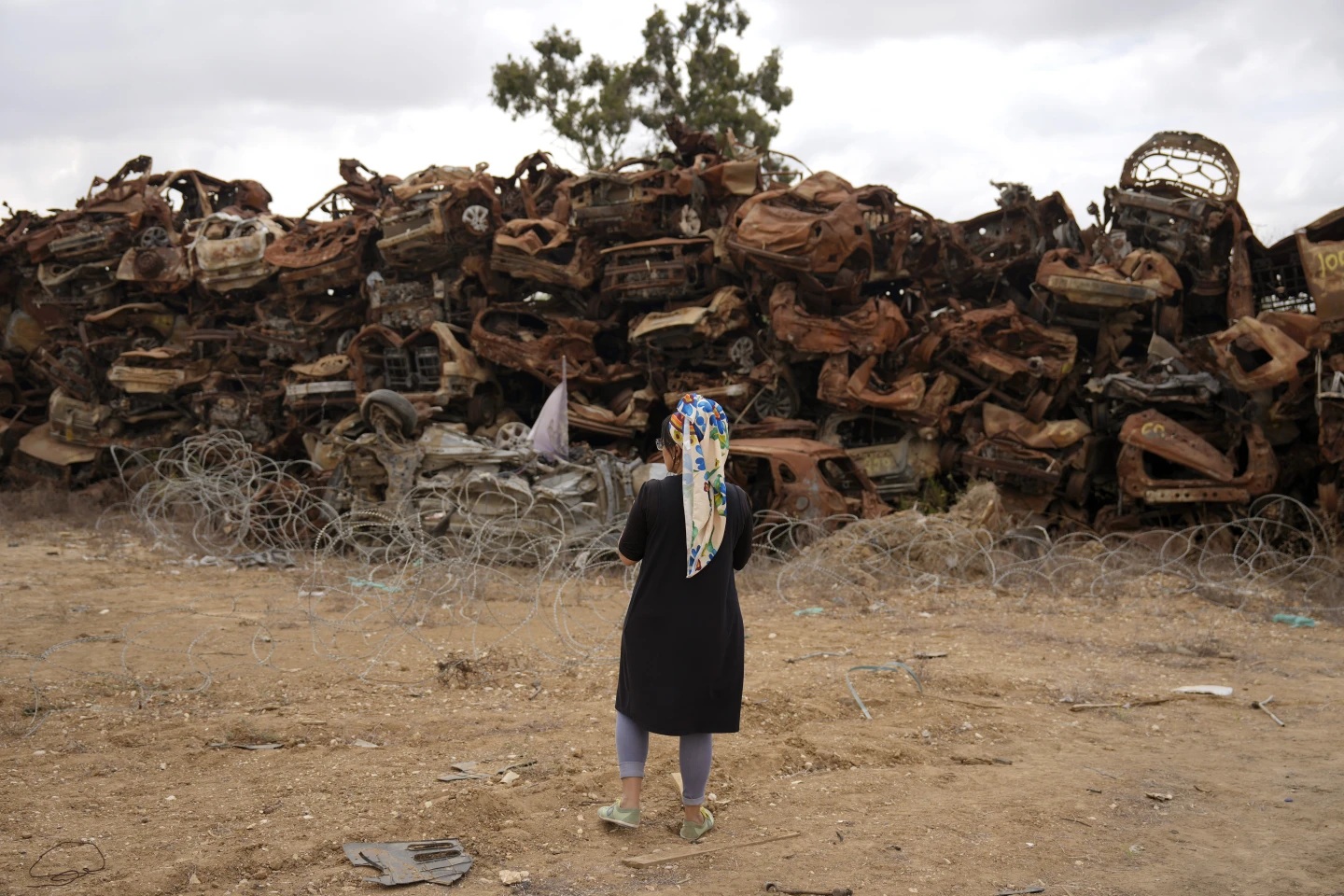
A woman looks at charred vehicles burned in the Oct. 7 cross-border attack by Hamas militants outside the town of Netivot, southern Israel, Monday, Oct. 7, 2024. (AP Photo/Ariel Schalit)
The mantra repeats everywhere: Israel’s security = Palestinian statehood. Israel will only have peace once a Palestinian state exists. Meanwhile, the rockets keep being stacked, and the logic keeps bending.
The Global Consensus That Is not Questioned
World leaders, diplomats, pundits, activists, and the UN all seem to agree on one thing—Israel will only have peace and security after a Palestinian state is established. Not before. Not during negotiations. Not after peace treaties with Egypt, UAE or Jordan. But someday. Eventually. Conditionally.
At the G20 foreign ministers’ meeting, representatives from the world’s wealthiest and most powerful countries nodded along, declaring unanimity behind a two-state solution as “the only path” to peace in the Israeli-Palestinian conflict. Speakers from nearly every corner of the globe endorsed the idea that sustainable security for Israel requires Palestinians to have a state of their own beside it.
Over at the United Nations Relief and Works Agency for Palestine Refugees (UNRWA), the commissioner-general has been traveling and holding speaking engagements like a UNRWA roadshow, urging world governments to preserve the agency’s role as essential to a “viable political transition” toward the elusive two-state outcome. According to his statements, UNRWA’s schools, clinics, and staff are not just humanitarian lifelines — they are the scaffolding of the future state that will, in theory, bring peace.
Meanwhile, the Human Rights Council dutifully adopted multiple resolutions dealing with the Gaza war, demanding an immediate ceasefire and an end to what it calls “collective punishment” in Gaza — and reaffirming the right of the Palestinian people to self-determination and, implicitly, a sovereign state. They even called on all states to halt arms sales to Israel and highlighted the urgency of addressing conditions on the ground.
Taken together, these global organs convey a remarkable consensus: peace and security for Israel, they say, hinge on the birth of another state. That’s the dogma — issued in press releases, diplomatic communiqués, and high-level speeches — as if its truth were self-evident. But here’s the curious thing: nowhere in the history of international relations has a country’s safety ever been made contingent on the creation of a neighboring polity that doesn’t yet exist. Yet in this conflict, it’s treated as gospel — rarely questioned, seldom dissected, and almost never framed as the profound logical leap it represents.
If peace depended on creating Atlantis, global leaders would be just as confident in that too.
A Strange Condition for Security
Let’s pause for a moment and unpack the world’s favorite geopolitical brain teaser: Israel can only have real security after a Palestinian state exists. Not before. Not now. But sometime in the indeterminate future, when paperwork, borders, and political theory finally align.
Step back and ask yourself: when has any country’s safety ever been conditioned on the creation of a state that doesn’t yet exist? Imagine telling France: “Your citizens can sleep soundly, but only once the Basques finally get their independent republic.” Or Germany: “Your borders are safe, once the Bavarians negotiate a new constitution.” Preposterous, right? Yet this logic is treated as self-evident when applied to Israel.
What it really signals to the world—and to those looking for loopholes—is that terror can be strategically tolerated. As long as the Palestinian state remains “not yet,” violence is implicitly granted temporary legitimacy. Rockets, stabbings, car-ramming attacks? Merely footnotes in a future peace plan. The people under attack? Obliged to wait patiently for someone else’s borders to be drawn.
Even the rhetoric of diplomats reinforces this absurdity. Peace is a condition, not a right. Security is a promise contingent on someone else’s political fulfillment. And Israel, the target of this logic, is expected to act like a responsible party in a contract where all the clauses favor the other side—and where the “counterparty” hasn’t even been formed yet.
The Message This Sends to Terror Groups
If you were a terror group looking for moral cover, you’d struggle to design a better public relations strategy than the world’s current peace rhetoric. While Western capitals and international organizations insist Israel can only enjoy security once a Palestinian state exists, groups like Hamas, Hezbollah, and the Houthis interpret that not as a diplomatic formula, but as a strategic green light for continued violence.
Take Hamas, for example. In recent ceasefire negotiations and indefinite pauses in fighting, the group has made one thing crystal clear: they won’t disarm unless an independent Palestinian state is established. By tying the cessation of violence explicitly to statehood, Hamas isn’t just bargaining — it’s reinforcing the idea that terror pays until political demands are met.
That’s not an isolated quirk. Hezbollah — the Lebanese militia powerful political force — has publicly aligned itself with Hamas’ broader “Axis of Resistance.” Its leader has even framed Hamas’ negotiations with Israel as representing the entire alliance, implying that violence isn’t secondary, it’s strategy.
Then there are the Houthis in Yemen, who have extended this logic even further. Drawing on emotional and political solidarity with the Palestinian cause, they have fired missiles and drones toward Israel and even targeted international shipping routes — all while broadcasting their support for Palestinians. These actions, which they frame as solidarity with Gaza, are less about humanitarian concern and more about boosting their own regional relevance and legitimacy.
Make no mistake: what these groups say they’re doing is cloaked in the language of defense and liberation. What they are actually doing is exploiting the global insistence on Palestinian statehood as a license to continue terror operations without real penalty — because the world’s political consensus makes violence look like leverage, not lawlessness.
Put differently: in a conflict where the only path to peace is repeatedly described as “the Jewish state must disappear and be replaced,” violence doesn’t get condemned so much as contextualized and rationalized. And if you’re a militant actor positioning yourself as a defender of that narrative, you’ve just been handed a pretty convenient moral loophole.
Palestinian Security
Here’s where the logic goes truly upside down. According to the world’s standard narrative, Israel’s security is conditional not only on the establishment of a Palestinian state but also on the Palestinians themselves “having security.” Translation: Israeli civilians are expected to tolerate attacks while ensuring that Palestinians never feel threatened—even when those threats originate from the attackers themselves.
Consider a typical scenario: Israeli soldiers enter a Palestinian village to apprehend a terrorist who just carried out a car-ramming attack. The operation, designed to prevent further civilian deaths, is simultaneously described by international observers as a breach of Palestinian security. Or take Gaza: when Hamas launches the worst assault on Jews since the Holocaust—Israel’s military retaliates to stop further bloodshed. And yet, the same global consensus treats these defensive actions as “war crimes” endangering Palestinian security.
The result? A moral inversion so complete it could make Kafka blush: Accountability becomes aggression. Self-defense becomes provocation. Justice, a potential violation of humanitarian norms. In short, the language of “security” has been hijacked, redefined, and flipped inside out—so that Israel’s defensive measures are framed as offenses, and Palestinian terror operations are given context, justification, and even moral cover.
Peace on Lease, Security on Borrowed Time
So what have we learned from this delightful game of international logic? Israel’s security is conditional. Its peace is always “coming soon.” Palestinian statehood is the precondition for safety, even while violence continues in the meantime. Accountability is upside down, terror is contextualized, and self-defense is treated as provocation.
And yet, the world nods along, convinced that this arrangement makes sense. The moral calculus is simple: if Israel survives, it’s because it’s patient. If Palestinians attack, it’s because they’re waiting for their state. Violence isn’t violence; it’s a strategic placeholder. Justice isn’t expected; it’s inconvenient.
To put it in terms anyone can understand: perhaps the only reason Europe sleeps soundly is because no one is claiming Paris “from the Seine to the suburbs” or London “from the Thames to the outskirts.” Peace exists where nobody is drafting maps of your land and launching missiles to accelerate negotiations. Apparently, in today’s world, security is a privilege granted only as long as someone else’s borders remain unsettled—and as long as you can tolerate the consequences until then.
So next time someone tells you Israel will only have peace once a Palestinian state exists, remember: in this fairy tale, terror is a bargaining chip, accountability is a violation, and the only truly safe countries are the ones that no one is planning to redraw on a map.
In the end, the lesson is simple: peace is guaranteed—until someone makes a claim. After that, you’re told to wait patiently, absorb the violence, and be grateful you’re part of the peace process.
Related Topics
Related Posts