The views expressed herein are solely mine.
Israel’s Qualitative Military Edge Must Be Israeli
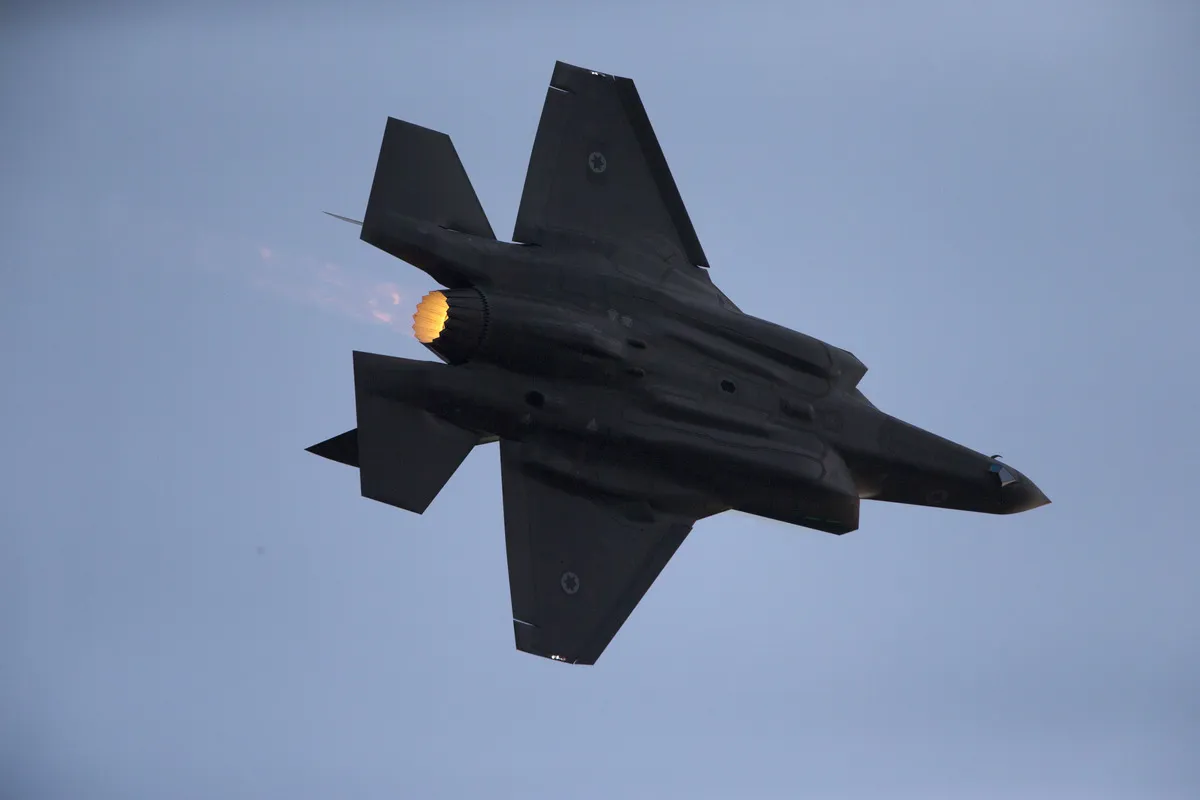
An Israeli Air Force F-35 plane performs during a graduation ceremony for new pilots in theAn Israeli Air Force F-35 plane performs during a graduation ceremony for new pilots in the Hatzerim air force base near the city of Beersheba, Israel, Thursday, Dec. 29, 2016. AP Image / Ariel Schalit.
On June 6, 2026, Israeli forces struck Beirut’s Dahieh district after Hezbollah rocket and drone attacks on northern Israel. Iran had threatened Israel and then launched ten ballistic missiles. These operations show Israel can act independently when deterrence requires it, yet also reveal how its qualitative military edge (QME) has narrowed.
Last year the United States diluted that edge by extending advanced weapons to Saudi Arabia, the United Arab Emirates (UAE), and other Gulf partners. Saudi Arabia received F-35 stealth fighters and NATO non-member ally status; the UAE and others gained additional high-end systems. This decision carries a clear obligation: these states must become far more proactive against Iran. Advanced platforms cannot remain just as prestigious assets. Riyadh’s Yemen campaign cannot end without severing Iranian supply lines to the Houthis. If Washington narrows Israel’s advantage, Riyadh and Abu Dhabi must impose measurable pressure on Iranian networks, weapons flows, proxy infrastructure, sanctions-evasion routes, and maritime blackmail.
U.S. law defines QME as the ability to defeat credible threats while sustaining minimal damage and casualties through superior means. Israel’s 2026 defense budget stands at roughly $45 billion against $3.8 billion in annual U.S. security assistance. Israel cannot allow its security doctrine to depend indefinitely on a Washington consensus that erodes its freedom of action.
Israel must also make its QME increasingly independent because American politics on both the left and right is moving in a more hostile direction. Gallup’s 2026 polling found sympathy nearly split—41 percent with Palestinians, 36 percent with Israelis—reversing the 54-to-31 percent lead Israel held three years earlier. Pew found only 34 percent of Democrats view Israel favorably, while Republican support has weakened to 69 percent, its lowest level in more than two decades.
The generational picture is worse. Yale’s 2026 youth poll found 55 percent of voters aged 18–22 agreed America should end its “slavish surrender” to Israel and 55 percent agreed Israel is “an apartheid state.” Whether a post-Trump Republican future is Vance-led or a Democratic future follows an Alexandria Ocasio-Cortez/Gavin Newsom coalition, Israel cannot assume Washington will remain structurally pro-Israel. The QME must rest less on American political moods and more on Israeli industrial sovereignty, technology leverage, and regional security architecture.
Iran now faces acute economic pressure. The U.S. naval blockade around the Strait of Hormuz costs Tehran an estimated $450 million per day. This distress creates leverage. Israel should use its channels with Moscow to maintain deconfliction with Russia and pragmatic communication with China. In sanctions-relief or frozen-asset discussions, the United States and partners should require portions of those funds to be redirected through verified civilian and stabilization mechanisms in Gulf states affected by Iranian coercion. Such redirection would raise the costs of Iran’s proxy and naval blackmail model.
Restoring the QME requires three practical steps that reduce dependence while preserving selective U.S. engagement.
First, expand distributed production. Israel should establish factories in partner countries to manufacture Israeli-designed systems for those nations’ forces, keeping the most advanced production inside Israel. This generates revenue, strengthens alliances, and frees domestic factories for national requirements. Existing models can be scaled to multiply capacity without compromising sovereignty.
Second, convert technological advantage into continued U.S. cooperation. Israel can share select battle-tested innovations—advanced loitering munitions, electronic-warfare techniques proven against drone swarms, and directed-energy systems—through joint programs or targeted sales to U.S. forces. These exchanges sustain influence and mutual benefit even as grant assistance declines.
Third, the United States should help formalize an Abrahamic NATO-style framework that functions more like Five Eyes than a treaty alliance. It should not be an Article 5 arrangement with automatic collective-defense obligations. Rather, it should serve as a standing coordination mechanism to prevent disastrous outcomes before, during, and after conflict. Israel, the UAE, Bahrain, and Morocco should turn existing informal habits into a permanent framework focused on intelligence fusion, early warning, sanctions enforcement, maritime surveillance, cyber coordination, and planning against Iranian proxies, turning the Abraham Accords into a working security architecture with the UAE, Bahrain, and Morocco providing financial, logistical, and geographic depth for intelligence networks against proxies and coercion.
These steps address political reality in Washington. Structural pressures—including post-2028 aid negotiations, congressional scrutiny, fiscal constraints, generational hostility, and competing priorities—make one-way dependence unwise. The QME cannot rest on shifting external priorities. It must rest on Israeli production sovereignty, selective technology leverage, and institutionalized cooperation with states facing the same threat.
Current operations confirm the requirement. Multi-layered defenses intercept most threats, yet the cost-exchange ratio favors cheap mass attacks. Domestic munitions expansion and directed-energy scaling can correct this. Offshore production and targeted technology sharing with the United States can maintain influence. A formal Abrahamic-NATO-like intelligence model can turn shared threat perception into operational habits.
There is also an immediate Israeli political reality. If Benjamin Netanyahu wants to survive the wave before the upcoming elections, he must answer Iran’s aggression decisively while delivering visible steps toward QME independence—expanding domestic production, accelerating directed-energy deployment, institutionalizing regional intelligence coordination, and proving Israel’s security future will not be hostage to Washington’s next turn.
The QME was never meant to be a permanent external gift. Recent American decisions extended advanced platforms to other states while doing too little to dismantle Iranian networks. Israel has demonstrated battlefield independence. Its policy must now match that reality by building the industrial base, technological capacity, and regional partnerships to preserve its edge on Israeli terms.
This is urgent because Iran’s behavior has changed. Before the war, Tehran threatened shipping but did not openly blackmail the Strait of Hormuz with the leverage it now seeks. The regime is using Oman, mining the area, setting tolls, and demanding more than $24 billion in frozen assets as a condition for negotiations. That is strategic insanity.
Releasing such funds without structural concessions would help the regime remain in power and let it sell the narrative that its resilience—not coercion and proxy warfare—explains its survival.
The State of Israel must act now. A Qualitative Military Edge that depends on Washington’s mood, Gulf hesitation, or shifting American consensus is not a strategic asset; it is a borrowed blade that can be snatched away when needed most. Only an Israeli-forged QME, built with its own hands, genius, and unbreakable will, can guarantee that when Tehran chooses blackmail, Jerusalem answers not with paralysis or permission-seeking but with the thunder of sovereign power that no ally can veto and no enemy can survive.
Related Topics
Related Posts