
Iran Should Remember That Samson’s Hair Grew Back
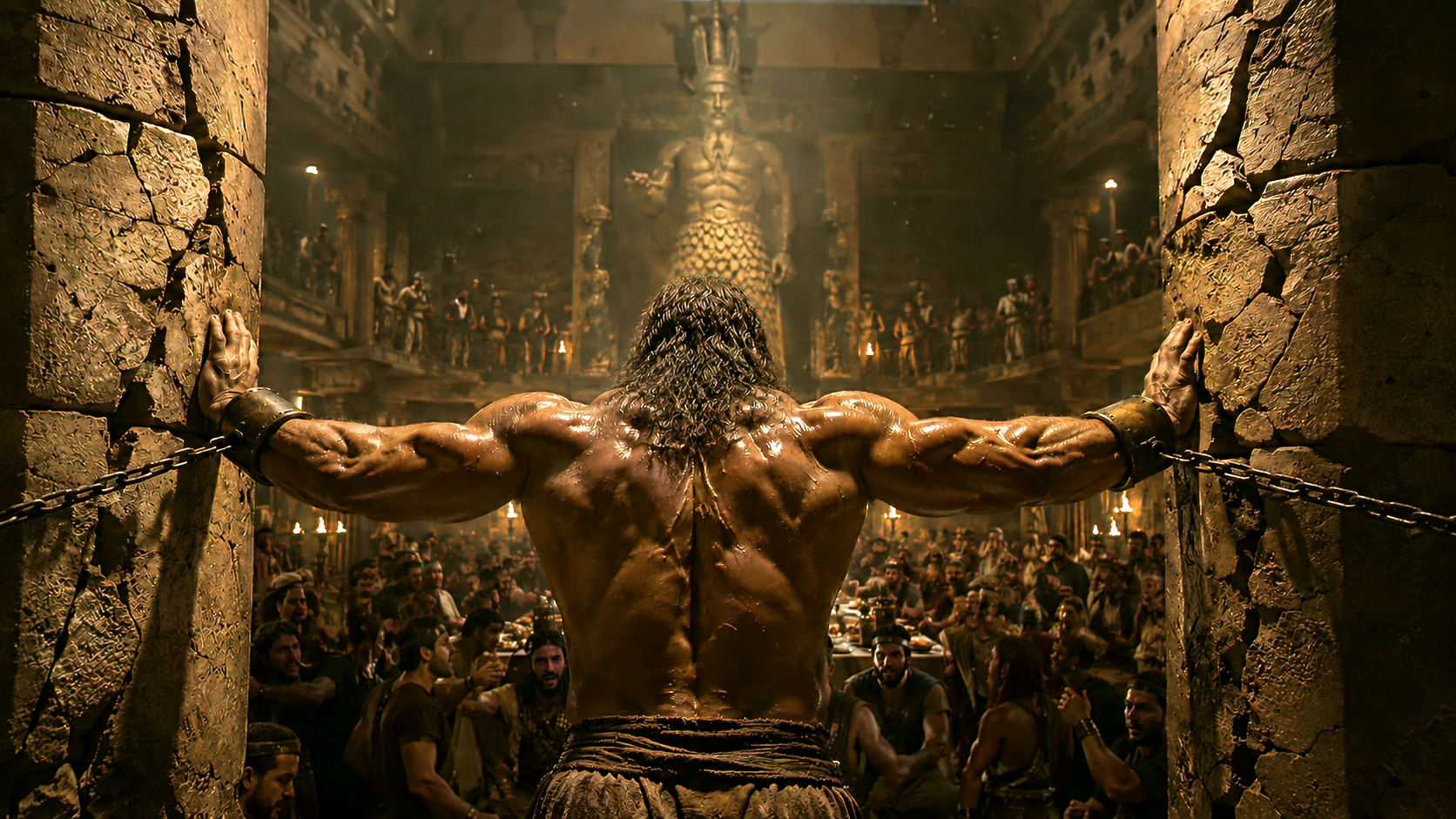
“Let me die with the Philistines.” Judges 16:30
On June 7, 2026, Iran fired ten ballistic missiles at northern Israel, hours after Israeli aircraft struck a Hezbollah headquarters in the Dahiyeh district of Beirut. Israel’s defenses intercepted them all, and the barrage caused no reported casualties. It was the first Iranian fire on Israel since the April ceasefire. Schools closed nationwide, hospitals moved operations underground, and the Home Front Command tightened its guidance to the public.
The trigger this time sat in Lebanon. Israel had struck Iran’s proxy in Beirut, and Iran replied by firing on Israel itself. Tehran had warned that any Israeli attack on Beirut would draw an answer, and it kept the promise. The message is a tripwire. Touch Hezbollah, and missiles fall on Israeli cities.
No country accepts that arrangement for long. Israel will not absorb fire on its homeland every time it acts against a militia on its border. So the ladder rises, rung by rung, and the calibration that keeps it small can fail in an afternoon. The question worth asking before that happens is a cold one. How high can this climb before it reaches the line Israel will let no one cross.
The doctrine the nine powers share
Nine states hold nuclear weapons. Their doctrines rest on more or less the same foundation, the threat of a retaliation so severe that no rational enemy will invite it. Deterrence is a promise of punishment that no attacker could expect to survive. On that much, Washington, Moscow, Beijing, and the rest agree.
Of those nine, Israel is the smallest. It has no strategic depth, no vast interior to trade for time, no second country to fall back into. A handful of warheads in the right places could end it as a functioning state. The others can lose cities and keep fighting for years. Israel can lose very few before the war is simply over.
Here is the paradox at the center of the matter. Vulnerability reads as weakness. For a nuclear state it can be the root of the most absolute deterrence of all. The power that cannot afford to absorb a blow is the power most determined to make the first one unthinkable.
The blind man at the pillars
The image is ancient. Samson was the strongest of his people, betrayed by Delilah, shorn of the hair that carried his strength, blinded by the Philistines and chained in their temple as entertainment. They led him out to mock him on a feast day. They were certain he was finished.
His hair had grown back. He asked to be placed against the two central pillars, set his arms, and pulled the temple down on three thousand of his enemies and on himself.
Strategists borrowed the name. The Samson Option is the informal label for Israel’s last resort, the willingness to bring the structure down on everyone rather than fall alone. Israel has never confirmed it, just as it has never confirmed the arsenal beneath it. The silence is deliberate, and the silence is part of the weapon. I have asked before whether the temple columns may yet fall on Israel’s enemies.
The threshold no one will name
The comforting reading of the doctrine is that Israel would wait until the very end, until the nation itself was collapsing, before it reached for the pillars. That reading is a form of self-deception. A state that waits until it has been destroyed may have already lost the means to answer. The threshold has to sit before the point of no return.
Scholars of nuclear posture have a name for what vulnerability does to a small state. Vipin Narang describes a posture of asymmetric escalation, in which a country under an existential and conventionally superior threat lowers its nuclear threshold and reserves the right to use the weapon early. The textbook case is Pakistan. The logic fits any state with little room to retreat.
For such a state the threshold is set by effect more than by the category of the weapon used against it. The line is the moment it can no longer defend its population, and that moment can arrive without a single warhead crossing the border. The exact red lines stay deliberately unspoken, and the ambiguity is itself a shield, because an enemy who cannot find the line cannot safely approach it.
Four ways the temple could fall
Consider the ways Iran could reach that line, from the clearest to the most uncertain.
The first is direct. Iran uses a nuclear, chemical, or biological weapon against Israel. This is the plainest trigger, and because it is plain the deterrence around it is strongest. It is the case of assured retaliation, and the scenario Tehran is least likely to choose on purpose.
The second is a declaration. Iran announces that it already holds the bomb. By then the Begin Doctrine, the preventive strike that hit Osirak in 1981 and Syria in 2007, has already failed, since there is nothing left to prevent. A declaration is not an attack, and it would not by itself bring Israel to the pillars. It would more likely push Israel to drop the silence and confirm the bomb, then deter a nuclear Iran in the open, the way rivals hold each other off by the certainty of return fire. A disarming strike on an already armed Iran would stay on the table, far more dangerous than the clean preemption Begin imagined. This scenario points away from Samson.
The third is invasion by land, and the current map makes it remote, though not impossible. Iran shares no border with Israel, with Iraq, Syria, and Jordan between them, and Jordan has already helped knock Iranian fire from its own sky. The barrier is the alignment of those states more than geography itself. A contiguous corridor under Iran or its allies, the land bridge it has long sought, would reopen the route in principle. As things stand, the real fear of a ground breach runs through proxies, an October 7 across several fronts at once.
The fourth should frighten everyone, and it is the shape of what began on June 7. Iran and Hezbollah launch hundreds, then thousands of missiles, and Israel’s layered defenses begin to be critically overwhelmed. Analysts already warn that the interceptors are thinning, that the Pentagon plans to buy only a fraction of the THAAD rounds spent in the last war, and that Iran keeps rebuilding its missile lines for exactly this. A single missile that slipped through earlier this year killed eight people in Beit Shemesh. Multiply that leakage across a thousand launches and the effect turns existential while the means stay conventional. This is the gray zone, and the dangerous one. Iran may believe it stays below the nuclear line while it crosses that line from the other side, by effect rather than by warhead. The ten intercepted missiles of June 7 were a probe. The peril is the day a probe becomes a flood.
The argument against the fear
Honesty requires the counterweight. The threshold may sit higher than the alarm suggests. Israel has lived under existential threat since its first day, absorbed invasions, missile barrages, and decades of open calls for its erasure, and has never reached for the last resort. A state with that record does not stand at a hair trigger. The doctrine exists to deter rather than to be used, and the discipline behind it argues for a line drawn high, the same patience the slow blockade now shows.
So the line is genuinely contested. Vulnerability drags the threshold down. Decades of restraint hold it up. Anyone who claims to know exactly where it rests is guessing.
The arithmetic of the temple
Israel’s smallness makes it easy to wound, and it changes nothing about what wounding it would cost. Israel has never confirmed a single warhead, yet open estimates run from around ninety to several hundred, and the yields are as unknown as the count. Even the low end of that range is many times what ending Iran as a functioning state would take. The cities would not survive a full answer. What remained would be scattered and rural, nearer to the shepherds of the desert than to a nation. No one needs to want that for it to be true. It is arithmetic.
There is a second figure in the sum, and Tehran rarely says it aloud. Israelis and Palestinians live pressed together and among one another, in the same narrow land, often on the same streets. No blow large enough to erase Israel would spare them. Iranian missiles in this war have already killed Arab citizens of Israel. So there is a question Tehran has never answered, how it means to destroy Israel without also destroying the Palestinians it claims to defend.
What the dealmakers forget
The decision is not Israel’s alone. As the missiles flew, the American president pressed Netanyahu to hold his fire, warning that another round could wreck the talks with Tehran, and Israel held back while vowing a response in its own time. Trump’s caution carries its own message. A president who rushes to cap the exchange is one who has seen how far it could climb.
Restraint, though, leaves a hard question open. Hezbollah keeps firing through every ceasefire it signs, drones and rockets crossing the border again and again, and Iran answers any Israeli reply with missiles of its own. A state told to absorb the blows while its response is held back is a state being cornered, and the cornered one is the one whose threshold falls.
Amid the dealmaking and the calls for calm, the deeper danger recedes from view while losing none of its force. The threshold stands where it always stood, and so does the reason it sits low.
The hair has grown back
Samson’s hair grew back. That is the part the Philistines forgot. They had seen his strength with their own eyes, and still they led him out as a broken man, sure the danger had passed. They misjudged what finished meant for a man like him.
Iran risks the same error in another form. Tehran does not doubt that Israel holds the weapon. Everyone knows it does. The error lies elsewhere, in misjudging how low the line sits, in believing it can bleed Israel slowly through saturation and proxies while staying safely beneath the threshold, when vulnerability is the very thing that lowers the threshold.
The hair has grown back. The arms are already searching for the stone. What no one outside a small room in Jerusalem can know is how much those pillars will bear before the hands begin to push, and whether Iran will find the line before it has already stepped across it.