
CEO of Time to Stand Up for Israel
Israel’s Relentless Defense Doctrine
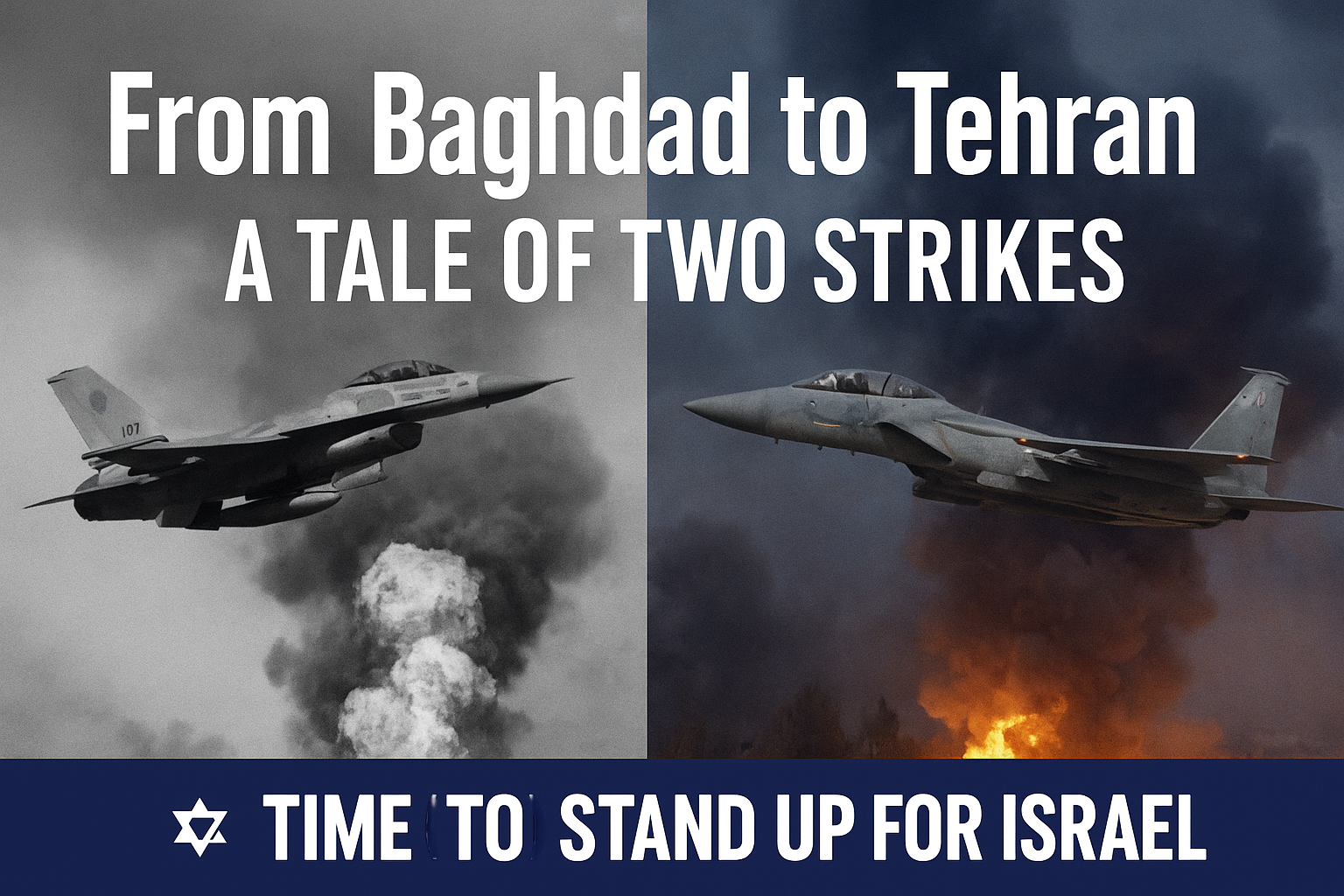
Photo Credits: Sabine Sterk (AI)
From Baghdad to Tehran: Israel’s Relentless Defense Doctrine
The Legacy of Operation Opera
In June 1981, Israel stunned the world with one of the boldest military operations in modern history. Operation Opera, also known as the Osirak raid, was a daring preemptive strike that destroyed Iraq’s nuclear reactor just outside Baghdad.
At that time, Saddam Hussein’s regime was working with France to complete what Iraq called a “peaceful” nuclear research facility. Israel saw through that illusion. Intelligence showed that the reactor, once operational, could produce the fuel for a nuclear bomb, one that could be aimed at Israel. Prime Minister Menachem Begin, whose nation had already endured multiple wars and faced relentless calls for its annihilation, made a fateful decision: strike before it’s too late.
On June 7, 1981, eight F-16s escorted by six F-15s flew over 1,000 kilometers of hostile airspace. The mission lasted just a few minutes, but its impact was historic. The Osirak reactor was obliterated in a precise, controlled strike that left little room for doubt: Israel would never allow its enemies to obtain nuclear weapons.
The world’s reaction was predictable: condemnation, resolutions, outrage. Even the United States initially criticized the strike. But years later, when Saddam invaded Kuwait and his ambitions became clear, the same critics quietly admitted what Israel already knew; the 1981 strike prevented a nuclear-armed Iraq and possibly a regional catastrophe.
Menachem Begin later declared:
“We shall not allow any enemy to develop weapons of mass destruction to be used against us.”
That statement became the Begin Doctrine, a cornerstone of Israeli defense policy: When an existential threat arises, Israel will act, even alone.
Four Decades Later: The Strike on Iran
Fast forward to 2025, and the same doctrine still defines Israel’s survival instinct. The difference? The threats are far more complex and so are the operations.
Iran’s nuclear ambitions have been an open secret for decades. Despite diplomatic efforts, sanctions, and international oversight, Tehran has steadily enriched uranium, developed long-range missiles, and funded a network of terrorist proxies from Lebanon to Yemen. Israel’s leadership, across party lines, recognized that the “point of no return” was fast approaching.
In mid-2025, Israel acted once again. Reports confirmed that Israeli jets and drones carried out coordinated strikes deep inside Iran, targeting nuclear and military sites including Natanz, missile factories, and command centers. Cyber warfare, intelligence operations, and precision airstrikes merged into one of the most sophisticated military actions in Israel’s history.
While details remain classified, experts agree the goal was clear: cripple Iran’s ability to produce a nuclear weapon and demonstrate that Israel’s deterrence remains uncompromising.
Two Operations, One Doctrine
Though separated by more than forty years, the parallels between Operation Opera and the 2025 Iran strike are unmistakable. Both stem from the same guiding principle, the defense of a small nation surrounded by hostility, forced to take its security into its own hands.
The similarities:
- Both were preemptive, not reactive. Israel struck before its enemies could build or use nuclear weapons.
- Both targeted nuclear facilities posing an existential threat.
- Both were executed with surgical precision over long distances, defying regional air defenses.
- Both invited international condemnation but later gained retrospective validation.
- Both underscored Israel’s strategic independence, acting alone if the world stands idle.
The differences:
- The 1981 operation was a single, focused strike; the 2025 operation spanned multiple targets, technologies, and battlefields.
- In 1981, Israel faced one dictator; in 2025, it confronts a web of militias, proxies, and state actors linked to Iran.
- The 2025 strike combined cyber warfare, intelligence coordination, and aerial dominance, a 21st-century evolution of the same survival instinct that guided Begin.
Israel’s Strategic Consistency
Critics label Israel’s preemptive actions as “aggressive” or “destabilizing.” But context matters. No other country on Earth faces what Israel does: constant rocket fire, genocidal rhetoric from neighboring regimes, and the looming threat of nuclear annihilation.
When Israel acts, it does not do so for conquest or expansion; it acts for self-preservation. The alternative would be silence in the face of existential danger. And Israel has learned from history that silence can be fatal.
Operation Opera ensured that Saddam Hussein never had a nuclear bomb. The 2025 strike sends the same message to Iran and the entire region: Israel will never allow its enemies to acquire weapons of mass destruction.
Lessons for the World
- Prevention saves lives. Critics of preemptive strikes often overlook the countless lives spared by preventing a nuclear conflict before it begins.
- Diplomacy without enforcement fails. Iran’s repeated violations of nuclear agreements prove that words alone cannot stop regimes determined to build the bomb.
- Moral clarity is strength. Israel’s willingness to act despite global pressure demonstrates that moral courage sometimes requires standing alone.
- Deterrence works. Both strikes reminded adversaries and the world that Israel’s survival is not negotiable.
Conclusion: The Continuum of Survival
From Baghdad to Tehran, the distance is vast but the principle remains identical. When faced with annihilation, Israel chooses life.
Operation Opera in 1981 and the strike on Iran in 2025 are not isolated events. They are chapters in the same ongoing story, the story of a nation born from ashes, determined to prevent another catastrophe, and unafraid to defend itself in a world that too often forgets what indifference can cost.
Israel does not seek war. It seeks to live. And as long as threats remain, the message will echo through the desert skies once again:
Never again means never again.
Related Topics
Related Posts