Israel’s secular ethos is unraveling – with surprising results
Israel recently added a new chapter to its evolving constitutional framework. Alongside human dignity and liberty, which form the legal bedrock of the nation’s human rights regime, this July the Knesset added a single sentence to the country’s Basic Laws: “Torah study is a basic value in the heritage of the Jewish people and in the State of Israel.”
On the face of it, this briefest of constitutional amendments is the product of a precarious political transaction. It was designed as a legal shield for Prime Minister Benjamin Netanyahu’s ultra-Orthodox (Haredi) coalition partners, securing military service exemptions for yeshiva students in exchange for keeping his government intact.
For over two decades, the Israeli Supreme Court has repeatedly struck down Haredi draft exemptions on the grounds of constitutional equality – a dispute that collapsed the government in 2019 and catalyzed a political crisis spanning five election cycles in just three and a half years, culminating in the current sixth Netanyahu government. By elevating Torah study to the highest legal rank, Haredi leaders are betting that the court would hesitate to strike down a principle carrying constitutional weight.
While critics rightly warn of an alarming leap toward a theocratic state driven by a religious minority wielding disproportionate political leverage, the true significance of this law extends far beyond coalitional cynicism. It reflects a profound, structural transformation of the Israeli legal and social fabric itself.
Historically, Israel’s supreme socializing agent has been its military. The duration and prestige of service – particularly in elite intelligence units that double as pipelines to the high-tech sector – have long served as the primary currency of social and civic capital. Backed by extensive tangible perks, from housing subsidies to generous business discounts, military service forms the foundation of Israeli national identity. Unsurprisingly, to much of the world, “Israeli” has become virtually synonymous with “soldier” – though often to the dismay of Israelis today who actively seek to distance themselves from any association with the IDF.
Importantly, the army was also a secularizing agent. Conceived at the founding of the state as the ultimate national melting pot, the military was designed to forge the secular “New Jew”: a muscular, self-reliant figure built to replace the vulnerable diasporic Jew. Unlike other modern countries with mandatory army service, the Israeli ideal extended to women as well, who were cast not merely as mothers replenishing a devastated post-Holocaust population, but as part and parcel of the military effort.
That foundational ethos is rapidly unraveling, and the new Basic Law is its clearest legal manifestation.
Even before the trauma of October 7, 2023 and with accelerating force since, Israeli society has been undergoing a pronounced religious shift. Demographically, Orthodox families average more than double the birth rate of secular households, with official models projecting the Haredi community will grow from 13 percent to nearly a third of Israel’s population by mid-century. Culturally, post-October 7 polling by the Jewish People Policy Institute reveals a measurable surge in personal prayer, synagogue attendance, and the adoption of religious symbols, particularly among young Israelis.
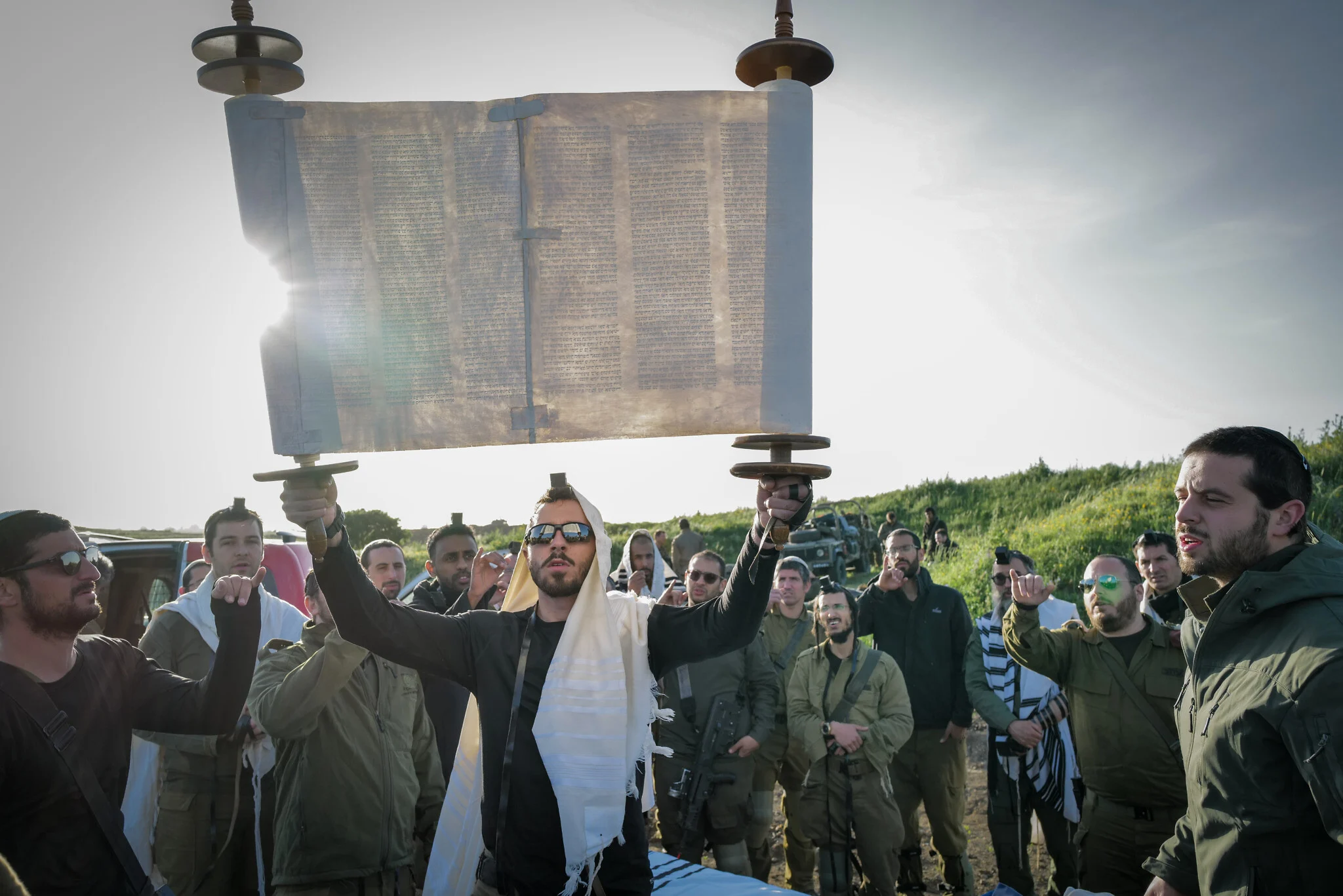
As military sociologist Yagil Levy has documented, these broader societal currents have driven a deep “religionization” within the armed forces. Where a secular military ethos once occupied the core of national identity with religion on the periphery, the dynamic has inverted: religious ideology is increasingly presented as the ultimate justification for military action.
This shift mirrors a growing push to exclude women from the public sphere more broadly, from demands for gender-segregated public spaces to mounting pressure to restrict female military service entirely, and combat roles in particular. The result is a striking paradox: even as female tank commanders defended southern kibbutzim on October 7, prominent rabbinic figures continue to demand their removal, insisting that mixed-gender crews violate Halakhic standards of modesty.
By enshrining Torah study as a core value, the state is shifting its moral center of gravity away from the secular army and toward religious tradition. As one prominent political activist recently told me: “If you don’t know how to speak Halakha (Jewish law), you’re out of the game.”
This is not simply a retreat from national Zionism; it is an evolution of it. As legal scholar Noah Feldman argues in To Be A Jew Today, when ultra-Orthodox leaders insist that Torah study itself amounts to an essential defense of the state, they are engaging in a form of “Zionization” of traditional Torah study.
Yet, by embedding Torah study into the legal machinery of the state, the ultra-Orthodox establishment may have unwittingly set off a powerful counter-process: the democratization of religion.
Once a religious practice is elevated to constitutional law, it can no longer remain insulated from other core constitutional values, such as human dignity and gender equality. Codified as a civil right, Torah study could theoretically be claimed by all citizens – including women and non-Jews – who could then demand state funding and equal access to religious institutions, from municipal rabbinates to rabbinical judgeships. Conversely, if state-funded religious curricula violate democratic rights, they become subject to judicial oversight. Ironically, by forcing religion deeper into the public square, the state strips private rabbinic monopolies of their exclusive authority over sacred texts, turning the Torah into a public utility that belongs to every citizen equally.
Against the Israeli government’s insistence on “absolute military victory,” critics often counter that Hamas is impossible to eliminate through force alone because it is driven by an ideology – and you cannot defeat an idea. Torah study is also an idea. It is the ancient proposition that the Divine is bound to the intellect, and that anyone – rich or poor, rogue or righteous – is entitled to pursue it, provided they do so with unconditional devotion.
So far, this Jewish idea has outlasted the ideal of the secular, militant, new Zionist. And on that front, Israel appears to be shifting into a striking, ancient-new direction.