The views expressed herein are solely mine.
Israel’s Strangest Friendship—and Its Smartest One
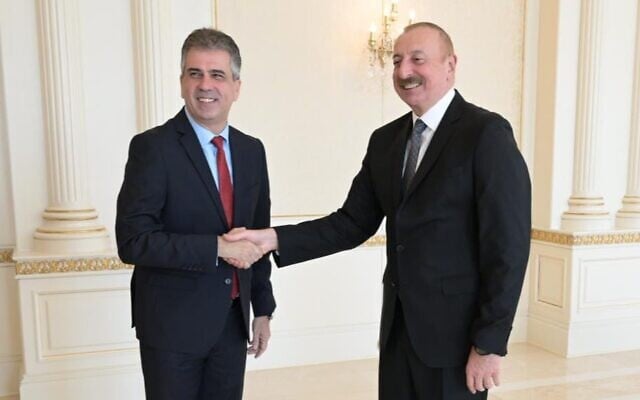
Foreign Minister Eli Cohen meets Azerbaijani President Ilham Aliyev in Baku, April 19, 2023 (Shlomi Amsalem/GPO)
On paper, the relationship makes no sense. In practice, it is ruthlessly logical.
A Shiite-majority, Turkic-speaking state bordering Iran has become one of Israel’s closest strategic partners. That state is Azerbaijan—and the partnership exposes how international politics actually works when ideology is stripped away and geography is allowed to speak for itself.
The anomaly begins with religion. Azerbaijan is overwhelmingly Shiite, sharing sectarian affinity with Iran, the regime that defines hostility toward Israel as doctrine. Yet Baku aligns not with Tehran, but with Jerusalem. This alone short-circuits the lazy assumption that Middle Eastern and Eurasian politics run on faith or sentiment. They do not. They run on threat perception.
Geography does the rest. Azerbaijan sits on Iran’s northern flank, commanding terrain, airspace, and access that no Western power could ever legally obtain. Israel, denied formal relations across much of the region, gains strategic depth and intelligence proximity without a single base or flag. This is deterrence by adjacency, not by declaration.
Military cooperation turns theory into outcome. Israeli drones, loitering munitions, sensors, and battlefield systems helped Azerbaijan decisively shift the balance in the Nagorno-Karabakh war. That victory was not a press release—it was empirical proof that Israeli defense technology works under real combat conditions. In return, Israel gains a partner that buys capability, not slogans.
However, energy is what really seals the bargain. Azerbaijan supplies Israel with a significant share of its oil, a Muslim state underwriting the energy security of the Jewish state while others issue communiqués. This way, pipelines beat podiums while tankers beat talking points.
Nevertheless, what truly makes this relationship “weird” is not that it exists, but that it is so openly transactional. There are no illusions about value alignment. No sermons about democracy. No performance for Western audiences. Just a shared understanding that survival favors the prepared and the proximate.
Critics call this cynical. They are wrong. This is Geopolitics 101, practiced by states that intend to survive.
Israel’s diplomatic history is filled with such partnerships—minority actors, non-Arab states, quiet alliances built on necessity rather than applause. Azerbaijan is simply the most vivid example because it defies every fashionable narrative at once: Muslim solidarity, sectarian determinism, and the idea that Israel is isolated.
This is not friendship. It is realism without apology.
And that is why Israel’s strangest diplomatic relationship may also be its most instructive one.
Related Topics
Related Posts