
Israel’s strongest American allies aren’t who you think!
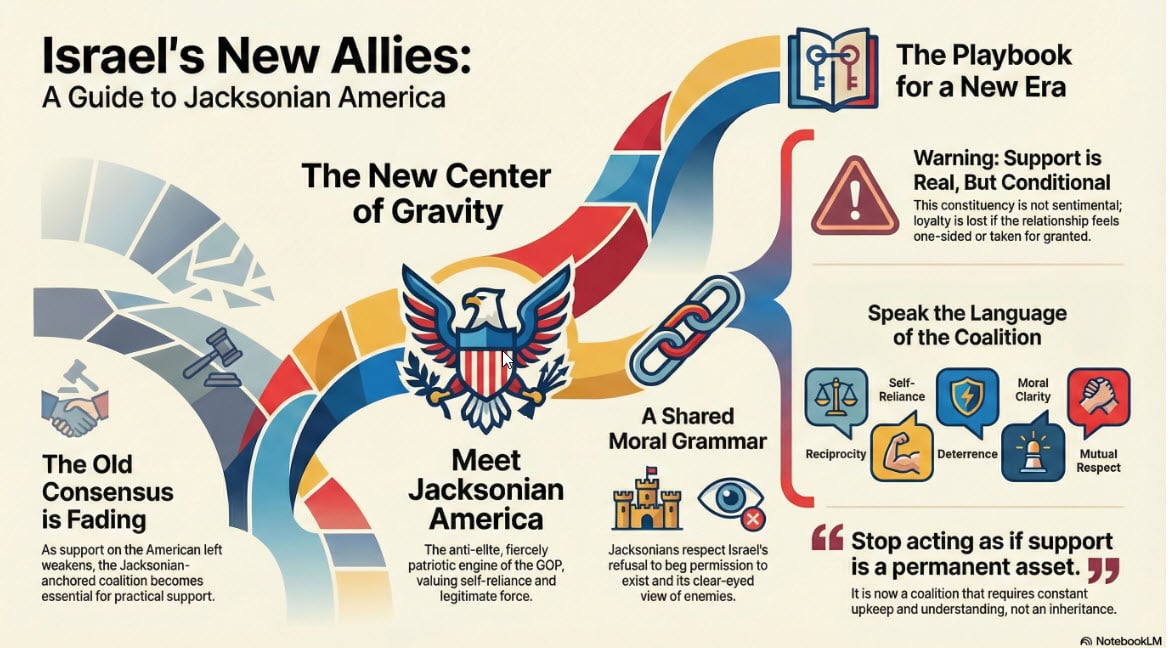
The Jacksonian “honor-and-order” right—now the engine of the GOP—instinctively understands Israel’s security logic. But support is not automatic, and it won’t stay loyal if Israel’s friends speak the wrong political language.
American support for Israel is no longer a single bipartisan floor you can safely stand on. It is becoming a coalition that must be maintained—and the center of gravity in that coalition has shifted.
If Israelis and pro-Israel Americans want a realistic map of where durable US backing is most likely to hold over the next decade, they should stop talking only in party labels and start paying attention to political culture. One constituency matters more than most analysts will admit: Jacksonian America—the honor-and-order, anti-elite, fiercely patriotic strain that now drives much of the Republican Party, energizes MAGA, and still attracts a meaningful slice of center-right voters who feel politically homeless.
This is not a think-tank abstraction. It is the temperament shaping what millions of Americans instinctively recognize as legitimate force, legitimate grievance, and legitimate self-defense.
The Jacksonian instinct: respect, reciprocity, and the right to survive
“Jacksonian” is less an ideology than a worldview: strong boundaries, deep suspicion of distant authority, preference for earned legitimacy over credentialed rule, and a sharp sensitivity to humiliation. It values self-reliance and expects governments to do the basics—protect citizens, enforce rules, punish violators—without moral lecturing.
In foreign affairs, that translates into something Israelis will find familiar: skepticism toward grand crusades, impatience with diplomatic theater, and a hard-edged clarity about enemies. Jacksonians may not love “entanglements,” but they do respect allies who fight like adults.
Which is why many of them respect Israel.
Why Israel is legible to Jacksonians
Jacksonians are drawn to countries that do not beg permission to exist.
Israel’s strategic posture—deterrence, intelligence, rapid response, escalation control, refusal to normalize hostage-taking or rocket fire—fits their moral grammar. They understand a small nation in a rough neighborhood that cannot outsource survival to committees or press releases.
They also have a visceral reaction to what they perceive as moral inversion: terrorism framed as “resistance,” or civilian targeting excused as “context,” while the party defending its citizens is scolded as the aggressor for winning.
You do not have to share Jacksonian politics to see the connection: their instinctive question is not “How do we look in the world?” but “What happens if we don’t stop this?”
The blunt political fact: this bloc now carries the load
For years, Israel could rely on bipartisan reflexes: aid packages, diplomatic cover, shared security language. That reflex is weakening on the American left—especially among younger voters and institutional culture centers that shape narratives (universities, NGOs, entertainment, parts of the press, activist networks).
In that environment, the question becomes practical: who can still assemble a governing coalition that votes yes—reliably—on military assistance, missile defense cooperation, sanctions on Iran, and the basic diplomatic defense of Israel’s legitimacy?
Increasingly, the answer is: the coalition anchored by the Jacksonian right.
That does not mean Israel should become a partisan symbol. It means Israel must understand where its political oxygen is actually coming from—and what can cut it off.
But here’s the warning Israelis shouldn’t ignore
Jacksonian support is real. It is also conditional.
This constituency is not sentimental. It does not remain loyal because it once was loyal. It stays loyal when the story makes sense in its terms:
-
Israel is a frontline ally against shared threats.
-
Israel fights its own battles and does not ask Americans to fight them.
-
Israel’s cause is morally clear: civilians are protected, terrorists are punished.
-
The relationship feels reciprocal and respectful—not bureaucratic, not manipulative, not taken for granted.
If Israel is framed—fairly or unfairly—as an open-ended dependency, or if the conversation becomes abstract, scolding, and managerial, Jacksonian support can drift into a colder “America First” posture: Why is this our problem? That drift is already visible in parts of the right, and it grows when supporters feel talked down to or used.
And Israelis should be cautious about one more temptation: assuming that any American bloc—right, left, or center—will stay “pro-Israel” forever. Coalitions shift. Generations change. Resentments accumulate. In American politics, gratitude is rarely inherited.
What Israel’s friends must do—starting now
If Israel wants to preserve durable American support, especially from the Jacksonian engine now powering U.S. conservatism, it must speak in a language this culture understands. Not slogans—structure.
Lead with:
-
Reciprocity: Israel fights enemies that also threaten U.S. interests and regional stability.
-
Self-reliance: Israel does not ask Americans to fight Israel’s wars.
-
Deterrence: Israel’s goal is to end terror’s belief that it can win.
-
Moral clarity: Targeting civilians is not “context.” It is a line civilization draws.
-
Respect: Don’t moralize. Don’t condescend. Don’t treat voters as instruments.
And for pro-Israel American Jews and communal leaders: stop imagining that “better messaging” means more sophistication. Jacksonians are not moved by cleverness. They are moved by courage, clarity, and fairness.
The call
Israel cannot choose the political weather in America. But it can choose whether it understands the forecast.
If the pro-Israel coalition in the United States is going to hold through the next decade, it will hold because Israel and its advocates stop acting as if support is a permanent asset and start treating it like what it has become: a coalition that requires upkeep.
Learn the Jacksonian grammar. Speak it without pandering. Honor it without being captured by it. And never—ever—assume that any American constituency will keep showing up for Israel simply because it always has.
That era is ending.