
Israel’s War, America’s Ending
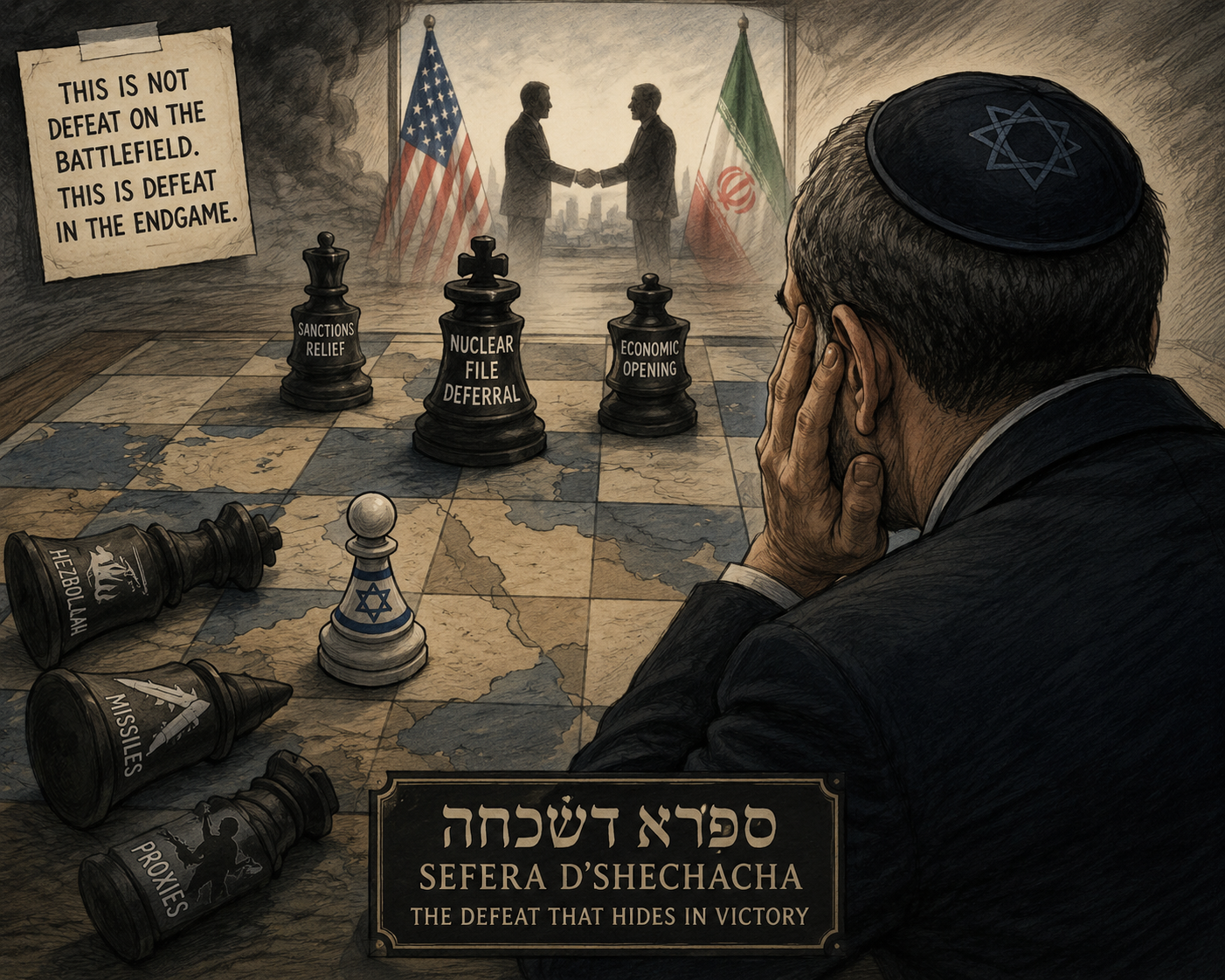
Illustration concept and authorship: Yochanan Schimmelpfennig.
Israel’s War, America’s Ending
Benjamin Netanyahu is claiming victory over a war whose ending he no longer owns.
That is the quiet defeat inside the new US-Iran arrangement. Israel may have struck hard, damaged Iran, and restored part of its deterrent image. But the decisive threshold was never the strike itself. It was the conversion of military pressure into political terms. And that threshold has now been crossed by Washington and Tehran, not by Jerusalem.
This is not an argument against ending the war. It is an argument against mistaking an externally managed ending for an Israeli strategic victory.
A country can win operations and still lose the architecture of the outcome. It can hit targets, degrade capacities, prove reach, and still fail to determine the political form in which those achievements are preserved.
That is Netanyahu’s problem now.
His language of victory sounds less like doctrine than salvage. When he says that the war’s main goals have been achieved, the question is not whether Israel achieved anything. It did. The question is whether the meaning of “main goals” has been narrowed after the fact to fit an ending Israel did not define.
There is a difference between a victory that produces terms and a victory retrofitted to someone else’s terms.
For the United States, the emerging arrangement has an obvious logic. Stop the war. Reopen channels. Stabilize the region. Calm markets. Prevent Lebanon from becoming the next chamber of escalation. Give diplomacy a corridor before the whole structure burns again. In Washington’s grammar, this may count as success.
But Israel’s grammar is different. Israel did not enter this confrontation merely to give the region a pause. It needed to reduce Iran’s ability to regenerate pressure: nuclear pressure, missile pressure, proxy pressure, Lebanese pressure, maritime pressure, diplomatic pressure. The problem was never only the current fire. It was the apparatus that makes fire available again and again.
That apparatus has not disappeared.
This is the distinction Netanyahu’s rhetoric tries to blur. A ceasefire stops movement. It does not necessarily alter capacity. A deal can suspend violence without dismantling the machinery that produced it. A regional pause can look like peace only if one forgets that the threat was not an episode but a system.
Iran does not need to emerge triumphant in order to gain from this arrangement. It only needs to emerge alive enough.
Alive enough to rebuild. Alive enough to negotiate. Alive enough to keep proxies meaningful. Alive enough to move the nuclear file into another diplomatic calendar. Alive enough to convert survival into leverage.
That is why this moment cannot be reduced to the sentimental opposition between war and diplomacy. The question is not whether diplomacy is preferable to war. It is. The question is whether this diplomacy removes the conditions of the next war, or merely gives them time to reorganize.
Netanyahu’s personal defeat lies in the gap between his political mythology and this result. For years, he cultivated the image of the indispensable strategist: the man who alone understood Iran, who alone could manage Washington, who alone could turn Israeli force into geopolitical advantage. Yet at the decisive moment, the ending is being shaped elsewhere, and he must now explain why that ending should still be called victory.
This is not strength. It is narrative overcompensation.
The deeper Israeli defeat is not humiliation. Humiliation passes. The deeper defeat is dispossession. Israel may still possess military capability, but its future use of that capability will now be interpreted inside a diplomatic frame built by others. Every Israeli move against Iranian assets or Hezbollah infrastructure may be judged not only as self-defense, but as a disturbance of an American-Iranian stabilization process.
That is how freedom of action is narrowed without being formally abolished.
No one needs to tell Israel that it cannot act. It is enough to create a political environment in which every act must be justified against the supposed higher virtue of de-escalation. The weapon remains in the hand, but the grammar surrounding its use has changed.
This is why the danger of the deal is not only what it contains. It is what it normalizes. It normalizes the idea that Iran’s violence can be managed rather than structurally defeated. It normalizes the idea that Israel’s security can be folded into a wider diplomatic choreography whose first aim is regional quiet, not Israeli strategic clarity. It normalizes the old asymmetry: the aggressor’s apparatus is treated as a problem to be administered, while Israel’s response is treated as the event requiring restraint.
Netanyahu cannot say this openly. To attack the deal directly would risk a collision with Washington. To embrace it fully would admit that Israel’s war ended under terms not made in Jerusalem. So he chooses the only available formula: victory with reservations, success with ambiguity, achievement without ownership.
But a victory that cannot name its own terms is already wounded.
The issue is not whether Israel should reject every diplomatic arrangement. That would be childish. Nor is the issue whether every war must end in total destruction of the enemy. That would be fantasy. The issue is whether the end of this war leaves Israel safer in structure, or only quieter in appearance.
If Iran’s missile program remains insufficiently dismantled, if Hezbollah remains part of the regional equation, if the nuclear question is deferred, if economic relief precedes structural neutralization, if the proxy system survives as a latent instrument, then the war has not ended in strategic transformation. It has ended in managed postponement.
And postponement is not peace.
It is risk with a calendar.
For Netanyahu, the temptation will be to sell the Israeli public a disciplined fiction: that the essential work has been done, that remaining dangers are secondary, that Israel retains every option, that the campaign achieved what it needed to achieve. Some of this may be politically useful. None of it should be mistaken for strategic truth.
The truth is sharper.
Israel proved it could strike. It did not prove it could own the ending.
That is the defeat hidden inside the language of victory. Not the defeat of Israeli courage. Not the defeat of the Israeli army. Not even necessarily the defeat of deterrence in the narrow operational sense. It is the defeat of conversion: the failure to transform military pressure into binding political reality.
The international system is comfortable with such endings. They allow everyone to breathe without requiring anyone to decide. Washington gets de-escalation. Tehran gets survival. Europe gets vocabulary. Markets get relief. Diplomats get another round.
Israel gets risk with better stationery.
That may be enough for a communiqué. It is not enough for security.
A war is not won when the shooting stops. It is won when the enemy loses the capacity to make the next shooting politically, militarily, and structurally available.
By that measure, Netanyahu’s victory speech is premature.
Worse: it may be what defeat sounds like when it is forced to speak in the language of diplomacy.
Yochanan Schimmelpfennig