The views expressed herein are solely mine.
The Vance Deal’s Nuclear Trap for Israel
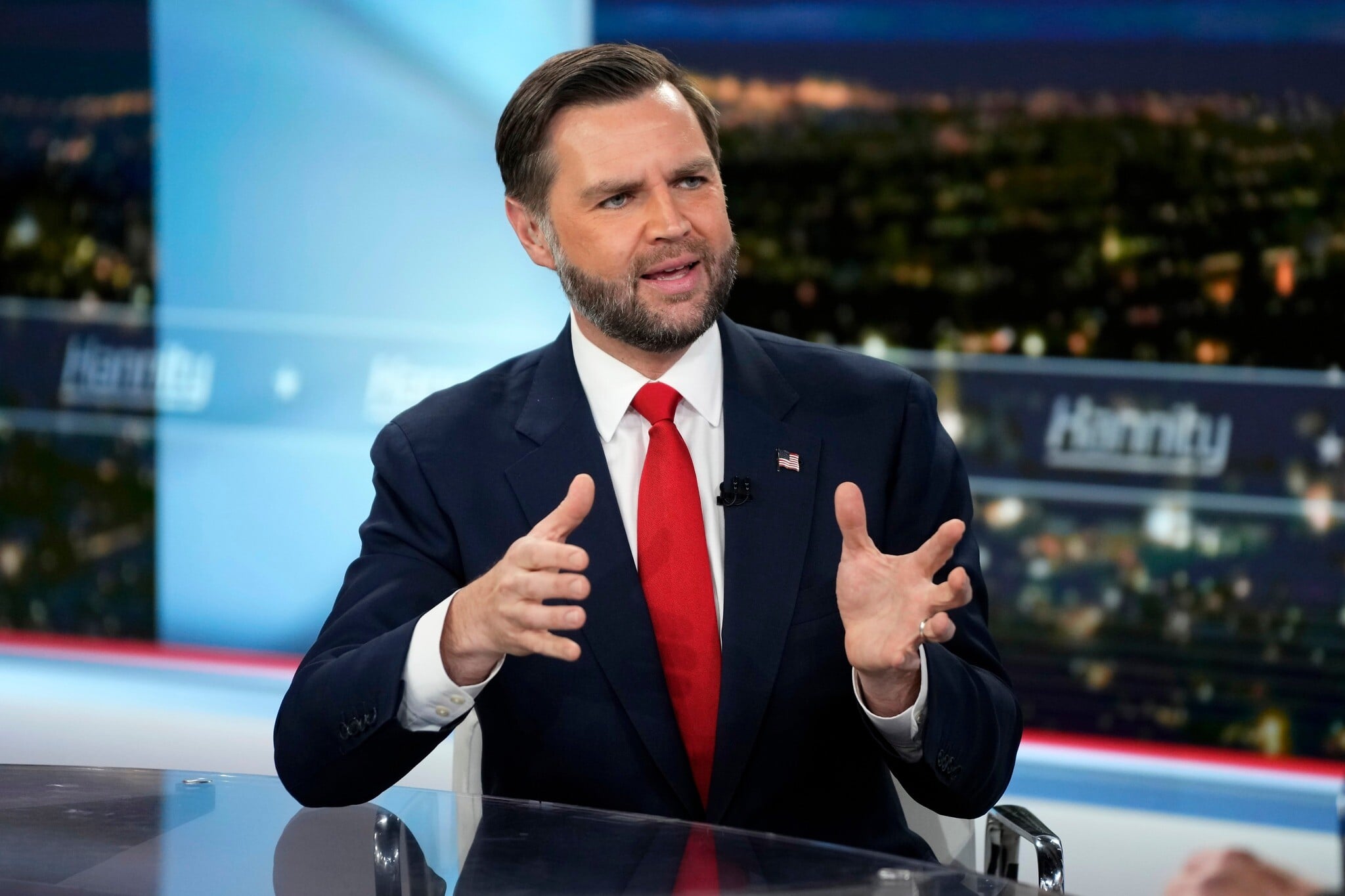
US Vice President JD Vance appears on 'Hannity' on June 15, 2026, in New York. (Charles Sykes/Invision/AP).
The “Vance Deal”—underwritten by U.S. Vice President Vance’s preferred Middle East patrons in Turkey, Qatar, Pakistan, and Saudi Arabia—does not end a crisis. It monetizes American retreat, legitimizes and strengthens the Iranian regime, lifts America’s naval blockade of Iran (which was costing the kamikaze thuggish regime roughly $435 million a day), and reopens the Strait of Hormuz on terms that let Iran and Oman turn global shipping into a tollbooth.
Fighting pauses in Iran and Lebanon, but the halt is poisonous: it risks derailing Beirut’s campaign to disarm Hezbollah, strengthens Hamas’s anti-demilitarization posture, and hands Tehran cash, time, and chokepoint leverage to pressure Israel. The nuclear file, naturally, is shoved into future talks—the oldest trick in the appeasement manual.
The symbolism was grotesque: Flag Day, Trump’s birthday, the UFC fight card, the World Cup, and Hezbollah’s attack on Israel all collapsed into one obscene piece of political theater—a midterm relaunch for the Republican Party, gift-wrapped as Trump’s birthday present and paid for with Israeli leverage.
But the deeper message is uglier than the pageantry. The pro-West, pro-freedom, and above all pro-Israel force once associated with Marco Rubio inside the Republican Party is not merely fading; “thanks” to Vance’s “peace efforts,” it is dead.
Vice President Vance claims that Iran gets no cash simply for signing, and President Trump “conditions” future sanctions relief on behavior. Both politicians ignore the deal’s content and maliciously overlook immediate payoffs. Under this Obama 2.0 clemency order, Iran receives $25 billion from the release of frozen assets in Qatar and early sanctions relief for oil and petrochemical exports, including $12 billion before nuclear talks are supposedly set to begin in 63 days. The United Arab Emirates commits to releasing an additional $20 billion (with $3 billion already in Tehran), thereby bringing Gulf capital into Iran under the deal’s political cover.
In parallel, Washington clears the way for private investment, paving the way for roughly $300 billion in foreign capital over the decade. This echoes Obama’s poisonous Cuba policy, too, on a larger scale: Havana gained remittances and tourism without reforms while the regime’s security services benefited. Iran’s mullahs will do the same. As radical ideologues hostile to America and Israel, they will strengthen the Islamic Revolutionary Guard Corps and proxies rather than pursue moderation or nuclear limits.
The regime retains 440.9 kilograms of 60-percent enriched uranium—sufficient, with further enrichment, for at least ten nuclear weapons—with more than 200 kilograms hidden in Isfahan tunnels. Inspectors are barred from critical sites; still, these issues could be solved in a later phase, because, yeah, “this is not a big deal”.
The Islamic Republic of Iran governs 90 million people across 1.65 million square kilometers. Israel has about 10 million people and 22,000 square kilometers—more than seventy times smaller and without strategic depth. Tehran projects power through an arc of proxies from Hezbollah in Lebanon to the Houthis in Yemen. Jerusalem is a narrow democracy with no margin for error. The scale and depth disparity make any linkage between Iranian nuclear concessions and Israeli deterrent capabilities one-sided and unjust.
Almost no one is saying it—perhaps because they have not seen the trap, or perhaps because they prefer not to admit it—but the deal’s semantic fog creates a dangerous opening: Israel could eventually be pressured to limit, disclose, or even dismantle elements of its nuclear deterrent in exchange for Iranian “steps” that Tehran can reverse, disguise, or violate at will.
The irony is not that Israel and Iran are morally, politically, and strategically incomparable; it is this ambiguity that gives Washington’s new isolationist wing a pretext to corner Israel while pretending to be even-handed. For Vance’s skeptical faction inside the Republican Party, the argument writes itself: “if Iran must accept limits, why not Israel too?”
We all know that this logic is obscene. Israel is a small, densely populated democracy with no strategic depth, surrounded by enemies and proxies that openly contemplate its destruction. Its nuclear ambiguity is not a luxury but the final insurance policy for a state that cannot afford a single catastrophic mistake. Iran is the opposite; Tehran is a vast revolutionary terror-sponsor of Islamist proxies across the region, ballistic missiles, ideological ambitions, and a declared project of regional domination. To equate Israel’s deterrent with Iran’s aggression is not balanced; it is a geopolitical malpractice that rewards Tehran for creating the threat in the first place.
Nevertheless, when isolationist demagogues hurl playground insults at Israel’s leaders and sneer at the Jewish state for refusing to enter their Jonestown-like cult of strategic self-erasure, they expose the bargain beneath the rhetoric: Israel must become smaller, quieter, weaker, and more obedient so Washington can market capitulation as statesmanship.
That is what makes the current moment so odd. Vance’s anti-Israel instincts no longer sit on the fringe; they now echo through a growing bloc of American politics already poisoned by hostility toward the Jewish state.
Trump’s recent flirtation with that camp raises a chilling possibility: a future Washington looking for votes in the upcoming midterms may not merely pressure Israel diplomatically, but seek to cage its nuclear backup, restrict its conventional edge, punish preemptive action with an arms embargo, or even repeat the hoax that “Israel committed genocide in Gaza”. Jerusalem would then face the oldest Jewish nightmare in modern dress: defend itself while its most important ally locks the armory and ignores what loyalty means.
With this in mind, the State of Israel must start seeing U.S. security assistance as transitional, not permanent. The next security memorandum should become a reverse-arsenal agreement: Israeli systems entering Pentagon inventories through joint U.S. production. The Jewish state should build production facilities in the United States, India, Greece, Cyprus, and Abraham Accords states for non-sensitive components while keeping final assembly and sensitive technology at home. This would generate defense revenue, reduce dependence on Washington, create American and Israeli jobs, diversify supply chains, and shield Jerusalem from aid leverage or future arms embargoes over defensive operations.
Nonetheless, the mullahs won this round. They will receive $45 billion up front, plus access to an additional $300 billion. They retain control of Hormuz and the power to impose tolls or shut it down at will. They push Israel toward new deterrent limits while accepting none themselves. The Vance deal rewards blackmail, hands a genocidal regime both cash and a chokepoint, and teaches every rogue state and terrorist army the same lesson: threaten critical infrastructure, squeeze global trade, bleed the West long enough, and Washington may eventually pay you for being “tough enough.”
The insanity is obvious: radicals who despise America and Israel are being rewarded for their hostility because President Trump wants his postcard moment with Mohammad Ghalibaf—his failed Iranian version of Venezuela’s Delcy Rodríguez—and a sequel to the 2018 Kim Jong Un photo-op circus.
Washington has chosen to reward the arsonist, lecture the firefighter, and then stand grinning in the smoke, pretending it saved the house. The Vance deal will not bring peace. It is capitulation in costume—a Tucker Carlson-flavored surrender sold as realism.
Related Topics
- Abraham Accords
- Antisemitism
- Barack Obama
- Benjamin Netanyahu
- Cyprus
- Donald Trump
- Gaza
- Gaza Reconstruction
- Gaza Rocket Attacks
- Greece
- Hamas
- Hezbollah
- IDF
- Iran
- Islam
- Israel At War
- Israel-India Relations
- Israel-US Relations
- Israel: Jewish and Democratic
- Israeli Foreign Policy
- Israeli Politics
- Israeli society
- Jerusalem
- Latin America
- Lebanon
- Middle East
- Oman
- Pakistan
- Qatar
- Saudi Arabia
- Terrorism
- The Arab World
- Tucker Carlson
- Turkey
- UAE - United Arab Emirates
- US Midterm Elections
- US Politics
- Weapons
- Yemen