
Eyes everywhere
Italian Autonomous Police Union fires at inaction directives imposed on agents
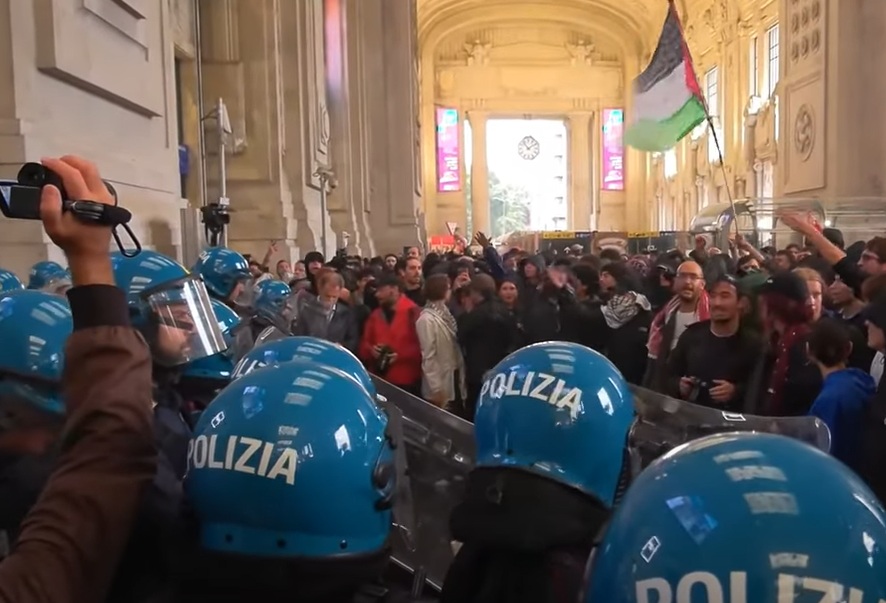
Italian anti-riot police attacked in Milan's Central Station by pro-Palestinian rioters on September 22 (YouTube screanshot Local Team; used in accordance with Clause 27a of the Copyright Law).
“Enough with the target practice against law enforcement!” This is the appeal launched by the Autonomous Police Union (SAP) Secretary General Stefano Paoloni, following the September 22 turmoil caused by far-left and pro-Palestinian demonstrators during a national strike for Gaza:
“In many Italian cities, including Milan, Rome, Florence, Bologna, Turin, and Trieste, incidents with the police broke out during the pro-Pal marches. These are the usual professionals of disorder who seek confrontation regardless of the reason for the demonstration. Law enforcement was subjected to all kinds of violence, but, apparently, it was decided not to offer resistance other than to contain the disturbances. The risk of incidents being exploited,” he concluded, “cannot prevail over the safety of officers. The 60 officers injured in the Milan demonstration are proof that we were used as target practice.”
Milan’s Central train station was besieged for several hours by thousands of pro-Palestinian and far-left demonstrators who threw poles, dumpsters, crates, glass bottles, stones and anything else they could get their hands on at the officers, destroying the building’s large atrium and smashing the glass doors.
In Bologna and Rome, protesters stormed the city’s freeways during rush hour, paralyzing traffic and causing panic among drivers before the belated intervention of riot police, who pushed them into side streets and then chased them. In Venice, police were forced to fire water cannons to prevent protesters from blocking the streets. Similar scenes took place in Genoa, Venice, and Florence. (Read here about the September 22nd riots in Italy).
The violence unleashed yesterday is hardly surprising. Since October 7, 2023, there has been a rapid increase in violence, both verbal and physical, by far-left and pro-Palestinian groups. The escalation has ranged from glorification of Hamas and terrorists, antisemitic statements, blacklists, calls for “action” against “Zionist enemies,” and even physical assaults such as the one occurred on September 16 at the University of Pisa when a mob of pro-Palestinian activists stormed Prof. Rino Casella’s class, accused him of being a “Zionist,” and beat him in front of his students.
Following the disaster on Monday, September 22, many in Italy are asking what went wrong and why the Interior Minister, Matteo Piantedosi, was unable to prevent the turmoil.
Well, the answer was provided by SAP secretary general Paoloni:“…It was decided not to offer resistance other than to contain the disturbances.”
An explanation that perfectly matches the previous statements made by Piantedosi himself in an interview on October 30, 2023, in anticipation of pro-Palestinian demonstrations:“We have an operational tradition that allows us to prioritize the management of these demonstrations”.
However, what happened Monday in Milan had nothing to do with the containment and management of a demonstration; it was a full-blown assault on police officers, who were also understaffed for some mysterious reason. This is inexplicable, considering that Milan is one of the hottest pro-Pal cities in Italy, and the clashes were largely predictable.
Just a few days before, on September 16, a far-left and pro-Palestinian protest in Milan turned into an unauthorized march, causing traffic disruption in a large area of the city center. Protesters attacked the police blockade, who, in turn, gave in and escorted the march through the streets.
Anyone with even a minimal amount of experience in public order and security knows that riots cannot be controlled, and forcing officers not to offer resistance puts their lives at risk, as well as those of the citizens they are supposed to protect.
Therefore, why did the directives not allow police officers to respond to the assaults as needed? A State that does not react to street violence and leaves police officers and citizens at the mercy of street violence cannot be defined as a “State” in the full sense of the term. The inaction on behalf of the authorities leads to a perception of weakness that only encourages further violence.
We now await political responses from the majority; responses that go beyond the indignant posts and circumstantial statements, because what we saw yesterday in Milan risks being only the beginning of a particularly violent fall-winter season at the hands of the far-left and pro-Palestinian front.
Related Topics
Related Posts