
Eyes everywhere
Italy and its ambiguous stance on Palestinian terrorism
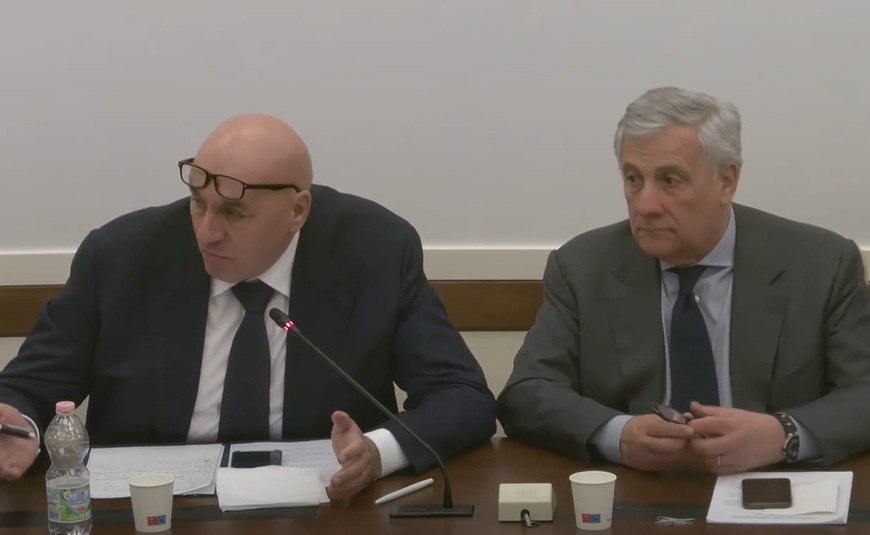
Italy's Defense Minister, Guido Crosetto and Foreign Minister, Antonio Tajani during a 2024 Parliament audition (Pupia News,YouTube; used in accordance with Clause 27a of the Copyright Law)
On August 30, 2025, the Italian Foreign Minister, Antonio Tajani, attended the meeting of the European Union Foreign Ministers in Copenhagen and made some concerning statements regarding Israel, as reported by Agenzia Nova press agency:
“Sanctioning more settlers and more harshly: this is the first step…Then, if it doesn’t help much, we can study other steps, but let’s already begin deciding on sanctions against the settlers. New sanctions on settlers, and on more settlers, is already a strong message towards defending the foundations of a new Palestinian state, because if the West Bank is annexed, it means the end of the idea of a Palestinian state, in which we believe. It doesn’t exist today (the Palestinian state), but we have to work to build it, so let’s start with the settlers and then we’ll see.”
Tajani’s remarks should be considered within the broader context of recent statements by Italian Prime Minister Giorgia Meloni and Foreign Minister Guido Crosetto, rather than in isolation. On August 27, Meloni accused Israel of “a reaction that has gone beyond the principle of proportionality”, during the annual Rimini Meeting of the influential Catholic activist group Comunione e Liberazione (CL), and once again called for a ceasefire and the release of the hostages from Hamas.
On August 8, 2025, the Italian Defense Minister, Guido Crosetto, released a series of statements to the Italian newspaper La Stampa, attacking Israel in relation to the Gaza military operations and even suggesting sanctions:
“What is happening is unacceptable. We are not facing a military operation with collateral damage, but the pure denial of the law and the founding values of our civilization. We are committed to humanitarian aid, but beyond condemnation, we must now find a way to force Netanyahu to think clearly.”
He also added: “We must always distinguish governments from states and peoples, as well as from the religions they profess. This applies for Netanyahu, and it applies to [Russian President Vladimir] Putin, whose methods, by now, have become dangerously similar.”
The Israeli Embassy to Italy consequently released a statement reminding Crosetto of the terrorist nature of Hamas and that “Israel rejects any dictates regarding its security or how it defends its citizens.”
Walker Meghnaghi, president of Milan’s Jewish community, also responded harshly: “Does Crosetto think he’s the Messiah when he says we must stop Israel? The Defense Minister is being inaccurate. Why doesn’t he get on a plane and see what’s happening before giving certain interviews?“
It is worth highlighting that, as a Defense Minister, Crosetto should know the difference between an occupation for political aims and a military takeover aimed at eradicating a terrorist organization from a specific territory. Crosetto should also keep in mind that it was Hamas that attacked Israel on October 7, 2023, and not the other way around.
Some controversial statements from 2024
Just for the sake of information, it is worth recalling a few statements the previous year. In April 2024, following Iran’s first missile attack against Israel, the Italian Foreign Minister, Antonio Tajani, said during the TV show “Stasera Italia”:
“The Iranians have assured us that our Italian soldiers in the area will be respected…The Italian contingent in Lebanon is under the aegis of the UN, it is in a condition to be protected, I don’t think there are any dangers either for the Italian soldiers or for the Italian citizens in Israel and Iran”. As for the Houthi attacks in the Red Sea, the minister explained how he was assured that “only ships that bring weapons to Israel would be attacked”. (Agi, Apr 14,2024).
This last statement is further interesting, since the European anti-Houthi mission “Aspides” in the Red Sea was being led by Italy and Greece.
In November 2024, four Ghanaian UN peacekeepers were wounded when a rocket hit their base in southern Lebanon. In addition, eight rockets hit the headquarters of the Italian contingent in Shama, southern Lebanon. The Italian Defense Minister, Guido Crosetto, immediately blamed Israel for the attack. Not long after, the Italian Foreign Minister, Antonio Tajani, also corrected Crosetto, saying that the rockets were fired by Hezbollah.
However, Tajani went beyond and added: “Judging by the type of rockets, we can confirm that it was Hezbollah that hit the Unifil base. Hezbollah has no right to touch the Italian troops, who have also guaranteed the safety of Hezbollah and it is therefore inadmissible and unacceptable that they shoot at the Italian contingent…If it was a mistake, they should learn to use weapons better”.
No further comment regarding these statements is required, as each one should form his own opinion.
Conclusive thoughts
It is interesting how the growing European criticism of Israel goes hand in hand with the progress of the final IDF offensive against Hamas in Gaza. The closer Hamas’s demise gets, the more accusations and political pressure against Israel increase. Is this a coincidence?
Is it possible that European countries, including Italy, are worried about the repercussions that Hamas’s final defeat could have domestically, on public order, in relation to the activity of the Islamist and far-left pro-Palestinian networks?
It is important to remember that Palestinian militants have been operating on Italian soil since the 1970s. To date, there have been no known reports of police operations involving arrests against Hamas in Italy. Let’s keep in mind that Hamas is classified as a terrorist entity by the European Union, just like ISIS and al-Qaeda.
Reports of financial movements into Italy from Israel, destined for Hamas, have been received on several occasions. In October 2024 and June 2025, the US Treasury Department sanctioned the Italy-based Palestinian activist Mohammad Hannoun, identified by Washington as a “Hamas operative and its financial collector in Italy.” However, the individual in question remains active and, two weeks ago, he publicly accused the Treasury Department (again from Italy and during a street demonstration) of spreading “lies.”
In January 2024, al-Aqsa Martyrs Brigades member, Yaeesh Anan, was arrested in the Italian city of L’Aquila at the request of Israeli authorities. The individual, currently detained, is accused of planning terrorist attacks against Israel from Italian soil, and had been active in Italy since October 2017, with the Italian authorities being aware of it from the beginning. Furthermore, Anan had entered Italy illegally after Norway refused him international protection and withheld his passport. Moreover, despite their status of “unemployment”, Anan and one of his associates had respectively 8 and 9 open bank accounts, moving thousands of euros.
These are just two of a larger series of cases regarding Palestinian militants on Italian soil that would require further in-depth analysis.
As explained to the Times of Israel by Swiss journalist and author, Stefano Piazza: “In Italy, discussing Palestinian terrorism has always been a minefield, a topic that divides, polarizes, and is often removed from public debate. While the violence of Hamas, Islamic Jihad, and other Palestinian groups fully falls within the international definition of terrorism—indiscriminate attacks against civilians, suicide bombings, kidnappings—in Italian political and media discourse, are frequently presented in watered-down language, if not justified as acts of “resistance.” To understand the reasons for this difficulty, it is necessary to retrace the history and unresolved issues that have marked Italy’s relationship with the Palestinian cause.”
On August 27, 2025, Israeli Ambassador to the UN, Danny Danon, said in an interview with The Times of Israel, referring to the plans of France, the United Kingdom, Australia and Canada to recognize the state of Palestine: “These countries want to show that they are doing something, so they blow off steam by coming up with these declarative statements”.
Italy is not among those countries willing to recognize a Palestinian state yet; however, it’s legitimate to ponder whether Rome is worried about the potential repercussions of a final defeat for Hamas, particularly regarding possible internal reactions from the Islamist, the pro-Pal movement, and the far-left. Such a network is indeed extremely active in the country, while antisemitism is on the rise.
Related Topics