London based entrepreneur, cybersecurity analyst doing a PhD in AI
It’s Maths (not turtles) all the way down.
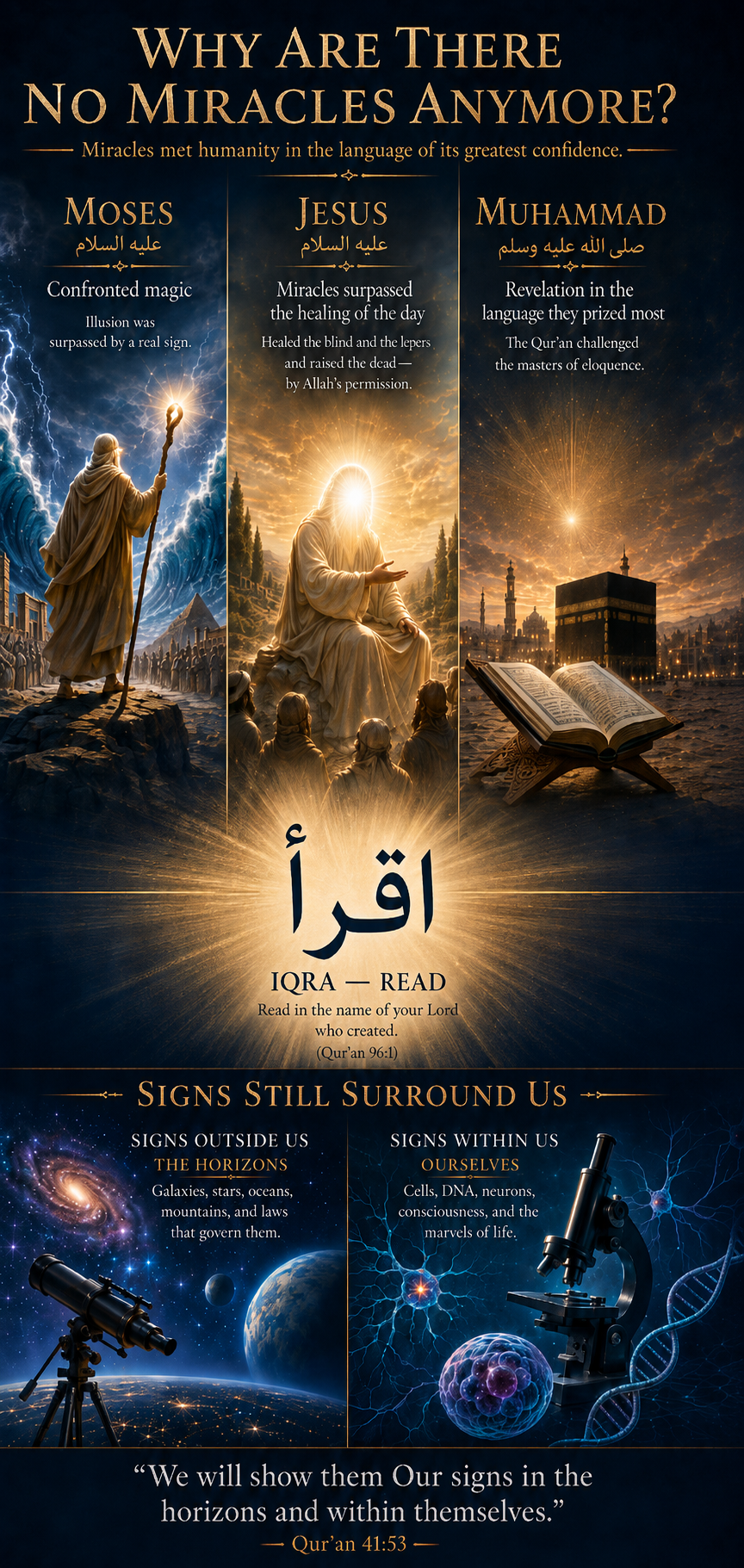
Why Are There No Miracles Anymore?
If God sent miracles before, why do we not see them now?
Why no sea splitting? No staff becoming a serpent? No dead being raised?
Islam’s first answer is straightforward: prophethood ended with Muhammad ﷺ.
But there is another pattern worth noticing.
Perhaps miracles were not random spectacles. Perhaps they confronted civilisations in the language of their greatest confidence.
Moses (alayhis salaam) confronted magic.
Jesus (alayhis salaam) confronted healing.
Muhammad ﷺ confronted language.
And today?
Our civilization trusts science.
The telescope. The microscope. The equation. The genome. The particle accelerator.
Perhaps our age is not primarily being asked to watch nature break.
Perhaps it is being asked to read nature more deeply.
Moses: Magic Meets Its Limit
Pharaoh summons his magicians. They throw their ropes and staffs and, the Qur’an says, they appear to move:
يُخَيَّلُ إِلَيْهِ — yukhayyalu ilayhi
They are made to seem as though they move. Qur’an 20:66
Then Moses casts his staff. It consumes what they produced, and the magicians themselves fall in prostration. Qur’an 20:69–70
The experts recognise the boundary of their expertise.
The sign enters their strongest domain—and exceeds it.
Jesus: Medicine Meets Its Limit
Jesus, peace be upon him, receives a different cluster of signs:
“I heal the blind and the leper, and I bring the dead to life—by Allah’s permission.”
— Qur’an 3:49
The Qur’an repeats the crucial qualification “by My permission” when recounting these miracles. Qur’an 5:110
A longstanding Muslim interpretation connects Jesus’ signs with the prominence of medicine and healing in Israel in his age. Today’s Israeli medical landscape is also booming. Hopefully after reading these articles, they will also develop a stronger moral compass and a more stringent ethical framework. The Qur’an does not itself state that historical theory, so it should remain an interpretation.
But its logic is compelling.
Medicine heals.
Jesus heals what medicine cannot.
Blindness.
Leprosy.
Death.
Again, the sign appears at the boundary of human capability.
Muhammad ﷺ: Language Becomes the Sign
Arabia’s great cultural technology was language.
Poetry transmitted memory, genealogy, honour, political power and social prestige.
Into that civilization came the Qur’an.
Its challenge was itself linguistic:
“If mankind and jinn gathered to produce the like of this Qur’an, they could not produce its like.”
— Qur’an 17:88
The enduring sign was not an isolated spectacle.
It was revelation: sound, rhythm, meaning, law, narrative, prayer and semantic compression transmitted as language.
The Prophet ﷺ himself said that previous prophets were given signs through which people believed, while what he had been given was revelation. Sahih al-Bukhari 4981
Moses’ staff cannot be inspected today.
The Qur’an can.
The sign became informational.
Āyah: Sign, Verse, Vector
Here the Arabic becomes crucial.
The Qur’an calls one of its verses an āyah.
But āyah also means a sign, indication or evidence.
A Qur’anic sentence is an āyah.
Something in creation can also be an āyah.
That does not mean every scientific discovery is a supernatural miracle.
It means reality can be read for what it indicates.
Smoke points toward fire.
A footprint points toward presence.
A biomarker points toward physiology.
Think of an āyah as analogous to a vector.
A vector has magnitude, but also direction.
One arrow proves little.
Many independent arrows can show convergence.
Now consider:
“We will show them Our signs in the horizons and within themselves until it becomes clear to them that it is the truth.”
— Qur’an 41:53
The Arabic names two domains:
Al-Āfāq (الآفاق) — The Macrocosm— the horizons, the world beyond us.
Anfusihim (أنفسهم) — The Microcosm— within themselves.
In modern terms, we might call these the telescopic and microscopic directions.
Outward:
galaxies, gravity, cosmology, space-time, physical law.
Inward:
cells, DNA, neurons, physiology, consciousness.
The verse is not predicting telescopes or microscopes.
Its point is broader: look outward and inward; both domains contain signs.
Modern science has simply given us astonishingly powerful instruments with which to do both.
César Hidalgo: Information Becomes Physical
César Hidalgo’s Why Information Grows begins with information itself. This is one of the best books I read recently and I highly recommend it.
Hidalgo defines information not merely as messages or meaning, but as physical order—whether embodied in a car, DNA, or “sequences of words in a book.”
A good example for this Hidalgo gives in the book is a crashed Bugatti. An uncrashed Bugatti is a “particular configuration of atoms”. This is the only one way this configuration can hold “financial value”. Any crash – of which there are multiple possibilities – distorts the information and depreciates the value. Value is therefore held in the “information” a “new Bugatti embodies”.
That distinction matters.
Ink and paper do not independently contain War and Peace.
Randomly rearrange the same matter and Tolstoy disappears.
The information resides in the configuration.
Earth is remarkable because matter here has become capable of storing information, processing it, transmitting it—and eventually understanding it.
DNA produces brains.
Brains produce language.
Language produces books.
Books produce science.
Science turns around and reads DNA.
Matter has become capable of reading matter.
Leonardo da Vinci: Prayer, Labour, Order
Leonardo is often presented simply as the great empirical observer.
His notebooks are more complicated.
He prayed:
“Thou, O God, dost sell us all good things at the price of labour.”
That prayer beautifully echoes a Qur’anic principle:
“And that there is not for man except that for which he strives.”
— Qur’an 53:39
The Arabic saʿā conveys striving, endeavour and purposeful exertion.
The verse does not mean human beings control every outcome. Rain may fall or not; illness may intervene; another person’s choices may obstruct us.
It establishes something more fundamental:
our moral agency lies in the direction and seriousness of our striving.
Leonardo’s intuition is strikingly similar.
Prayer does not substitute for labour.
Faith does not abolish effort.
It gives effort meaning.
Isaac Newton: Law Points Toward Mind
Newton did not discover physical laws and conclude that God had become unnecessary.
He concluded almost the opposite.
In the General Scholium to the Principia he wrote:
“This most beautiful System of the Sun, Planets and Comets, could only proceed from the counsel and dominion of an intelligent and powerful being.”
Newton’s eloquence is striking as it is beautiful –
“The supreme God is a Being eternal, infinite, absolutely perfect; “
His position matters.
Mechanism did not erase metaphysics.
The more clearly he saw the mechanism, the sharper the question of its source became.
Albert Einstein: The Mystery of Order
Einstein believed differently.
He did not affirm the personal God of Judaism, Christianity or Islam.
Asked directly about God in 1929, he replied:
“I believe in Spinoza’s God who reveals Himself in the orderly harmony of what exists…”
His famous “God does not play dice” language likewise concerned his resistance to fundamental randomness in quantum mechanics, not orthodox theology.
What matters here is what repeatedly impressed him:
Order.
Harmony.
Lawfulness.
The extraordinary fact that nature can be mathematically understood.
Bill Gates: DNA as Software
Bill Gates expressed biological information in the language of computing:
“DNA is like a computer program but far, far more advanced than any software ever created.”
— The Road Ahead
This is not an argument by Gates for God.
It is an analogy—and an unusually revealing one.
Biology is not merely a pile of matter.
Sequence matters.
Arrangement matters.
Information matters.
Change letters in the sequence and biological outcomes change.
Our civilization has therefore begun describing life using its own dominant vocabulary:
code.
Elon Musk: “The Creator”
Elon Musk is more difficult to categorise.
He has long discussed simulation arguments and has not traditionally presented himself as conventionally religious.
Yet in his 2025 Katie Miller interview, asked whom he looked up to most, Musk answered:
“The Creator.”
Asked his position on God:
“God is the Creator.”
Pressed further, he replied:
“I believe this universe came from something. People have different labels.”
That is not traditional Islamic, Jewish or Christian theology.
But it is plainly metaphysical.
The universe, Musk is saying, does not explain its own existence merely by existing.
Max Tegmark: Mathematics All the Way Down
MIT physicist Max Tegmark goes in another direction.
His Mathematical Universe Hypothesis argues that our physical world may itself be an abstract mathematical structure.
The deeper physics goes, the less reality resembles the naïve picture of solid “stuff.”
Tegmark should not be misrepresented as saying we probably live inside a simulation. Asked directly, he said simulation is logically possible but that he would answer “no” to whether we are probably simulated.
His proposition is stranger:
perhaps mathematics goes all the way down.
Rizwan Virk: Reality as Rendering
Rizwan Virk pushes the computational interpretation much further.
Asked recently how likely he thinks it is that we live inside a simulation, he answered:
“Over 70 percent, maybe as high as 80 percent.”
Simulation theory is not Islamic theology.
Now here is my “punch in the gut” statement – if we are in a “simulation” – it looks like a “binary classification” exercise – Heaven or Hell.
And all of life boils down to that binary classification at the point we breathe our last breath.
Whether you like Conor or Khabib, Tyson or Muhammad Ali, Federer or Nadal (I like Federer more!), vanilla or chocolate ice cream is not the ultimate goal of life. Or as the Quran says –
Neil deGrasse Tyson: Where Science Stops
Neil deGrasse Tyson provides the necessary corrective.
He refuses to put God wherever scientific knowledge currently ends.
On questions such as the origin of life, his position is essentially: we do not know yet; keep investigating.
That protects this entire argument from the classic “God of the gaps.”
If consciousness, abiogenesis and quantum gravity were completely explained tomorrow, the theological question would remain.
Science can describe the mechanisms.
It can measure the vectors.
It can follow them astonishingly far.
It does not, by its methodology alone, determine their ultimate metaphysical meaning.
A Universe That Reads Itself
Now place Hidalgo beside Qur’an 41:53.
The universe, through human beings, has become capable of writing books about its own origin.
That is the deepest informational recursion in the argument.
The Qur’an calls both revelation and creation āyāt.
Signs.
Things that point.
Things that can be read.
The telescope looks toward al-āfāq.
The microscope looks increasingly deeply into anfusihim.
Hidalgo sees information.
Quran points to – so who created this order. Why does DNA look like “language”?
Quran may point to another answer for that which I will let the readers explore on their own.
These “scientists” are not the new “prophets”; their work simply testifies, in radically different ways, to the edges of scientific understanding—and to the persistence of the metaphysical question beyond them which many simply cannot help acknowledging – either through pleasure or begrudgingly.
It’s a bit like acknowledging “fine” – “Steve Jobs was a great designer”, “He created the computing revolution almost single handedly”. “We tried to bury him after the Mac but simply could not”. “He came back with the iPhone” and his work still “echoes as the most valuable company in the world”. 14 years after his death. I am not comparing God to Steve Jobs, and refer to my separate article on “The Perfect Engineer” on the role of biomimicry in Engineering Innovation. Which even Steve Jobs copied in “rounded corners” of Apple products .
From the Golden Ratio, to the precise nature of physical laws, to animals exhibiting extraordinary instinct – the question remains the same, why is nature intelligible?
And we come back to the same verse :-
We will show them Our signs in the universe and within themselves until it becomes clear to them that this ˹Quran˺ is the truth. Is it not enough that your Lord is a Witness over all things? (Quran 41:53).
and
Who created and ˹perfectly˺ fashioned ˹all˺ (Quran 87:2).
So – back to us – do you want to “roll the dice” and see what happens after death. I don’t. I would rather be on the right side of the binary classification.
Footnote :- Fear of death and what happens after, I believe, is a reasonable and a legitimate factor in belief in God. The one who made the black holes and DNA, I am not sure I want to face his wrath. Religion is more than an insurance policy therefore – it is genuinely being in awe and seeing the “great power” behind everyday existence. While a lot of religion discusses love, morality, and the “happy” parts – this part needs to be given enough weight because it ties to a part of human psychology which is important. Fear works. And death is an inevitability no human has escaped till today. And no eloquent speech will magically make you immortal. So as I see it, it’s best to “get in line”. There are also parts of Islam – I readily admit – I don’t understand – like Yajuj Majuj, Dhul Qarnayn etc. But I don’t need to understand everything. I understand enough – and that’s enough for me. Similarly, I don’t understand all of science and never will – that doesn’t stop me from working to become a scientist.
The title is a humorous play on “it’s turtles all the way down” – before any “fanatic” of any denomination blames me for heresy which unfortunately due to “political sensitivities” I can’t rule out in today’s world. Similarly, while I am a big fan of Steve Jobs, and nobody can deny the “language of computing” he brought into the world is everywhere around us – from apps and phones to personal computers – this is not in any way ascribing equivalence between a man and God or even hinting or alluding to it in any way. Do not misunderstand – and if you do – you are solely responsible for it.
Finally, there is a very good book I recommend called “Signature in the Cell” by Stephen Meyer. Stephen is Christian (I believe), but it is a very good take on DNA and the intersection of science and metaphysics in general.
Related Posts