
It’s Mine Because 3,000 Years Ago…
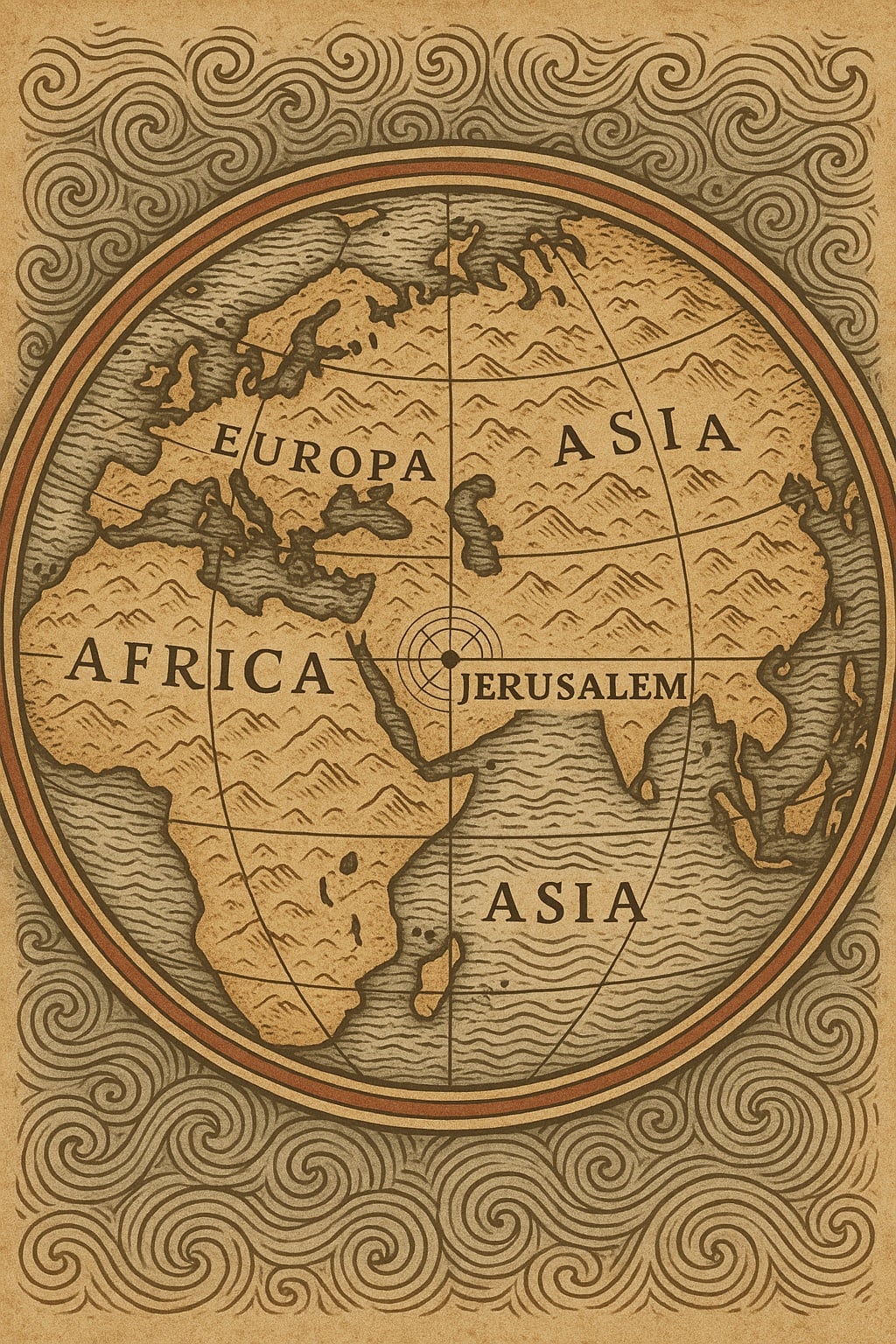
I caught myself becoming increasingly frustrated with a friend in the midst of an ongoing exchange about the October 7 War and Israel’s longstanding conflict with the Palestinians. There are many reasons these conversations can become difficult. One of those reasons is twofold: while most non-Jews (and many assimilated Jew) lack deep knowledge of Jewish history they are nevertheless flooded by a constant stream of distortion about Jews and our history. On top of this epistemological challenge, many find themselves in social circles where buying into and adopting these distortions is rewarded. I don’t blame people for not being Jewish history experts. It’s unfair to expect anyone to attain intimate knowledge about everyone else’s histories and cultures – but it is fair to ask people to acknowledge what they don’t know and how vulnerable to misinformation that lack of knowledge makes them.
During our conversation, my friend asserted that people who are sympathetic to Israel prefer to either jump back 2,000 years and contextualize events in light of ancient history or otherwise ignore history altogether and begin the timeline with Hamas’ October 7 invasion. He insisted that critics of Israel prefer to situate events within a timeline that begins at some point in modern history “between the Nakba and October 7.” Intentional or not, his comment alluded to the all too common quip, “history didn’t start on October 7.” The slogan functionally operates to shift blame away from Hamas by positing some vague historical context that supposedly justifies or rationalizes Hamas’ war and their crimes. The combination of “History didn’t start on October 7” with the charge that Israel’s friends overly emphasize irrelevant ancient history, frames supporters of the Jewish State as avoiding and therefore conceding historical arguments. Nothing could be farther from the truth.
The false assertion that Israel’s friends lack and therefore avoid historical arguments obscures the continuity of the Jewish People’s connection to our indigenous homeland. The charge that Jews and Israel’s supporters lack relevant historical arguments is therefore itself an anti-historical tool used to sever Jews’ connection to our ancestral lands and then vilify Jewish people. The trend has become increasingly common on social media. A new wave of AI generated memes and videos depict stereotypical religious Jews stealing phones, dogs, babies, and even the moon with the justification that “it was promised to us 3,000 years ago.” The message is clear: Jews are greedy and dishonest, justifying theft based on ancient history that has little connection to the modern world.
Jews and Israel’s supporters do not need to rely on Divine promises or on ancient history. Our connection to the Land of Israel may stretch back 3,000 years and more, but in the intervening centuries between then and now the connection has been renewed and carried forward through successive generations. Jewish history didn’t stop 3,000 or 2,000 years ago. The great empires and religions of the non-Jewish world may have written off the Jewish People as actors in history, but we never went anywhere. Jewish communities continued to live on our land, Jews in exile continued to yearn for our land, and Jews – our ancestors scattered in diaspora and those who stubbornly clung to the soil of the Land of Israel – continuously struggled to rebuild Jewish communities and reassert Jewish autonomy in our land. The history may have begun 3,000 years ago and more, but it pushed forward into the medieval, pre-modern, and modern eras.
It was promised 3,000 years ago…
For the sake of establishing a starting point, we might as well go back 3,000 years since the archaeological record testifies to the existence of the People of Israel at least as early as 3,200 years ago. In 1207 BCE the ancient Egyptian ruler Merneptah achieved a series of military victories. The monument recording these victories for posterity states that “Israel is laid waste, bare of seed.” It is the oldest extrabiblical source that explicitly references Israel. 3,200 years ago we were already struggling with the might of foreign empires.
It was promised 3,000 years ago…
2,140 years ago the Jewish people revolted against foreign imperial rule, defeating the Greek Seleucids and reestablishing Jewish independence under the Hasmonean dynasty.
It was promised 3,000 years ago…
1,959 years ago the Jewish People struggled against foreign rule of another imperial power: Rome. And 1,892 years ago we were at it again, fighting to liberate our land from Rome. After briefly reestablishing Jewish self-rule, Rome counterattacked, devastated our country, exiled and enslaved many, and officially renamed Judea (from which “Jews” derive our name) to the Greco-Roman exonym “Palestine.”
It is at this point that the narrative shifts. First the charge is that promises made or connections established three thousand years ago are irrelevant today. Once history creeps into the common era, however, the goal posts shift. The charge morphs into “Jews want to jump back 2,000 years.” But again, do we need to? Was there really a 2,000 year historical break during which Jews had no presence in, connection to, or active attempts to return to and reestablish independence in our ancestral lands? The answer, again, is no.
“Jump back 2,000 years…”
1,400 years ago Jewish forces allied with the Persian Sassanid Empire liberated Jerusalem and its environs from the Eastern Roman Byzantine Empire. They reestablished Jewish rule for a short period of time. That means that Jews were fighting for – and briefly succeeded in regaining – political autonomy just 23 years before the imperial armies of the Arab Islamic Caliphate conquered the Land of Israel/Roman Syria-Palestine. When armies from the Arabian peninsula did occupy the land there were still hundreds of thousands of Jews living there (despite years of Roman persecution and the exile of many of their brethren). The 9th century Islamic historian, Baladhuri, estimated the Jewish population of a single city (Caesaria) at 200,000.
“Jump back 2,000 years…”
1,300 years ago the Jews of the Land of Israel revolted against the imperial rule of the Umayad Islamic Caliphate. Fighting concentrated in the densely populated Jewish Galilee. This was not the only revolt against Islamic imperial rule by Jews in the Land of Israel or by Jews seeking a mass return to the land of Israel in that century.
“Jump back 2,000 years…”
926 years ago European Crusaders swept through the Holy Land and laid siege to Jerusalem. Jews fought alongside Muslim soldiers in defense of the city. The Islamic historian Ibn al-Qalanisi noted the great bravery of Jerusalem’s Jewish defenders.
“Jump back 2,000 years…”
865 years ago the messianic claimant David Alroy rallied the Jews in the Mesopotamian diaspora to rebel against the Seljuk Empire and reconquer the Land of Israel. His message spread widely, alarming Muslim rulers and leading to his capture and execution.
“Jump back 2,000 years…”
500 years ago Christian rulers reunified Spain after centuries of Muslim rule. They presented Jews with an ultimatum: convert to Christianity or flee. 50,000 – 100,000 Jews fled, mostly resettling in the Ottoman Empire. Of these, about 15,000 made for the Land of Israel, reinforcing a declining Jewish population and reinvigorating important cultural centers in Jerusalem, Hebron, Tiberius, and Tzfat. The return of Jews from Spain was important since the Jewish community in the land had dwindled following Crusader massacres and then years of plague, war, and harsh taxation by the Islamic Mamluk rulers.
“Jump back 2,000 years…”
365 years ago the would-be messianic figure, Shabbati Tzvi, led a mass movement of Jews stretching from the Ottoman heartland to Eastern Europe, Morocco, and Yemen. His followers numbered in the hundreds of thousands, with tens of thousands actually selling their homes and property to prepare for their imminent return to the Land of Israel. Contemporaneous reports describe Jews in Yemen and Morocco abandoning their homes to make the arduous journey home on foot. Other reports tell of Jewish merchants in Italy closing their businesses and preparing ships as Jews in Hamburg sold their houses. The mass movement alarmed Ottoman imperial authorities who arrested Shabbatai Tzvi and forced his conversion to Islam. His conversion caused widespread despair and existential crisis throughout the Jewish world.
“Jump back 2,000 years…”
248 years ago the spiritual master and father of Hasidic Judaism, Rabbi Israel ben Eliezer (known as the Baal Shem Tov) sent 300 families – among them some of his most senior disciples – to the Land of Israel in order to establish communities and hasten redemption. The Baal Shem Tov instilled in his followers a yearning for aliyah (return to the Land of Israel).
“Jump back 2,000 years…”
215 years ago disciples of the Vilna Gaon and their families returned to the Land of Israel to establish communities, create agricultural settlements, and strengthen Torah study in the land. The Vilna Gaon was one of the most celebrated rabbinic scholars and community leaders in modern Jewish history. Like the Baal Shem Tov, he taught the spiritual value and importance of returning to the Land of Israel.
“Jump back 2,000 years…”
141 years ago Jews in the Russian Empire faced widespread anti-Jewish violence (pogroms). Grassroots Jewish organizations sprang up in Russian and Polish towns. Their members included traditionally religious and secular Jews, rabbis, professionals, and common people. What they shared was a belief in taking practical steps to immediately return to their ancestral land. The grassroots network took the name Hovevei Tzion (Lovers of Zion), since Zion is a traditional Jewish moniker for both Jerusalem and the Land of Israel. Over 25,000 Jews returned home before the First Zionist Congress launched modern political Zionism in 1897.
“Jump back 2,000 years…”
Over the course of the 19th and 20th centuries, millions of Jews returned to the Land of Israel. They came from the former Russian Empire and Soviet Union. They came from Germany and Poland. They came from Yemen, Morocco, Iraq, and many other Middle Eastern and North African countries. They came from Ethiopia and India. Jews returned from all these diaspora communities, joining Jews who had never left and those who had themselves returned earlier. Many came as refugees fleeing anti-Jewish persecution in European and Middle Eastern countries, but they were also pulled by the living bond of an indigenous people to their land. They were the latest links in an unbroken chain stretching back over 3,000 years to the present day.
This short survey is not exhaustive. It represents a tiny drop in the ocean of Jewish History and the ongoing connection between the People of Israel and the Land of Israel. The connection of a people who never forgot our land, never stopped yearning for it, never gave up the culture and identity we developed on it, and never stopped struggling to stay on and return to our land. We can start the conversation 3,000 years ago. We can start it 2,000 years ago. But we don’t need to.