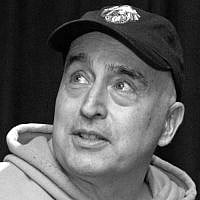
"I'm the spokesman for the OK Boomer generation"
It’s Never Too Late to Be What You Might Have Been

Photo: Tony Senatore: all rights reserved
There comes a time in life when we have to ask ourselves whether we are content with the path we’ve taken or whether there is something more we ought to be doing. For me, that moment came after nearly three decades of pursuing a music career and eventually deciding to return to college and finish what I had abandoned in 1980.
I enjoyed a measure of success as a bass player. Depending on whom you ask, I was something of a cult figure, an innovator, or perhaps someone who had overstayed his welcome. Ultimately, success is subjective, and I have never been particularly interested in letting other people define it for me. I realized very early in my musical career that it would be relatively easy to imitate my heroes on the bass guitar, learn their techniques, and attempt to reproduce what they had already accomplished. But I also understood that doing so would ultimately make me an inferior version of the original. I wanted to develop my own voice, establish my own identity, and create something that was distinctly mine.
That realization influenced a rather unconventional decision. Instead of attending music college, as many aspiring musicians do, I went to New York City. The city’s music venues became my campus, and the extraordinary musicians I watched perform every weekend became my professors. I learned by observing, listening, experimenting, and immersing myself in an environment where originality and individuality were essential. I deliberately chose a different educational path because I worried that following the conventional route, studying the same curriculum and learning the same approaches as everyone else, might actually impede my originality. I wanted to discover my own musical vocabulary rather than become proficient at speaking someone else’s.
Looking back, I recognize that this philosophy would become a recurring theme in my life. I saw myself as an iconoclast, fashioning my own version of a modern-day Howard Roark, using music rather than architecture as my means of expression. I realize that invoking Ayn Rand might cause some readers to bristle. Still, there is one idea with which I wholeheartedly agree: there is something profoundly inspiring about individuals who possess revolutionary ideas, challenge conventional thinking, and have the courage to stand behind their convictions, even when doing so comes at considerable personal cost. Today’s modern-day Roarks, in my estimation, include people like Jimmy Wales of Wikipedia and Sal Khan of the Khan Academy. Both have challenged traditional educational models and made knowledge more accessible to people who might otherwise never have had the opportunity to benefit from it. Their accomplishments remind us that genuine innovation is not necessarily about accumulating wealth or celebrity. Sometimes it is about changing the world in a way that makes life better for everyone else.
After many years of trying to make my mark in the musical universe, I eventually reached a point where I felt compelled to make another radical change. It was time to leave my comfort zone and pursue something decidedly different, something perhaps more cerebral, but hopefully more fulfilling. The cultural landscape was changing. Record stores were closing, the music business was transforming, and television was increasingly a parade of reality shows and manufactured celebrity. Programs like American Idol seemed to symbolize a broader cultural shift in which the distinction between genuine accomplishment and momentary popularity was becoming increasingly difficult to discern.
I became increasingly troubled by a society seemingly obsessed with instant gratification, superficial entertainment, and the pursuit of celebrity. We appeared to be celebrating popularity contests while giving considerably less attention to the hard work, intellectual discipline, and perseverance required to accomplish something meaningful. America could dance with the stars, produce amusing home videos of babies and pets, and keep up with the Kardashians. Still, I wondered whether we were giving the same enthusiasm to mathematics, science, literature, history, and the development of critical thinking. The contrast was particularly troubling to me because I believed that the rest of the world was moving forward while we were becoming increasingly preoccupied with distractions.
I wanted to recapture something I felt I had lost: the idealism of the eighteen-year-old who once believed that the world was full of possibilities. This time, however, I would use education and the college classroom rather than music and the stage as my means of expression. Returning to college after nearly thirty years away from the classroom was intimidating. I entered Columbia University in 2013 with considerable trepidation, carrying with me a lifetime of experiences, a healthy dose of skepticism, and an insatiable curiosity about the world. I had no illusions that the experience would be easy. I was older than most of my classmates, had spent decades outside the academic environment, and knew I would have to work considerably harder than I might have if I had continued my education when I was eighteen. But I also brought something that I could never have possessed as a younger student: perspective.
I wasn’t returning to college to obtain a credential or add another accomplishment to my résumé. I wanted to challenge myself intellectually, explore ideas that had previously been outside my reach, and discover what I was capable of becoming. Columbia became much more than an institution where I attended classes. It became an intellectual home, a place where I encountered people, ideas, and perspectives that challenged many of my assumptions and helped shape the person I would become.
One particular experience stands out as a defining moment in my intellectual development. It occurred during my first class in East Asian Civilization, taught by Professor Gray Tuttle. Through that course, I began learning about the extraordinarily complicated historical and political relationship between Tibet and China. What struck me was how much more there was to the story than I had previously understood. There were competing historical narratives, conflicting perspectives, and layers of cultural, political, and historical complexity that could not be adequately understood by simply accepting one side’s account. It was an eye-opening experience. I began to appreciate that understanding the world requires considerably more than absorbing information or adopting the prevailing interpretation of an event. It requires patience, research, intellectual humility, and a willingness to examine perspectives that might challenge our existing beliefs. That class helped establish something that would become central to my approach to education and, ultimately, to life itself: the realization that understanding complicated issues requires extraordinary effort. There are rarely convenient answers to complicated questions, and the willingness to acknowledge that complexity is essential to becoming an educated person.
So what does education mean to me? At its most fundamental level, education is about self-improvement, but not the superficial kind routinely marketed to us through late-night infomercials promising six-pack abs and instant transformations. Genuine education is an inward process. It is about developing the mind, questioning our assumptions, and becoming increasingly aware of how much we don’t know. As the historian Will Durant observed, education is a progressive discovery of our own ignorance.
I believe education comes in two equally important forms. There is the knowledge acquired in the university classroom, through books, research, discussion, and the guidance of accomplished professors. And then there is the education that comes from living, what we commonly refer to as the School of Hard Knocks. Neither should take precedence over the other. Theories that appear perfectly reasonable within the protected environment of academia sometimes fall apart when confronted with the complexities of the real world. Conversely, the experiences we accumulate in everyday life can be difficult to understand without the intellectual tools that formal education provides. The truly educated individual recognizes the value of both.
For me, the ultimate purpose of education is to transform a closed mind into an open one. It should encourage intellectual independence, autonomy, and self-sufficiency. It should never be viewed exclusively as a means of acquiring material wealth or climbing the socioeconomic ladder. A liberal arts education is particularly valuable in this regard. Studying history, philosophy, literature, sociology, mathematics, and the sciences equips us with the tools to think independently and distinguish between what we believe and what we can demonstrate.
Sister Miriam Joseph, in The Trivium, discusses the importance of grammar, logic, and rhetoric as the foundations of a liberal education. These disciplines enable individuals to rise above the limitations of their immediate material circumstances and pursue a more rational, intellectual, and ultimately freer existence. There is something profoundly liberating about examining an argument, recognizing its weaknesses, challenging its assumptions, and arriving at an independent conclusion. Education should give us that ability.
Socrates, as presented in Plato’s Republic, offered an especially compelling metaphor. Education is not simply the act of putting knowledge into a mind that lacks it, just as it is not possible to put sight into blind eyes. Rather, education is the process of turning the mind toward what it ought to see. That distinction has stayed with me.
One of the most important lessons I learned during my college years had very little to do with the subject matter of a particular course. It had everything to do with critical thinking. I had never been particularly comfortable with mathematics. Returning to the classroom meant confronting some of the very subjects I had once hoped never to encounter again. Yet I eventually developed a genuine appreciation for mathematics and the extraordinary power it possesses to describe and illuminate the world around us. What fascinated me was not simply the process of solving equations but the objectivity of the discipline itself.
In mathematics, the answer is the answer. It doesn’t matter whether you arrive at it through a method preferred by your professor or one you have developed independently. What matters is whether your reasoning is sound and whether you have arrived at the correct solution. I found this particularly refreshing because so much of our public discourse seems to operate in precisely the opposite fashion. Politicians, pundits, academics, and other individuals who shape public opinion frequently become so invested in defending the preferred ideologies that they lose sight of the actual problems they are supposed to solve. Preserving a theory or political identity becomes more important than examining whether the ideas produce the intended results. This is a serious intellectual failing.
Critical thinking requires us to step outside our ideological comfort zones, examine evidence honestly, and be willing to reconsider our positions when the facts warrant it. It means caring more about arriving at the truth than winning an argument. Education should not be reduced to the rote memorization of historical dates, military battles, names, and theoretical concepts. Those things have their place, but they are only the beginning. The real intellectual work comes when we connect the dots, bring together what we have learned in the classroom with what we have experienced in life, and apply that knowledge to the complicated social, political, and ethical questions confronting us.
This ability to think critically is not the exclusive property of a privileged intellectual class. It is an ability inherent in all of us. Sometimes it simply requires the right teacher to bring it to the surface. That is one reason I eventually became interested in the teaching profession. I discovered something deeply satisfying about the possibility of helping another person develop the intellectual tools necessary to think independently. It took me nearly thirty years to fully appreciate that there is no substitute for a quality education. At an age when many people are thinking about slowing down, I had developed an appetite for knowledge that I never possessed when I was younger. My only frustration was realizing how much I still had to learn and how little time I had to do it all.
When I graduated from Columbia, I initially intended to continue my academic journey and pursue a doctorate. But, true to form, I found myself reconsidering the conventional route once again. Just as I had chosen to bypass music college in favor of learning from the musicians and experiences of New York City, I decided against immediately proceeding to graduate school. This time, however, my reasoning was somewhat different. I wanted to concentrate on the intellectual territory I had not explored at Columbia and, quite frankly, on ideas I might never have encountered even if I had remained in an academic environment for another twenty years.
I became increasingly interested in the work of organizations such as the Mises Institute and thinkers like Walter Block and the legendary Paul Gottfried, both of whom I am grateful to call my friends. Their writings and conversations introduced me to intellectual traditions and perspectives that broadened my understanding of economics, political philosophy, history, and the relationship between individuals and the institutions that govern their lives. I was attracted to many of their ideas, but I never regarded intellectual admiration as an obligation to agree with everything someone says. Just as I had refused to become an inferior imitation of my musical heroes, I had no intention of becoming an intellectual imitation of the people whose work I admired.
I consider myself an independent thinker. I listen, read, question, and occasionally disagree, even with people whose friendship and intellectual contributions I greatly value. My conclusions are my own, and they have sometimes angered friends on both the political left and the political right. I suppose that is an occupational hazard of refusing to wear an ideological uniform. But I have come to believe that intellectual independence is one of the most valuable things an education can provide. The objective should not be to graduate with a collection of approved opinions or to replace one set of unquestioned assumptions with another. It should be to develop the ability to think for oneself.
If there is one idea I would like people to take away from my experience, it is this: learn for the sake of learning. We live in an extraordinary age. Thanks to the internet, online lectures, and massive open online courses, people have access to educational resources that previous generations could scarcely have imagined. Some of the world’s finest professors make their lectures available to anyone with an internet connection. When I was in high school in the late 1970s, the encyclopedias my father purchased were among the best educational resources available to me. Today, an enormous portion of the world’s accumulated knowledge is accessible from a computer or smartphone. The opportunities are remarkable.
But I would offer an important qualification: no amount of technology can replace the relationship between a dedicated teacher and a motivated student. The classroom remains an essential environment for intellectual development. There is something uniquely valuable about the exchange of ideas, the challenge of a professor who refuses to accept superficial answers, and the camaraderie that develops among students pursuing knowledge. Technology can make education more accessible, but accessibility alone does not guarantee learning. A student still has to do the work.
No educational reform, no new technology, and no amount of finger-pointing about failing schools can compensate for a lack of commitment from the people who are supposed to benefit from education. Teaching and learning are reciprocal responsibilities. Teachers must bring knowledge, preparation, enthusiasm, and dedication to their classrooms. Students must bring curiosity, discipline, perseverance, and a willingness to put in the hours necessary to master their subjects. When either side fails to fulfill its obligations, the entire educational enterprise suffers.
I have occasionally been known to lecture younger classmates about what I considered a lackadaisical attitude toward their studies. Sometimes my tirades probably sounded like something out of an old television sitcom, with the obligatory “You kids get off my lawn!” thrown in for good measure. But my intentions were sincere. I wanted them to recognize the opportunities in front of them and appreciate that education is something worth taking seriously. I also wanted them to learn from some of my mistakes.
And that brings me to the people who deserve much of the credit for making my own educational journey so rewarding: my professors. The faculty members I encountered at Columbia challenged me, encouraged me, and exposed me to ideas that broadened my intellectual horizons. Their influence extended well beyond the subjects they taught. They helped me develop greater confidence, purpose, intellectual curiosity, and a sense of belonging. We live in an age in which criticism is plentiful, but gratitude is often in short supply. We don’t always take the time to acknowledge the people whose dedication and hard work enrich our lives. I am grateful for the professors who took their responsibilities seriously and recognized that teaching is about considerably more than delivering information. At its best, teaching inspires another person to reach beyond what they thought possible. I hope my participation in their classrooms showed how much I valued their efforts.
Aristotle described the good life as one grounded in virtue and the pursuit of excellence. I have come to appreciate that excellence is not simply about professional achievement, financial success, or public recognition. It is also about becoming a better, more thoughtful, and more capable human being. Sometimes I find myself nostalgic for my younger years, when, as Shakespeare wrote in Antony and Cleopatra, I was green in judgment and cold in blood. But I have also come to understand that the disappointments, setbacks, mistakes, and experiences accumulated throughout my life were not necessarily wasted years. They were part of my education, too.
My years in the music business taught me things that no university could have taught me. They introduced me to extraordinary people, exposed me to the realities of human nature, and gave me experiences that I would never trade. My years in the classroom, in turn, gave me the intellectual framework to understand those experiences better. The two worlds were not mutually exclusive. They complemented one another.
Looking back, I realize that returning to college was about much more than finishing something I had started in 1980. It was about reclaiming a part of myself that had never entirely disappeared. It was about rediscovering the idealism, curiosity, and enthusiasm for life that I possessed as a young man, but now with the benefit of decades of experience. Education has given me a renewed sense of purpose and an appreciation for the possibilities that still lie ahead. Perhaps that is the greatest lesson of all.
We spend far too much time defining ourselves by what we have accomplished, what we have failed to accomplish, and what other people think of us. We become prisoners of our own histories, convinced that certain opportunities have passed us by. But learning has no expiration date. Intellectual curiosity has no age limit. And the pursuit of a more meaningful life should never be considered the exclusive privilege of the young.
I may have taken a rather circuitous route to get here, but I have learned something along the way: the years we spend pursuing knowledge are never wasted. At this stage of my life, education has given me an extraordinary amount, and I feel an obligation to give something back. If my experiences can encourage even one person to reconsider an abandoned dream, return to the classroom, challenge an assumption, or pick up a book and begin learning something new, then perhaps I will have accomplished something more meaningful than anything I ever achieved on a stage.
George Eliot’s words remain as relevant to me today as they were when I first encountered them: “It’s never too late to be what you might have been.” And I would add one thought of my own: it’s never too late to discover what you are still capable of becoming.
Related Topics
Related Posts