
Lawyer, Blogger, Jewish Advocate, Podcast Host
It’s Not About the Land – It’s About God
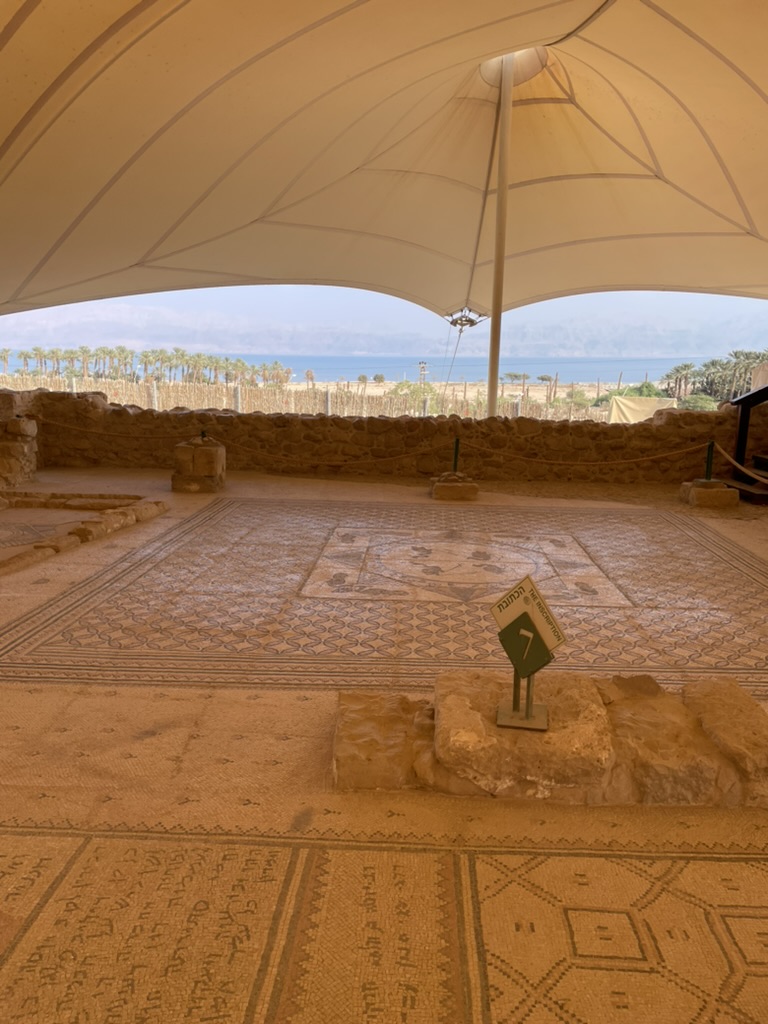
Ancient Synogogue of Ein Gedi overlooking the Dead Sea
And Why So Much of the “Pro-Palestinian” Movement Unwittingly Supports Terrorism and Harms the Cause of Peace
When Hamas terrorists stormed southern Israel on October 7, 2023, much of the world was horrified by the savagery. Yet many who rightly condemned the massacre never grasped its most fundamental truth: the attack was not about borders, occupation, or even nationhood. It was about God and the belief that annihilating Israel is a religious duty under Hamas’s radical interpretation of Islam.
Two years later, on the verge of the release of the hostages, and only a week after as hundreds of thousands protested across European capitals and beyond chanting “Free Palestine,” many unknowingly echo that same theology. Whether they realize it or not, they align themselves with the Hamas Charter and its stated goal of erasing Israel from the map. The sad reality is that even after the hostages are home and the current hostilities cease, Hamas and other forms of anti-Israel and antisemetic radicalism (including their “Pro-Palestinian” supporters) will continue in one form or another.
This article is not about the small but loud minority who celebrate Hamas’s actions. It is written for those who mean well. Those who sincerely seek justice and peace, but who, out of moral confusion or lack of awareness, end up reinforcing the very ideology that fuels the conflict.
As Haviv Rettig Gur powerfully argued in his August 2025 MIFF Bergen lecture, for decades the West has misread this conflict as a political problem awaiting diplomatic finesse. Redraw the map, trade prisoners, broker a ceasefire, and peace will follow. But Hamas does not live in that universe. Its worldview is theological. Its charter, rhetoric, and entire strategy flow from a sacred narrative that views Jewish sovereignty in the heart of the Muslim world as a cosmic affront, an inversion of divine order that must be undone.
A Fortress of Faith and Fire
Hamas spent years transforming Gaza into an underground city of war. Over 500 kilometers of tunnels and tens of thousands of shafts were carved beneath civilian neighborhoods, strategically designed not to protect Gazans, but to endanger them. When Israel responded to the October 7th invasion, it was drawn into a battlefield that Hamas had meticulously engineered to ensure devastation above ground and moral confusion abroad.
This, Gur argues, is not mere cruelty; it is theology. The destruction of Gaza was anticipated, even desired, INDEED THE STRATEGY – as a reenactment of sacred struggle – suffering as proof of faithfulness. Every ruined tower, every mourning mother becomes part of a story in which divine redemption is purchased through blood.
Peace as Apostasy
In this religious frame, peace is not reconciliation, it is heresy. To accept Israel’s permanence is to concede that divine justice can tolerate Jewish sovereignty. Hence every “truce” is temporary, a tactical pause (hudna) before the next holy round. No amount of Western aid or negotiation can reach a movement that sees coexistence itself as blasphemy.
The Counterarguments – and Why They Miss the Core
It is true that Gaza’s people have suffered enormously. Poverty, unemployment, and despair have deepened under isolation and war. These conditions help fuel anger and radicalization, especially among the young. It’s natural, and morally right, to feel compassion for those living amid rubble and ruin.
But to confuse cause and catalyst is to miss the essence of what drives this conflict. Misery may feed extremism, but it does not create it. Hamas’s founding purpose long predates today’s blockade or economic crisis. Its’ 1988 Charter invokes divine duty, not social justice, calling for the eradication of Israel as a theological imperative.
If Hamas’s war were truly about living standards, it would invest in schools instead of rockets, infrastructure instead of tunnels, and diplomacy instead of death. It would, like the Palestinian Authority once did, accept negotiations toward statehood. But Hamas rejects not just Israel’s policies, it rejects Israel’s existence.
That’s why the narrative that blames “oppression” for terrorism ultimately collapses. Many societies face poverty and hardship, yet do not teach their children to glorify martyrdom or sanctify genocide. The root of this conflict lies not in deprivation but in indoctrination. Until that belief system changes, no amount of aid will buy peace.
A Mirror for the West
Here lies Gur’s warning: Western activists who brand Israel “colonialist,” “apartheid,” or “genocidal” unwittingly echo Hamas’s own absolutism. By denying Israel’s legitimacy, they amplify the same metaphysical claim, that Israel has no right to exist. Language meant to defend the oppressed ends up sanctifying a theology of annihilation.
The irony is tragic. In the name of human rights, Western discourse now mirrors an ideology that glorifies endless death. The same moral vocabulary that once dismantled apartheid and Nazism now lends itself to those who massacre infants in the name of purity.
The Path Forward – Moderation and Moral Courage
There is another way, and we’ve already seen it succeed. The Abraham Accords proved that peace is possible when nations reject religious absolutism and choose partnership over hatred. The United Arab Emirates, Bahrain, Morocco, and others chose to engage Israel not because they abandoned their identity, but because they elevated it, recognizing that coexistence, trade, and mutual respect serve both faith and humanity.
These countries show what happens when moderate voices prevail, when leaders have the courage to step beyond grievance and into shared destiny. They demonstrate that peace is not a fantasy; it is the fruit of moral clarity. The extremists who wage holy war fear this model most, because it exposes the lie that Islam and Israel are fated to be enemies.
Until similar moderation takes root among Palestinian leaders, until those who truly seek peace and human dignity overcome those who sanctify death, this conflict will remain trapped in its own theology.
Wholeness in an Age of Division
The work of peace, then, begins not only in Gaza or Jerusalem but within each of us. Wholeness means seeing reality without illusion, recognizing evil for what it is while still holding fast to the humanity we are commanded to preserve. To live with a whole heart is to reject both hatred and moral confusion, to refuse the seduction of easy narratives, and to act from clarity, compassion, and conviction.
In an age when moral fog is mistaken for nuance, the call of conscience is simple but profound: to stand for life, to name truth, and to live in alignment with it – fully, courageously, and whole.
Related Topics