Protect What You Love
It’s Not Bravery. It’s Fear Demanding Action
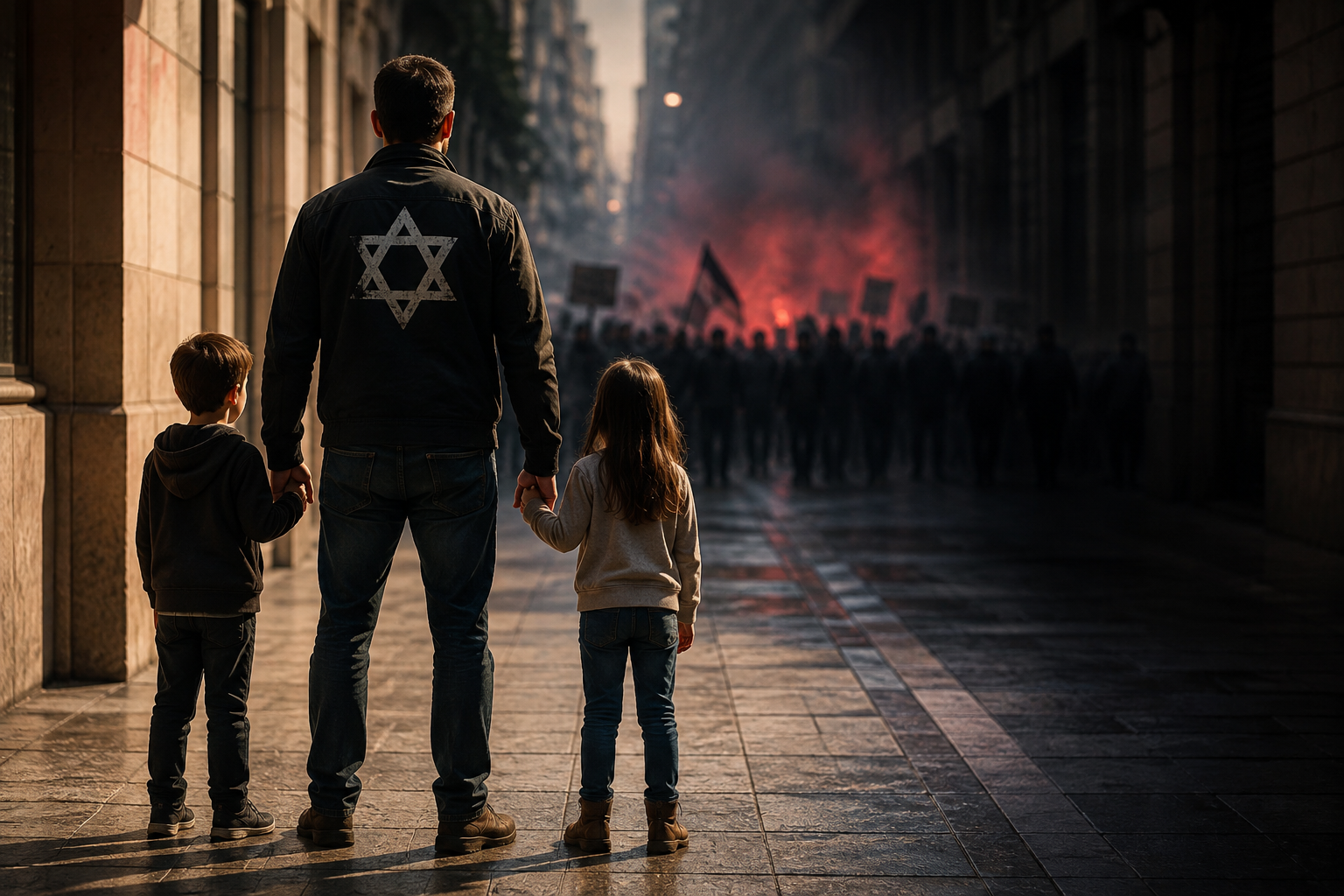
Sometimes fear is the reason to act before the danger becomes harder to stop.
People sometimes tell me I’m brave for speaking up against antisemitism. I understand why they say it, but bravery isn’t how I experience it. I speak because I’m afraid of what happens when people recognize a danger and choose silence because speaking carries a social cost. I’m a father, and I think about what my children will inherit from the choices my generation makes now. That fear gives me a very clear reason to act.
For much of my life, I’ve been trained to recognize threats before they fully develop. As a soldier, you learn to notice the small things that don’t fit. A change in behavior, an unusual movement, a detail that would be easy to dismiss can tell you more than the obvious threat that comes later. You learn to pay attention early because certainty often arrives after the situation has already become more dangerous.
That training stays with you. I use it when I walk into a room, when I teach self-defense, and when I look at the environment around Jews today. I see hostility becoming easier to express, Jewish students being intimidated, synagogues targeted, and Jews being expected to answer personally for decisions made by the Israeli government. Any one incident can be debated on its own. When the same type of hostility keeps appearing in different places, I pay attention to the pattern.
I’ve spent more than two decades teaching people to protect themselves, and one of the most common problems I see has very little to do with physical ability. People often recognize that something is wrong before they’re willing to accept what they’re seeing. They question their instincts, worry about overreacting, and give the situation more time because they want a harmless explanation. Sometimes that extra time helps. Sometimes it allows the threat to develop.
That same hesitation appears when people talk about antisemitism. They want more proof before using the word. They want to know the attacker’s politics, the protester’s intention, the larger context, or whether the person making the threat would describe themselves as antisemitic. Those questions can be legitimate, but they can also become a way to avoid recognizing behavior that has already crossed a line.
People have asked me whether someone who believes in peace should train to fight. My answer has always been yes. Peace becomes more sustainable when you have the ability to protect yourself if another person decides to use violence. Refusing to prepare for violence can become a form of denial, because your safety then depends entirely on another person continuing to behave reasonably.
I approach antisemitism with the same basic responsibility. I want people to argue about Israel. I want them to protest, criticize governments, challenge policies, and express political views I may strongly disagree with. A free society needs room for that. The problem begins when Jews are intimidated, threatened, excluded, blamed collectively, or expected to distance themselves from Israel before they are treated as acceptable members of society.
Silence often feels comfortable because its cost is delayed. Keeping quiet can preserve a friendship, a professional relationship, or an invitation. It can save you from online abuse and from being called difficult, political, or overly sensitive. I understand why people make that choice. I also think we need to be honest about what repeated silence can produce.
My children will grow up inside the social boundaries that adults establish today. They will inherit what we defended and what we allowed to become normal. If Jews repeatedly learn that speaking openly about antisemitism creates more problems than enduring it quietly, the next generation will absorb that lesson. Some will speak less. Some will hide visible signs of being Jewish. Some will decide that certain rooms are easier to enter if nobody knows who they are.
I don’t want that lesson passed to my children.
Self-defense has also taught me to be careful with simple rules. “Never hit first” sounds responsible, and in many situations it is good advice. There are also situations in which a threat has already become clear before the first strike lands. Intent, ability, distance, behavior, and the surrounding circumstances can tell you that an attack is coming. Waiting to be hit before responding can be a serious mistake.
The principle I take from that has nothing to do with looking for confrontation. It is about recognizing when action is already justified by what is happening in front of you. In public life, that action can be speech. You can challenge a lie before it spreads further. You can stand beside a Jewish student while intimidation is still being excused as activism. You can tell someone that holding Jews responsible for the Israeli government is unacceptable. You can object before hostility becomes familiar enough that people stop noticing it.
Early response has value because people adjust quickly to what they see repeatedly. Language that once sounded extreme can become ordinary through repetition. Behavior that once caused outrage can become something people walk past. The change usually happens in increments, which is exactly why it can be difficult to recognize while you are living through it.
As a Jewish father, I want my children to be able to walk through New York wearing a Star of David without first deciding whether the neighborhood, school, subway car, or social group makes it safe to do so. I want them to develop their own relationship with Judaism and Israel. They should be able to disagree with me, criticize Israel, defend Israel, or decide that politics is not central to their identity. I don’t want fear to teach them that being less visibly Jewish is a useful form of protection.
Speaking publicly has consequences. I’ve experienced them. People become angry. Relationships change. Strangers send threats. Some people decide they no longer want anything to do with you. I take those consequences seriously, but I can live with them more easily than I could live with knowing that I saw a problem developing and chose comfort because the alternative was unpleasant.
There is also a communal consequence to speaking. People often stay quiet because they assume they are alone. Once someone says publicly what others have been thinking privately, that assumption can break. I’ve heard from people who told me that seeing another Jew speak openly gave them confidence to stop hiding their own concerns. That doesn’t mean they agree with everything I say. It means they know someone else is willing to stand in the same space.
That kind of support changes how people behave. A person who believes nobody will stand beside them is more likely to withdraw. A person who knows others will speak when a line is crossed has more room to remain visible and engaged. Communities become stronger when people know they won’t be abandoned for saying something unpopular but sincere.
Speaking also carries responsibility. I can misread a situation. I can make a factual mistake. I can reach the wrong conclusion. When that happens, I should correct it. Experience with threats doesn’t make me infallible, and conviction doesn’t remove the obligation to think carefully. It does give me a reason to take warning signs seriously and to act when I believe the evidence is clear enough.
So when people call me brave, I understand the compliment. My own calculation feels more practical. I know what I’m willing to risk, and I know what I’m trying to protect.
I’m afraid of my children growing up in a country where being openly Jewish requires more calculation than it does today. I’m afraid of watching hostility become familiar because too many people kept waiting for a clearer reason to object. I’m afraid of looking back years from now and realizing that we recognized the direction early and chose silence because speaking felt inconvenient.
That fear demands action. For me, the action begins with speaking.
Do something amazing,
Related Topics