Looking forward
It’s the money, Fareed
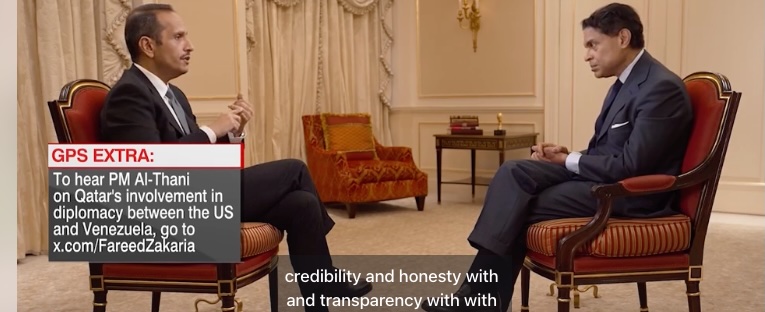
Screenshot of the interview of Qatar's PM and FM by CNN's Fareed Zakaria on 2 November, 2025
Zakaria’s interview with al-Thani is a case study in how money manipulates media coverage and bolsters sponsors of terror
I’m not one to yell at the news, but I couldn’t help myself watching Fareed Zakaria interview Sheikh Mohammed bin Abdulrahman bin Jassim Al Thani, Qatar’s prime minister and foreign minister, on CNN’s Global Public Square on November 2, 2025. The interview’s bias can be summarized by reflecting on Zakaria’s introduction to Qatar: “The Gulf nation of Qatar is smaller than the state of Connecticut, yet it has played an outsized role in mediating conflicts from Gaza to Yemen to Venezuela to the Democratic Republic of Congo.” I believe this statement is a case study through which we can observe the hidden variable of money in journalism and its effect on the realm of ideas.
The term “hidden variable” is used by researchers to explain bias leading to false research outcomes. For example, a study linking coffee and lung cancer might be hiding that the majority of coffee drinkers in the study sample were smokers, and cigarettes, not coffee, are the hidden variable that causes lung cancer. Or a study claiming that attaining an undergraduate degree leads to higher earnings may be biased if it omits the higher socioeconomic status of the families of those who can afford to matriculate. Or a journalist who reports that Qatar has played an outsized role in mediating conflicts without reporting that Qatar spends billions a year in fomenting many of those same conflicts through financing Islamist groups.
Zakaria, a prominent intellectual who has written volumes about the state of the world and the future of geopolitics, obviously knows this. Why, then, would he not ask it? A generous explanation may be that Zakaria, like most journalists, tends to shy away from confronting interview subjects out of fear that they and their friends might avoid appearing on his show again. Short-term losses for long-term gains.
Yet those of us who know the business of journalism and understand the mechanics of the spread of ideas know there’s a more likely hidden variable determining the types of questions asked and the degree of amplification any message receives: money. And Qatar has lots of it.
On average, the city-state of Qatar earns more than one hundred billion US dollars every year from its sale of fossil fuels, mainly natural gas, which makes up approximately 35% of its GDP and 83% of its government revenues. With a small population of 360,000 citizens who are anything but Spartans, Qatar recognizes it won’t be able to defend against war kinetic war. Instead, it pays to host the largest US overseas base on its shores and mainly uses its money to buy influence.
The quest for influence explains why Qatar recently signed a deal with CNN, Zakaria’s network, to open a major hub in Doha. The deal is structured as a media partnership: Qatar provides the facilities and pays CNN millions a year to receive and broadcast content from Qatar and its propaganda network, Al-Jazeera. This follows Qatar’s long-term relationship with the BBC and is a central reason why the BBC is a platform for disinformation and antisemitism. The list of media partnerships continues. It is buttressed by the billions Qatar spends to position itself on Western academic campuses, where the next generation of journalists and media managers and public relations executives are shaped and formed.
And that is why the media has stopped focusing on rapidly increasing global heating and instead focused on Gaza. That’s why the media ignores famines and massacres financed by Gulf states. That’s why one small country can be tied to so many scandals all called Qatargate and yet be interviewed on one of the world’s most prominent news segments as a paragon of diplomacy.
It is important to emphasize that Qatar is not the bogeyman and shouldn’t be seen or used as a scapegoat. The al-Thani family are just one of many powerful juntas sowing chaos far away from their seats of power to distract the public from their shenanigans. Yet that does not excuse intelligent journalists like Fareed Zakaria from platforming them, granting them undeserved credibility.
Asking Zakaria to confront Qatar publicly is unrealistic. He knows that if he were to cross Qatar he would struggle to find another job in journalism. He would find book publishers less interested in his books (Qatar owns many and the media channels they use to publicize their wares). He would find social media algorithms less friendly (Qatar has a stake in privately held Twitter/X and close ties with the backers of every other network present and future). A journalist as prominent as Zakaria knows where the checks are signed. I’ve found that people in power tend to loathe the idea of losing it.
What Qatar understands is that knowledge is power and those who can buy and sell the producers of knowledge are its brokers. No amount of argumentation or fact-checking or calls for honest reporting will change the fact that Qatar has billions to spend a year to keep the world distracted. The only way to put an end to the pernicious effects of Qatar (and other members of the Axis of Extraction with a vested interest in causing chaos to Open Societies) is to turn off their tap: end the world’s dependence on fossil fuels and develop alternative sources of knowledge creation and distribution. Until then, well-meaning journalists like Zakaria should do their best to avoid being used as tools for disinformation and manipulation.
Related Topics
Related Posts