English Professor; Executive Director, Writing on the Wall
Jacob’s Scar
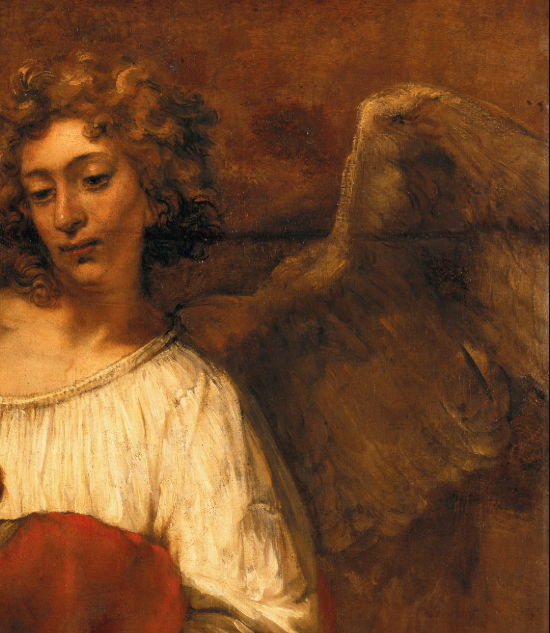
Rembrandt's Angel (Wikimedia Commons)
Some identities come about through conquest. Israel’s identity, however, turns on a wound, on the human, on the vulnerability of Jacob.
In the story in Genesis, Jacob prepares to meet Esau, his estranged twin, and finds himself alone on the banks of a river where he is attacked by an angel. The “angel” is also a man, a satanic force, and guardian to his enemy brother. Jacob holds his own in the struggle, but the angel wounds him, knocking his hip bone out of its joint.
This is a second fall: Adam and Eve suffer dislocation; they are dislocated out of Eden. Jacob cries out, “my soul is split.” Not only is his thigh dislocated, but also his mind, conflicted against itself.
Before letting off the wrestling angel, Jacob demands a blessing; the angel bestows it, a new name, Israel. The scar is where the two names meet – Jacob’s scarred imperfection, who he is, with Israel, who he is destined to become. Jacob calls the place of his wounding ‘Penuel’ – the place where he saw the face of God.
Jacob is loved, and scarred.
Biblical stories, as the rabbis knew, come to life in their retelling, for them, in the genre they invented: midrash. But they are not the only ones who bring the sacred stories into the present.
Rembrandt: The Amsterdam Midrashist
From 1639 to 1658, Rembrandt lived in a large house on Jodenbreestraat, a main street of Amsterdam’s Jewish quarter. Menasseh ben Israel, Europe’s most important rabbi, was both his neighbor and patron.
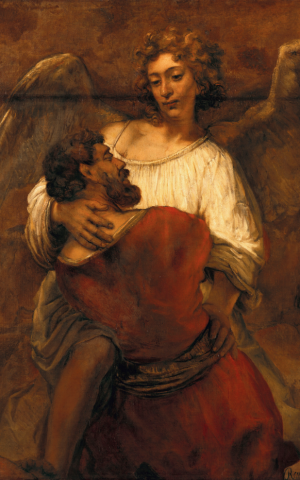
Rembrandt’s painting Jacob Wrestling with the Angel is the artist’s pictorial midrash – his way of filling in the gaps left open in the biblical story.
Rembrandt’s angel is fleshly, physical. The wings, even with their feathery movement upward, dissolve into the earthen terrain of the background. Natural and angelic worlds merge. Angelic love is human; human love, divine.
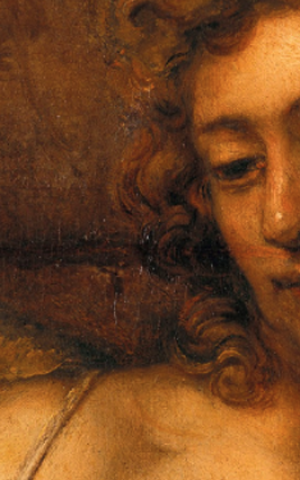
Rembrandt shows the angel in two aspects: intimate and loving on the one side, withdrawn and menacing on the other. On the left, she (yes, she) is maternal, even nurturing, feminine. Her chest is exposed; the strap of her garment rests on the softness of her shoulder. She is ruddy, her hair curled youthfully under her chin, eyeing Jacob with affection, a smile just visible. Her right hand and curled right leg bring Jacob close in an erotic embrace. She is part of his world; she loves him; she sustains him.
The angel on the right, however, is already preparing her leaving-taking. She knows she must leave Jacob’s human world, most beloved by God.
Shadows darken her face; curls trail off into melancholy blackness; a scar lines her left cheek. She is careworn, her neck turned unnaturally, a hint of (masculine) vengeance in the corner of her eye. Her hand, firmly on Jacob’s hip, pushes him away.
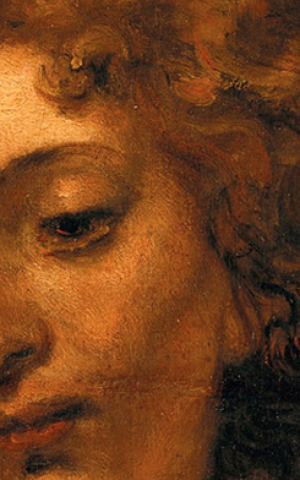
In the painting, not only is the angel scarred, but Rembrandt ‘scars’ the painting. A thick black line traverses the work, just above the mouth of the angel. The painting, like Jacob, is dislocated. ‘Both’ angels love Jacob in his human state. But without the dislocation of the human, the scar, there is no new name, no future. The scar is the place where Jacob and Israel are one, the sacred human.
The wound comes with a new name, a name with a future. Only by remaining himself, flawed and human can Jacob become the ideal, Israel.
As the people of Israel, we recognize, the scar is ours.
Jacob says to God, ‘I am unworthy of all your kindness.” This after the years of servitude to Laban, the constant threat of his predatory brother, Esau. Jacob knows that blessings also come with burdens.
This is the blessings of the scar: acknowledging that it is Jacob’s human vulnerability that makes Israel eternal.
Related Topics
Related Posts